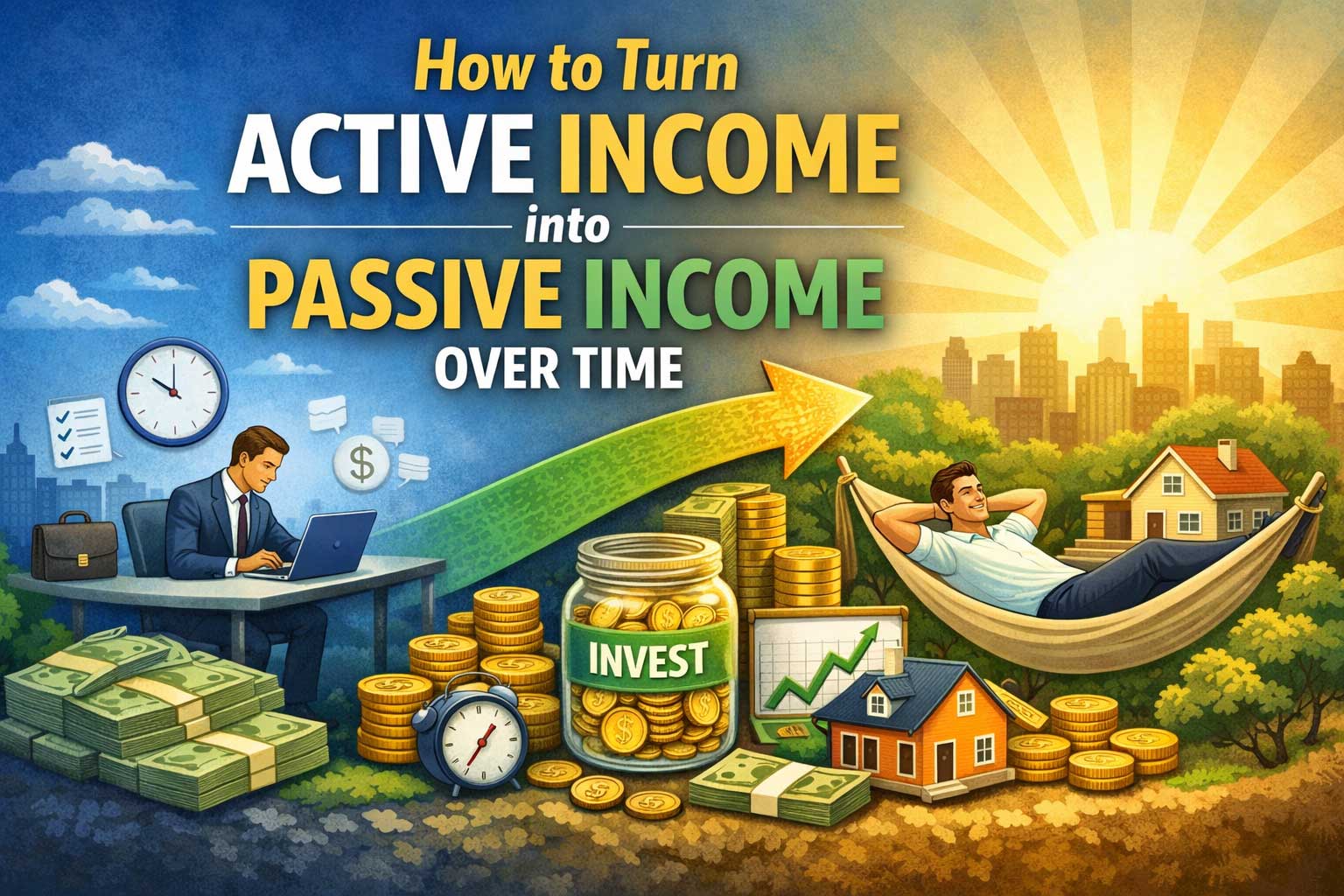
Turning active income into passive income isn’t a single “move.” It’s a process—more like building a machine that keeps producing value after you stop pushing it every day. Active income is what you earn by showing up: a salary, freelance work, consulting, overtime, commissions, driving deliveries, taking client calls, completing projects. Passive income is what continues to flow with minimal ongoing effort: returns from invested capital, rent after expenses, profits from a systemized business, royalties, licensing, and other asset-based cash flow.
Most people get stuck because they treat passive income as a shortcut. In reality, passive income is usually the reward for earlier active effort that was converted into assets. The conversion is the key idea. Your job (or any active work) is not just to pay bills—it can also be the “fuel” that buys, builds, or funds assets that eventually pay you back.
This guide gives you a complete, practical roadmap: how to stabilize your finances, create investable surplus, choose the right passive income paths, manage risk, and grow a portfolio of income-producing assets over time. You’ll also learn how to avoid the most common traps—fake passive income, underpriced risk, and lifestyle inflation—and how to build momentum through reinvestment.
Understanding the Real Difference: Income vs Assets
Active income (earned income)
Active income depends on your time, attention, and presence. If you stop working, it usually stops.
Examples
- Salary or hourly wages
- Freelance gigs and contracts
- Service-based business income (you deliver the service)
- Commission-based sales (requires ongoing activity)
- Overtime, bonuses tied to performance
- Most side hustles that need constant effort
Passive income (asset income)
Passive income is generated by assets—financial assets, real estate, business systems, intellectual property, or scalable products. It still requires planning, maintenance, and decision-making, but it’s not tightly bound to your daily hours.
Examples
- Interest and bond income
- Dividends or fund distributions
- Rental cash flow (after expenses)
- Profit shares from businesses you don’t operate daily
- Royalties or licensing income
- Income from digital products with automated delivery
A crucial truth: passive income is rarely “no work”
The more honest definition is low-maintenance income. Every passive stream has:
- Setup work (often intense at the beginning)
- Capital requirements (money, time, or both)
- Maintenance (small but real tasks)
- Risk (market risk, tenant risk, business risk, platform risk)
If you accept that passive income is built—not found—you can choose paths that fit your skills, time, and risk tolerance.
The Active-to-Passive Conversion Formula
Turning active income into passive income usually follows a simple structure:
- Create surplus (earn more than you spend)
- Protect surplus (avoid leaks: debt, lifestyle inflation, bad deals)
- Allocate surplus (choose asset-building channels)
- Acquire or build assets (invest, buy, create, systemize)
- Reinvest returns (compound growth)
- Diversify and stabilize (reduce dependency on any one stream)
This looks straightforward, but each stage has depth. Let’s walk through it in a way you can actually implement.
Step 1: Stabilize Your Base Before You Chase Passive Income
Passive income grows best on a stable foundation. If your cash flow is chaotic, you’ll make desperate decisions—selling investments early, taking high-risk bets, or quitting too soon.
Build your “stability stack”
Think of stability as a stack of protections:
1) Essential budget baseline
Know your “bare minimum” monthly cost: housing, food, utilities, transport, insurance, and essential debt payments.
2) Emergency fund
A common target is 3–6 months of essential expenses. If income is variable (freelancer, commission), consider 6–12 months.
3) High-interest debt strategy
High-interest debt is often the biggest blocker to building passive income because it compounds against you. You don’t need perfection, but you do need a plan.
4) Basic insurance coverage
One major accident, illness, or liability event can wipe out years of progress. Passive income plans need downside protection.
Why this matters
If your foundation is weak, you’ll either:
- Stop investing during hard months
- Withdraw investments at the worst times
- Panic-sell assets
- Take “quick money” schemes
Stability gives you the patience to let assets grow.
Step 2: Increase the Gap Between What You Earn and What You Spend
Passive income is funded by surplus. The size of your surplus determines the speed of your progress more than almost anything else.
The three levers
You can create surplus with three levers:
- Increase income
- Decrease spending
- Improve efficiency (keep more of what you earn through smart systems)
Lever 1: Increase active income (the fastest accelerator)
Before passive income becomes meaningful, your best return often comes from improving your active earning power.
High-leverage ways to increase income
- Negotiate salary or rates based on measurable results
- Move from “tasks” to “outcomes” (paid for impact)
- Develop scarce skills: analytics, automation, sales, high-level communication, leadership
- Add a complementary income stream that increases your main income (not competes with it)
- Specialize: “generalist” often earns less than “specialist” in the market
A simple rule
In the early years, the fastest way to build passive income is often to build a higher income engine first.
Lever 2: Reduce spending without feeling deprived
Cutting spending is not about living miserably. It’s about removing low-value expenses and keeping what genuinely improves your life.
High-impact expense categories
- Housing (biggest lever for many people)
- Transportation (payments, repairs, upgrades)
- Subscriptions and convenience spending
- “Invisible” lifestyle creep (small upgrades everywhere)
Use a values filter
- Keep what you deeply value
- Cut what you barely notice
- Replace expensive habits with cheaper equivalents that still satisfy the need
Lever 3: Efficiency systems that protect surplus
Even if you earn more, money can disappear without systems.
Examples
- Automate transfers to savings/investments right after payday
- Separate accounts: bills, daily spending, investing, taxes (if self-employed)
- “Default choices” that reduce impulse spending
- Monthly money review (30 minutes) to correct drift early
Step 3: Decide What Kind of Passive Income Fits You
There are different “families” of passive income. Each has its own tradeoffs.
Family A: Capital-based passive income (investing)
You invest money into assets that produce returns.
Examples
- Broad market funds
- Bonds and fixed income products
- Dividend strategies (with caution)
- Real estate investment structures
- Private business ownership (higher risk)
Pros
- Highly scalable
- Doesn’t require building an audience
- Can be automated
Cons
- Requires capital
- Returns take time to become meaningful
- Market volatility
Family B: Asset-building passive income (business systems)
You build or buy a system that produces profit without your constant involvement.
Examples
- A business with staff or automation
- Productized services managed by a team
- Licensing your system or process
- Acquiring a small business and delegating operations
Pros
- Potentially higher returns than basic investing
- More control than markets
- Can use skills as an advantage
Cons
- Operational risk
- Needs management and process design
- Can become “active” again if not systemized
Family C: Intellectual property passive income (content/products/royalties)
You create something once (or a few times) and sell or license it repeatedly.
Examples
- Digital products
- Books, courses, templates
- Software tools
- Photography/music licensing
- Royalties from creative works
Pros
- Can start with low capital
- Scales globally
- Margins can be high
Cons
- Usually requires marketing
- Competitive markets
- Platform risk and changing algorithms
How to pick the right path
Ask yourself:
- Do I have more money or more time right now?
- Do I want predictable, steady growth or higher-risk/high-upside?
- Am I willing to learn operations and management?
- Do I prefer building systems or investing passively?
Most people do best with a blend:
- Start with capital-based investing as the foundation
- Add one scalable asset-building or IP stream as a growth engine
- Diversify over time
Step 4: Build Your “Surplus Pipeline” (So Investing Happens Automatically)
Passive income grows when investing is consistent, not occasional.
The pipeline approach
Think of your income as flowing through pipes:
Income → Essentials → Safety → Investing → Lifestyle
If lifestyle is last, your assets grow. If lifestyle is first, assets struggle.
A simple automation blueprint
- Payday arrives
- Automatic transfer to:
- Emergency fund (until complete)
- Investment account (ongoing)
- “Taxes account” (for self-employed)
- Bills paid automatically
- Remaining funds go to spending account
This reduces willpower and makes progress inevitable.
The “raise capture” method
Every time your income rises, capture part of it automatically.
Example: You get a raise of 300 per month.
- Add 150 to investments automatically
- Keep 150 for lifestyle improvements
Now your investing rate increases without feeling restricted.
Step 5: Learn the Two Numbers That Control Everything
You don’t need complicated financial math, but you do need clarity.
Number 1: Your savings rate
Savings rate = (Income – Expenses) ÷ Income
This matters because it determines:
- How fast your invested capital grows
- How quickly you can reduce reliance on active income
A higher savings rate often speeds up the timeline dramatically, even if income is moderate.
Number 2: Your passive income gap
Passive income gap = Monthly expenses – Monthly passive income
Your goal is not “a huge passive income.” Your goal is to shrink the gap until it reaches zero (or until you choose a partial gap because you like working).
Step 6: Use a Practical Roadmap for Building Passive Income
Here’s a staged approach that works for most people.
Stage 1 (0–6 months): Stabilize and create investable surplus
- Track baseline expenses
- Build emergency fund
- Stop financial leaks (high-interest debt, unused subscriptions, impulse spending)
- Start small automated investing, even if tiny
- Focus on increasing active income through skill upgrades
Key mindset
This stage is about creating breathing room and momentum.
Stage 2 (6–24 months): Scale active income and build the foundation portfolio
- Increase earning power: negotiate, specialize, raise rates
- Keep lifestyle inflation in check
- Invest consistently (foundation assets)
- Learn basic asset allocation and risk management
- Begin exploring one additional passive stream (IP or business system) if appropriate
Key mindset
In this stage, active income is the engine. Passive income is the construction site.
Stage 3 (2–5 years): Add scalable assets and reinvest aggressively
- Expand investing amounts
- Add income-producing assets (real estate, business equity, scalable products)
- Systemize or delegate parts of your active work
- Reinvest a large portion of returns to compound growth
- Diversify across asset types
Key mindset
This is where compounding becomes visible and motivating.
Stage 4 (5–10+ years): Optimize for stability, freedom, and resilience
- Reduce dependency on any single asset or platform
- Shift risk down if your goal is stable income
- Build a “cash flow stack” of multiple passive streams
- Maintain, monitor, and protect assets
- Decide how much active work you want (if any)
Key mindset
Passive income becomes a lifestyle choice, not a desperate goal.
Step 7: Choose Specific Strategies to Convert Active Income Into Assets
Below are real, proven categories of conversion. You can mix them based on your situation.
Strategy A: Turn surplus into a long-term investment portfolio
This is the classic path: consistent investing over time.
How it works
- You create monthly surplus
- You invest regularly
- Your capital grows
- Over time, you can generate income from returns and withdrawals
What makes it powerful
- Consistency beats timing
- Compounding rewards patience
- It scales without needing employees or customers
How to do it responsibly
- Avoid chasing hype or “guaranteed returns”
- Diversify
- Keep fees low where possible
- Keep your investing plan stable through market cycles
- Increase contributions as your income rises
The best part
Even if you later build a business or buy real estate, a strong investment foundation reduces pressure and improves decision quality.
Strategy B: Convert active work into a systemized business
Many people earn great money but it stays active because they are the bottleneck. The goal is to remove the bottleneck.
The systemization ladder
- You do everything
- You document what you do (processes, checklists)
- You standardize offers (productized services)
- You delegate delivery
- You manage and improve systems
- You step back while the system runs
Practical ways to systemize
- Templates for repetitive work
- Clear SOPs (standard operating procedures)
- A predictable sales process
- A team member or contractor for delivery
- Quality control checkpoints
- A simple dashboard to track performance
Examples
- A designer turns custom projects into fixed-scope packages delivered by a small team
- A marketer builds a retainer-based service with delegated execution
- A local service business hires a manager and focuses on oversight instead of daily operations
Common trap
If you don’t build systems, you don’t build passive income—you build a stressful job you own.
Strategy C: Turn skills into scalable digital assets
This is a powerful approach if you have more time than money.
What counts as a scalable digital asset
- A digital product (templates, spreadsheets, guides)
- A course or workshop with automated delivery
- A tool or small software product
- A paid community with structured content
- Licensed resources used by businesses
The real conversion process
Active effort becomes passive income only when:
- The product is repeatable
- Delivery is automated
- Support is limited or tiered
- Marketing is systemized (not random posts)
How to make it more “passive”
- Create a strong onboarding and FAQ
- Automate fulfillment and access
- Use clear boundaries for customer support
- Update on a schedule (not constantly)
- Build one or two acquisition channels that can run consistently
Common trap
Endless content creation without a clear product or offer can become a full-time active job with uncertain payoff.
Strategy D: Convert active income into real estate cash flow (carefully)
Real estate can be a powerful passive income stream, but it’s not “easy.” It is a business with financing, risk, maintenance, tenants, and regulations.
Why it works
- Leverage (using borrowed money) can amplify returns
- Rent can provide ongoing cash flow
- Properties can appreciate over time
- You can outsource management (for a fee)
How to keep it from becoming fully active
- Buy properties with healthy cash flow after realistic expenses
- Budget for repairs and vacancies
- Use professional property management if it makes sense
- Keep reserves
- Avoid overleveraging
Common trap
Buying based on optimism:
- Underestimating repairs, vacancies, and maintenance
- Counting on appreciation instead of cash flow
- Taking on too much debt too quickly
If you choose real estate, treat it like a disciplined financial project, not a quick path to freedom.
Strategy E: Buy income-producing assets (business acquisition or equity)
Instead of building from scratch, some people buy assets that already produce income.
What this can look like
- Buying a small business with stable cash flow
- Buying a share in a business (private equity structures)
- Partnering as a silent investor with an operator you trust
Why it can work
- You buy an existing system
- Cash flow starts immediately
- You can apply management improvements
Why it can go wrong
- Poor due diligence
- Overestimating “hands-off” nature
- Dependence on one key person
- Industry risk or demand changes
This path can be powerful, but it’s advanced. It rewards careful evaluation, documentation, and risk control.
Step 8: Build a Compounding Flywheel (The Secret of “Over Time”)
Passive income isn’t built once. It’s built through a flywheel:
- Active income creates surplus
- Surplus buys or builds assets
- Assets produce returns
- Returns are reinvested
- Reinvestment increases asset base
- Larger assets produce larger returns
The reinvestment phase is where most people quit too early
Many people spend the first “extra” income immediately. But reinvestment is how passive income becomes meaningful.
A practical approach:
- Reinvest most returns until you reach a target income milestone
- Then allow a portion to improve lifestyle while still reinvesting the rest
This keeps motivation high while protecting growth.
Step 9: Avoid the Biggest Passive Income Mistakes
Mistake 1: Confusing “side hustle” with passive income
If it requires constant effort to keep paying, it’s active income. Side hustles are useful, but they become passive only when converted into assets or systems.
Mistake 2: Underestimating risk
Every passive stream has risk:
- Markets can drop
- Tenants can stop paying
- Businesses can lose customers
- Platforms can change rules
Risk management isn’t optional—it’s part of the plan.
Mistake 3: Lifestyle inflation
If every income increase becomes a spending increase, passive income progress slows dramatically.
Use:
- Raise capture
- Spending boundaries
- Values-based upgrades
Not random upgrades.
Mistake 4: Chasing high returns without stable foundations
High return usually means high risk. Build a base first, then take measured risks.
Mistake 5: Trying to do everything at once
Passive income grows better with focus:
- Choose one primary engine (foundation investing)
- Choose one secondary engine (business/IP/real estate)
- Add complexity only after you’re stable and consistent
Step 10: Make a Personal Plan You Can Execute
Here’s a detailed plan you can adapt.
Part A: Your current snapshot
Write down:
- Monthly after-tax income
- Monthly essential expenses
- Current savings
- Debt balances and interest rates
- Time available per week for asset-building
- Risk tolerance (low, medium, high)
- Skills you can monetize
Part B: Choose your primary path
Option 1: Investing-first path (best for most people)
Option 2: Business system path (higher upside, more effort)
Option 3: IP/digital asset path (low capital, marketing required)
Option 4: Real estate path (capital + management + reserves)
Part C: Set a 12-month conversion goal
Good goals are clear:
- “Invest X per month automatically”
- “Build emergency fund to Y”
- “Pay off debt with interest above Z”
- “Launch one scalable product and get it to consistent monthly sales”
- “Buy one cash-flowing asset with reserves in place”
Part D: Create weekly habits (small, repeatable)
Weekly money habit (30 minutes)
- Review spending drift
- Confirm automated transfers
- Track savings rate
- Adjust upcoming expenses
Weekly asset habit (2–5 hours depending on life stage)
- Skill building to raise active income
- Building your product, system, or acquisition channel
- Research, planning, documentation
- Improving operations or automation
You don’t need huge bursts. You need consistency.
Example Paths: How This Looks in Real Life
Example 1: Salaried employee → investment foundation → partial passive income
- Build emergency fund
- Automate monthly investing
- Increase income through promotion or job changes
- Maintain savings rate as income rises
- After several years, investment returns become meaningful
- Continue reinvesting while slowly reducing reliance on overtime
Best for
People who want a stable, low-maintenance approach.
Example 2: Freelancer → productized service → delegated delivery
- Freelancer stabilizes client pipeline
- Documents processes and builds templates
- Turns service into fixed packages
- Hires contractors to deliver parts of the work
- Focus shifts to sales and quality control
- Eventually builds a team that runs the service with minimal oversight
Best for
People with strong service skills who can build systems and manage others.
Example 3: Skilled worker → digital product → automated sales
- Identify a painful problem solved repeatedly in your work
- Create a high-quality template/guide/tool
- Automate delivery and onboarding
- Build one consistent acquisition channel
- Expand into a bundle or premium tier
- Reinvest profits into product improvements and marketing
Best for
People who can create clear solutions and communicate value.
Example 4: High saver → real estate with reserves → diversified income stack
- Save aggressively for down payment and reserves
- Buy a property with realistic cash flow assumptions
- Stabilize operations and outsource management if needed
- Repeat slowly without overleveraging
- Add investing portfolio alongside real estate
- Build multiple streams so no single tenant or property dominates
Best for
People comfortable with real-world operational risk and long-term planning.
How to Know You’re Making Progress (Even Before Income Is Big)
Passive income often feels slow at first. Use milestones that show momentum:
- Emergency fund completed
- Debt reduced meaningfully
- Automated investing is consistent
- Savings rate increased
- First asset acquired (even small)
- First month of income from an asset
- Reinvestment habit established
- Second asset or second stream added
- Passive income covers one expense category (utilities, groceries, rent portion)
- Passive income covers essentials (major milestone)
Covering one expense at a time builds motivation and clarity.
Building a Passive Income Portfolio That Survives Real Life
A resilient passive income plan isn’t just about maximizing returns. It’s about staying in the game.
Diversify by stream
You don’t want one source to control your life.
A simple long-term goal might be:
- Investment returns (foundation)
- One additional scalable stream (business or IP)
- Optional real estate or another income asset (only if it fits)
Diversify by risk type
- Market risk (investments)
- Operational risk (business)
- Tenant risk (real estate)
- Platform risk (digital products)
- Skill risk (your ability to adapt)
Diversification reduces the chance that one shock breaks your entire plan.
Keep liquidity and reserves
Reserves prevent forced selling and panic decisions.
Frequently Asked Questions
How much money do I need to start building passive income?
You can start with very little if you begin with automation and consistency. The earliest steps are about building surplus and investing habits. If you choose a digital asset path, you can often start with time more than money. The key is starting with a plan you can sustain.
Is passive income realistic for normal people?
Yes, but it usually takes time and consistency. Passive income tends to grow slowly at first, then faster as capital and systems compound. “Over time” is not a slogan—it’s the mechanism.
Which passive income stream is best?
The best stream is the one you will actually build and maintain. For most people:
- A foundation of consistent investing
- Plus one additional scalable asset (business system or digital product)
is a practical, balanced approach.
How long does it take to replace a full salary with passive income?
It depends on savings rate, income level, investment returns, and the type of assets you build. Replacing all active income often takes years, not months. A better approach is to aim for progressive milestones: covering one expense at a time.
What if I don’t want to quit working?
That’s completely valid. Many people aim for “optional work,” where passive income covers essentials and active work becomes a choice. This can reduce stress and improve life quality without needing full retirement.
Conclusion: Turn Today’s Work Into Tomorrow’s Freedom
Turning active income into passive income is a long-term conversion project. You use today’s effort to build assets that pay you back tomorrow. The process isn’t magic, but it is predictable when you focus on fundamentals:
- Stabilize your finances
- Create consistent surplus
- Protect surplus from debt and lifestyle creep
- Invest automatically and steadily
- Build or buy assets that scale
- Reinvest returns to compound growth
- Diversify and manage risk
- Track progress by shrinking your passive income gap
If you treat passive income as a system—not a shortcut—you can build real freedom over time. The goal isn’t to stop working overnight. The goal is to own enough assets that your life is no longer dependent on trading hours for money.