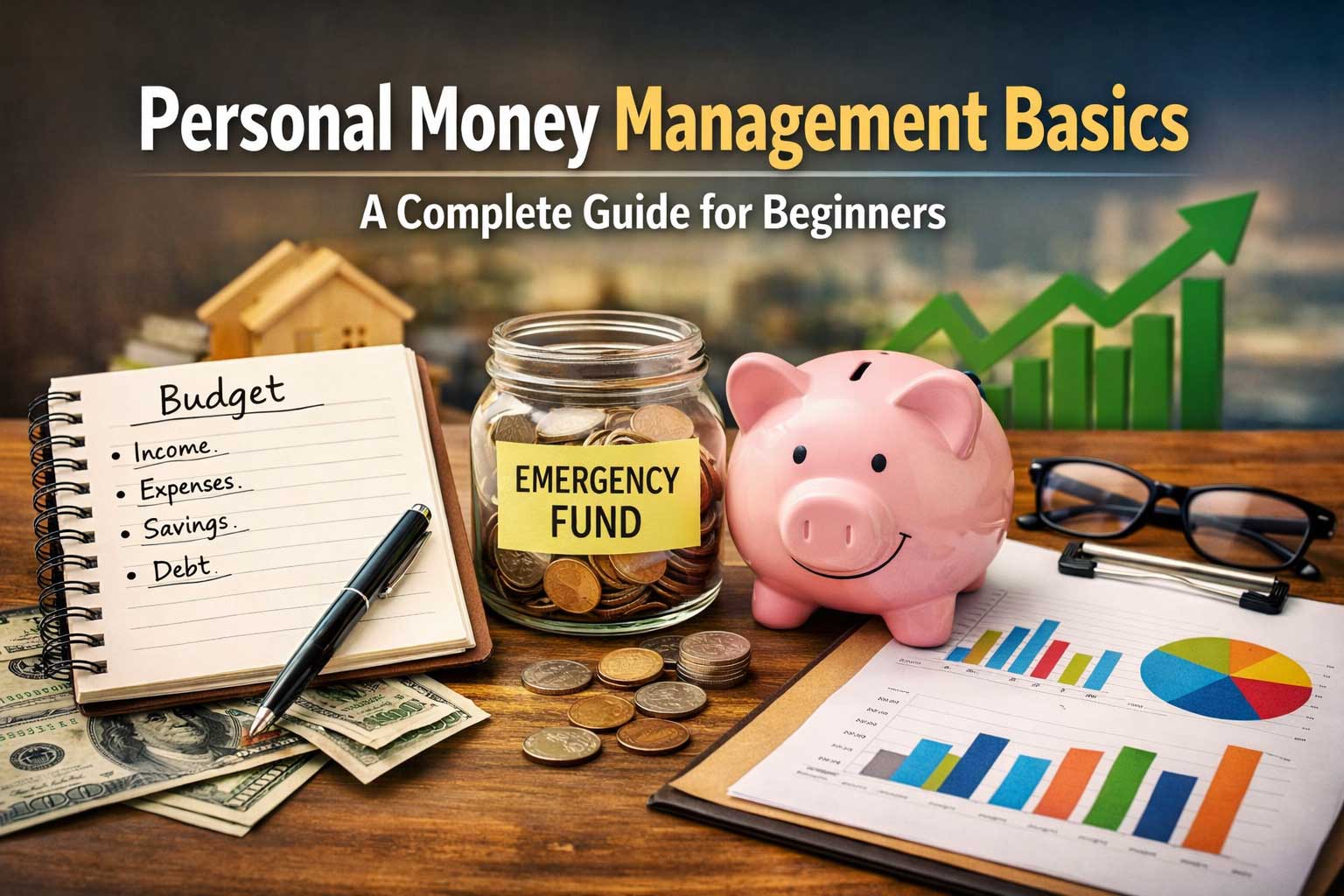
Personal money management isn’t about being “good with numbers.” It’s about building a system that helps you spend with confidence today while protecting your future. If you’ve ever wondered where your money goes, felt anxious before payday, or struggled to save consistently, you’re not alone. Most people were never taught how to manage money in a practical way.
This guide teaches the fundamentals in a simple, structured way—so you can create a plan you’ll actually follow. You’ll learn how to set goals, build a budget that doesn’t feel like punishment, control spending without feeling deprived, pay off debt strategically, build an emergency fund, and start investing even if you’re a total beginner.
Think of money management like learning to drive: at first it’s unfamiliar, but with the right checklist and practice, it becomes automatic.
What “Money Management” Really Means (And Why It’s Hard at First)
Money management is the daily and monthly process of:
- Tracking what comes in (income)
- Planning what goes out (expenses)
- Saving for future needs and goals
- Reducing financial risks (debt, emergencies, job loss)
- Growing money over time (investing)
It feels hard for three common reasons:
- Money is emotional. Spending can be comfort, status, identity, or stress relief.
- Most people don’t have a clear system. Without a system, every decision becomes willpower-based.
- Life is irregular. Bills, emergencies, seasonal expenses, and income changes break “perfect” plans.
The solution isn’t perfection. It’s a realistic system that can handle real life.
Step 1: Know Your Starting Point (Your “Money Snapshot”)
Before you budget or set goals, you need clarity. A money snapshot shows what your finances look like today.
A. List your monthly income (net, after tax)
Include:
- Salary or wages
- Side income
- Freelance earnings
- Support payments
- Any consistent monthly income
If your income is irregular, use the average of the last 3–6 months (or choose a conservative “minimum month” to be safe).
B. List your essential monthly expenses
These are “must-pay” basics:
- Housing (rent/mortgage)
- Utilities
- Food (basic groceries)
- Transportation
- Insurance
- Minimum debt payments
- Phone/internet
- Childcare (if applicable)
C. List your variable and lifestyle spending
These fluctuate and often leak money:
- Eating out
- Shopping
- Subscriptions
- Entertainment
- Personal care
- Gifts
D. Calculate your net cash flow
Net cash flow = Income – Total expenses
- If positive: you can allocate the extra intentionally.
- If negative: you need to reduce spending, increase income, or both.
E. Take inventory of your debts and savings
Write down:
- Debts: balance, interest rate, minimum payment
- Savings: emergency fund, other savings
- Investments (if any)
This snapshot is not for judgment. It’s your starting map.
Step 2: Set Clear Goals That Actually Motivate You
Money goals fail when they’re vague. “Save more” is not a plan. Better goals are specific, time-bound, and emotionally meaningful.
The 3 layers of money goals
1) Survival goals (stability):
- Build a starter emergency fund
- Catch up on overdue bills
- Stop overdrafts
- Make minimum payments on time
2) Security goals (resilience):
- 3–6 months emergency fund
- Insurance coverage
- Consistent monthly saving
- Debt reduction plan
3) Growth goals (freedom):
- Investing consistently
- Buying a home
- Starting a business
- Early retirement
- Funding education
How to create a strong money goal
Use this structure:
- What: Save $2,000 for emergency fund
- By when: In 6 months
- How: Save $335/month automatically
- Why it matters: So I feel safe if something breaks or income drops
That “why” is fuel. Your budget exists to support your goals, not restrict your life.
Step 3: Build a Beginner-Friendly Budget (Without Feeling Miserable)
A budget is simply a plan for your money—before you spend it.
The best beginner budget methods (choose one)
1) The 50/30/20 Budget (simple starting point)
- 50% Needs: housing, food, transport, insurance, minimum debt
- 30% Wants: dining out, fun, shopping, upgrades
- 20% Savings/Debt payoff: emergency fund, investments, extra debt payments
If you live in a high-cost area, your “needs” might be higher. That’s okay—adjust, but keep the concept.
2) Zero-Based Budget (best for control)
Every dollar gets a job:
Income – Expenses – Savings – Debt payoff = 0
This doesn’t mean you spend everything. It means you assign your money intentionally, including saving.
3) The “Pay Yourself First” Budget (best for consistency)
You automate saving and investing first, then live on what’s left.
This works well if your income is steady and you don’t overspend heavily.
4) Envelope/Category Budget (best for overspending triggers)
You set spending limits for categories (food, transport, fun).
When the category is empty, you stop spending.
You can do this with cash envelopes or digitally through separate accounts.
Step 4: Track Spending the Smart Way (No Obsession Required)
Tracking isn’t about being strict; it’s about awareness. Most people underestimate spending—especially small daily purchases.
Beginner tracking options
Pick the one you’ll actually do:
- Daily quick check (2 minutes): write down purchases in notes
- Weekly category check (15 minutes): review spending by category
- Monthly review (30–60 minutes): adjust your plan for next month
The “Big Three” categories that break most budgets
- Food (especially eating out and delivery)
- Shopping (impulse buys, online carts)
- Subscriptions and convenience spending
A powerful habit: Delay non-essential purchases by 24 hours.
This interrupts impulse and gives your goals a chance to speak.
Step 5: Create a Cash-Flow System That Prevents Mistakes
A budget is a plan; a cash-flow system is how you execute it automatically.
A simple 3-account system (beginner-friendly)
1) Bills account:
Rent, utilities, insurance, debt minimums—anything recurring.
2) Spending account:
Groceries, transport, fun, daily spending.
3) Savings account:
Emergency fund, goal savings, sinking funds.
When income arrives:
- Transfer bills money immediately
- Transfer savings automatically
- Keep spending money separate
This reduces overspending because your “spending account” becomes your clear limit.
Use “sinking funds” to stop surprise expenses
Sinking funds are small monthly savings for predictable irregular costs:
- Car repairs
- Medical expenses
- Gifts and holidays
- Annual subscriptions
- Travel
- School costs
Instead of panicking when costs hit, you’re prepared.
Example:
If you spend $600/year on gifts, save $50/month into a Gifts fund.
Step 6: Build an Emergency Fund (Your Financial Airbag)
An emergency fund prevents debt and panic.
What counts as an emergency?
- Job loss
- Medical expenses
- Car repair needed to work
- Urgent home repairs
- Family emergencies
What doesn’t count:
- Sales
- Vacations
- Upgrades you “really want”
- Regular bills you forgot to plan for (use sinking funds for that)
How much should you save?
Start with a starter emergency fund:
- $500 to $1,000 (or one month of essential expenses)
Then build toward:
- 3 to 6 months of essential expenses
If your income is unstable, aim for the higher end.
Where should you keep it?
Keep emergency money:
- Separate from spending money
- Easy enough to access quickly
- Not invested in risky assets (because emergencies don’t wait for markets)
The goal is stability, not high returns.
Step 7: Understand Debt (And Pay It Off Strategically)
Debt isn’t “bad” or “good” by itself. What matters is cost, risk, and impact on your life.
The main types of consumer debt
- High-interest debt: credit cards, payday loans (dangerous and expensive)
- Medium-interest debt: personal loans, some auto loans
- Low-interest debt: some student loans, mortgages (still important, but less urgent)
Two proven payoff strategies
1) Debt Avalanche (mathematically best)
Pay extra on the highest interest rate first.
Saves the most money long-term.
2) Debt Snowball (psychologically best for many)
Pay extra on the smallest balance first.
Gives quick wins and motivation.
Both work. The best method is the one you stick to.
The non-negotiables while paying off debt
- Always pay minimums on time (protect your credit)
- Stop adding new debt (or you’re refilling the hole)
- Use a plan for unexpected expenses (emergency fund + sinking funds)
A simple “debt payoff plan” template
- List debts with balance, interest rate, minimum payment
- Choose avalanche or snowball
- Decide your monthly extra payment amount
- Pay extra consistently
- Roll the payment to the next debt when one is paid off
Consistency beats intensity.
Step 8: Improve Your Credit (Without Becoming a Slave to Scores)
A credit score can affect:
- Loan approvals
- Interest rates
- Rental applications
- Some job background checks (in some places)
But a good credit score is usually the result of good habits, not complicated tricks.
The biggest factors you can control
- Payment history: pay on time, every time
- Credit utilization: keep credit card balances low relative to limits
- Credit age: older accounts help
- New credit: too many applications at once can lower score
- Credit mix: not essential, but variety can help
Beginner credit habits that work
- Set autopay for minimum payments
- Pay credit cards in full if possible
- If you carry a balance, aim to reduce utilization steadily
- Avoid “buy now, pay later” habits that hide spending
The goal isn’t to worship a score—it’s to build financial trustworthiness.
Step 9: Start Saving Consistently (Even If It’s Small)
Saving isn’t what you do after life is paid for. It’s what you build into life.
The secret to consistent saving: automation
If you “save whatever is left,” you’ll save whatever you didn’t spend accidentally.
Instead:
- Choose a savings amount
- Automate it right after payday
- Treat it like a bill to your future self
What to save for (in order)
- Starter emergency fund
- High-interest debt payoff buffer (so you don’t go back into debt)
- Sinking funds (predictable irregular costs)
- 3–6 month emergency fund
- Investing (long-term growth)
- Big goals (home, education, business)
Saving is your foundation; investing is your engine.
Step 10: Learn Beginner Investing (Without Fear or Confusion)
Investing is how you build long-term wealth. Saving protects you. Investing grows you.
Key beginner investing concepts
1) Risk and return:
Higher potential returns usually come with higher short-term ups and downs.
2) Time horizon matters:
Money needed soon shouldn’t take big risks.
3) Diversification reduces risk:
Don’t rely on one company, one asset, or one bet.
4) Compounding is powerful:
Small consistent contributions over years can outperform big one-time deposits.
Saving vs investing: where should your money go?
- Short-term goals (0–3 years): mostly saving
- Mid-term goals (3–7 years): mixed approach depending on risk tolerance
- Long-term goals (7+ years): investing becomes more appropriate
Common beginner mistake: investing before stability
If you don’t have an emergency fund and you invest money you might need, you may be forced to sell at a bad time. Stability first, then growth.
A beginner investing routine (simple and realistic)
- Contribute a fixed amount monthly
- Prefer broad diversification
- Avoid chasing “hot” trends
- Focus on long-term consistency
If you keep it boring and consistent, you’re already ahead of most people.
Step 11: Protect Yourself With Basic Insurance and Risk Planning
Money management isn’t only about growth. It’s also about preventing financial disasters.
Common protections to understand
- Health coverage: medical bills can destroy savings quickly
- Life coverage: important if someone depends on your income
- Disability coverage: protects income if you can’t work
- Auto and home/renter coverage: protects against major loss
Insurance is a “pay a little to avoid losing a lot” tool. You don’t need every policy imaginable, but you do need to understand your biggest risks.
Step 12: Plan for Taxes and Annual Expenses (So They Don’t Surprise You)
Many beginners struggle not because they spend too much monthly, but because they forget the “once a year” costs.
Examples:
- Insurance renewals
- Vehicle registration
- Annual memberships
- School costs
- Holidays and travel
- Tax payments (especially for freelancers)
The fix: an annual expense list + monthly sinking funds
Create a list of annual or irregular costs and divide by 12.
Save that monthly into sinking funds.
This turns financial chaos into predictable planning.
Step 13: Build Money Habits That Last (The Psychology Part)
Most money problems aren’t knowledge problems—they’re habit problems.
The most important money habits for beginners
1) Weekly money check-in (15 minutes):
- Review spending
- Check upcoming bills
- Adjust your plan
2) Automate what matters:
- Bills
- Saving
- Debt payments
3) Use a “pause rule” for impulse spending:
- 24-hour wait for anything non-essential over a chosen amount
4) Keep goals visible:
Your goals should be somewhere you see regularly. It reduces “mindless spending.”
5) Design your environment:
- Unsubscribe from marketing emails
- Remove saved cards from shopping apps
- Turn off “one-click purchase” features
Make good behavior easier than bad behavior.
Common Money Management Mistakes (And How to Avoid Them)
Mistake 1: Budgeting too tightly
If your budget has no fun, it won’t last. Include guilt-free spending.
Mistake 2: Ignoring small purchases
Small spending is not “small” when it happens daily.
Mistake 3: Not planning for irregular expenses
That’s what sinking funds are for.
Mistake 4: Saving without purpose
Name your savings categories. Purpose creates motivation.
Mistake 5: Paying debt without changing habits
Debt payoff is a behavior change project, not just a payment plan.
Mistake 6: Comparing yourself to others
Many people look rich and are broke. Build your plan around your life.
A Simple 30-Day Action Plan for Beginners
If you want a clear roadmap, follow this.
Week 1: Get clarity
- Write down all income sources
- List essential bills and due dates
- Track all spending for 7 days (no judgment)
Week 2: Create your first budget
- Choose a budget method (50/30/20 or zero-based)
- Set category limits (especially food and shopping)
- Set a starter savings target
Week 3: Build your system
- Set up a bills account (or separate bill money)
- Automate minimum debt payments
- Start a sinking fund for one irregular expense
Week 4: Start progress
- Build starter emergency fund (even small)
- Choose debt payoff method and start extra payments
- Schedule a weekly money check-in
After 30 days, you won’t be “finished”—but you’ll have control.
Money Management for Different Situations
If your income is irregular
- Use a conservative “baseline income” to budget
- Keep a bigger buffer in checking
- Save more aggressively during high-income months
- Prioritize essentials first, then goals
If you’re living paycheck to paycheck
Your first goal is breathing room:
- Cut high-leak categories (food delivery, subscriptions, impulse shopping)
- Negotiate bills when possible (phone plans, memberships)
- Build a starter emergency fund
- Consider small income boosts (selling unused items, short-term side work)
If you’re married or managing money with a partner
- Agree on shared goals
- Decide what’s shared vs personal
- Use a monthly money meeting (30 minutes)
- Set a “no questions asked” personal spending allowance for each person
Good systems reduce conflict because expectations are clear.
Frequently Asked Questions
How much should I save each month as a beginner?
Start with what’s realistic, even if it’s small. A common target is 10–20% long-term, but beginners often start lower while building stability and paying off high-interest debt. The key is consistency and gradual increases.
Should I pay off debt or build an emergency fund first?
Do both in stages:
- Build a small starter emergency fund
- Pay off high-interest debt aggressively
- Build a bigger emergency fund
This prevents emergencies from pushing you back into debt.
What’s the best budgeting method?
The best one is the one you’ll use. Many beginners start with 50/30/20 for simplicity, then move to zero-based budgeting for more control.
How do I stop impulse spending?
Use a system, not willpower:
- 24-hour rule
- Category limits
- Separate spending account
- Remove shopping triggers (saved cards, notifications)
When should I start investing?
After you have a starter emergency fund and your monthly budget is stable. If you have very high-interest debt, prioritize that first while still building basic stability.
Final Thoughts: The Real Goal Is Confidence
Personal money management isn’t about never spending money on fun. It’s about making choices that align with your priorities. When you have a system, money stops feeling like a mystery and starts feeling like a tool.
Start small:
- Track spending for one week
- Build a basic budget
- Automate one savings transfer
- Create one sinking fund
- Make one extra debt payment
You don’t need a perfect plan. You need a plan you can repeat.