The Invisible Hand: How Architecture Orchestrates Modern Living
As architects, we often find ourselves at odds with history. We are tasked with fitting 21st-century lives into 19th-century shells. In my practice, I’ve realized that architecture is not merely about erecting walls; it is about choreographing movement and distilling the habits of a client into a physical form. A recent project in the Sharon district of Paris—a 34-square-meter apartment in a 19th-century worker’s building—perfectly illustrates how modern architecture is reshaping our concept of “home” through spatial efficiency, materiality, and a renewed connection to the environment.
Spatial Efficiency: The End of the “Room”
The traditional layout of the 1800s, with its small, closed-off kitchens and separate toilets, is simply “not suitable for a modern lifestyle”. Today, we are moving toward the “gallery” concept, where pathways are subtly guided by design choices rather than rigid partitions.
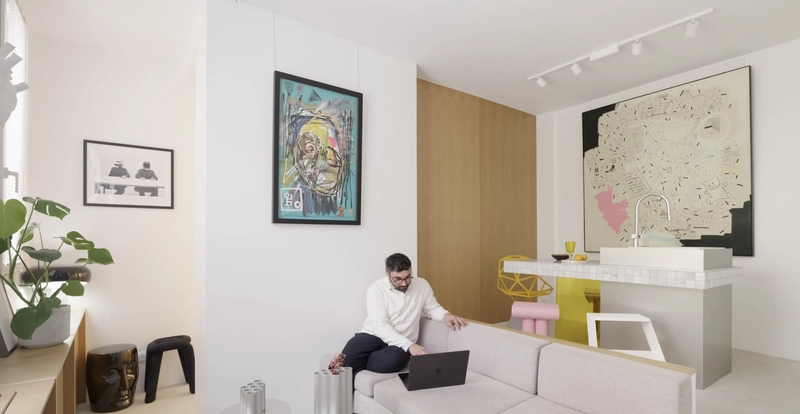
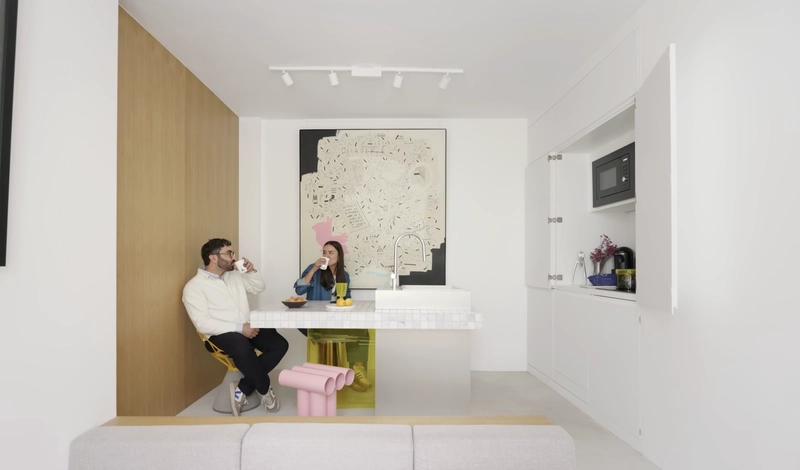
In small-scale living, every centimeter must justify its existence. We achieve this by creating multi-functional spines. For instance, a single “wall-to-wall low console” made of oak can serve as storage, a radiator cover, and a visual guide that draws the eye across the space, making a compact unit feel “larger and grander”. We also utilize vertical thresholds, such as a polished concrete platform, to distribute modern plumbing and electricity while physically separating the living and dining areas without a single door. Even privacy is now fluid; an L-shaped layout can provide a secluded dressing and bathing area without the need for doors, doubling the functionality of the square footage.
Materiality and the Sustainable Pulse
Modern architecture increasingly leans on a dialogue between the industrial and the organic. To break up the “coldness” of white walls and polished concrete, we integrate natural oak wood to add warmth and softness.
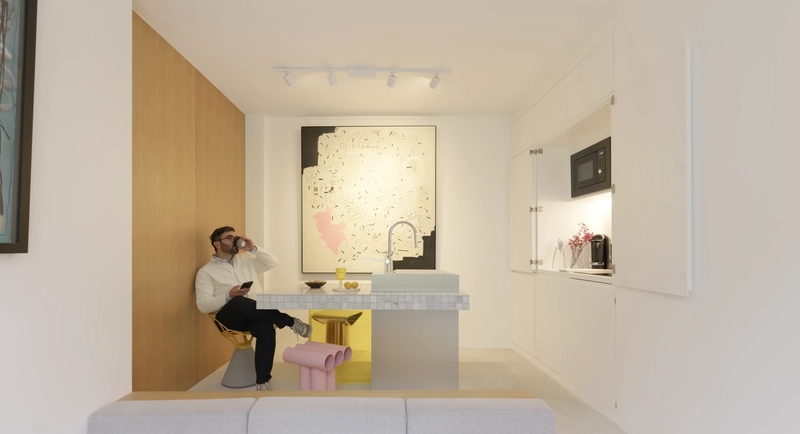
Sustainability in modern design often manifests as mindful reuse and local integration. In our Paris project, we utilized “leftover material” from the kitchen island to create bathroom shelving, ensuring nothing went to waste. Furthermore, we look for ways to hide the “visual clutter” of modern consumption. “Unkitcheny kitchens” allow appliances to be fully concealed within central blocks, maintaining a sculptural, minimalist aesthetic while remaining fully functional. By choosing quality materials like stainless steel, marble mosaic tiles, and yellow plexiglass, we transform utility into art.
Architecture and the Natural World
Even in a dense urban neighborhood like Sharon, which is known for being “lively and green,” architecture must act as a bridge to the outside world. Modern living demands natural light as a primary building material.
We often design with “large openings” that allow light to flood into the most private parts of the home, such as the bedroom. By keeping walls white and using mirrors to create the “illusion of a larger” space, we reflect the natural world back into the interior. Architecture should not be a barrier to nature but a frame for it, using track lighting to mimic the even illumination of a gallery when the sun goes down.
The Architect’s Extraction
Ultimately, our role is to “extract” the essence of a client’s life—their passion for art, their cooking habits, even their need for a laundry space tucked under a communal staircase. Modern architecture is the art of combining constraints with desire. When we get it right, the home becomes a “design object” that doesn’t just house a life, but enhances it.