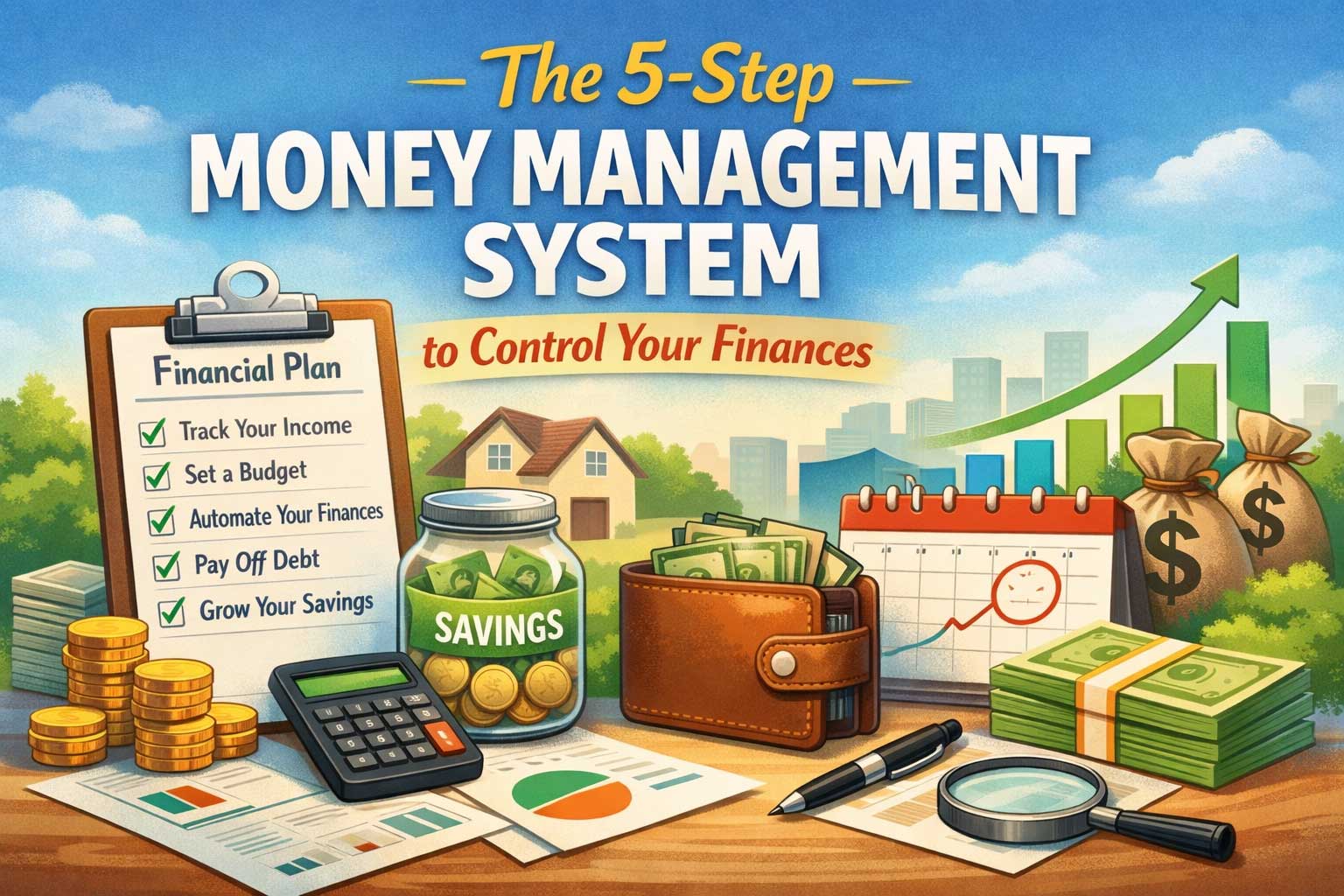
Money management isn’t about being “good with money.” It’s about having a system that makes good decisions easier than bad ones—especially on busy days, stressful months, or when life throws surprises at you.
Most people don’t struggle because they lack intelligence or discipline. They struggle because their money decisions are scattered: a bill here, a subscription there, a random transfer to savings when they remember, and credit card payments that happen only when the balance looks scary. Without structure, even a high income can feel tight. With structure, even a modest income can feel stable.
This article gives you a complete, practical, 5-step system you can implement immediately—no complicated math, no perfect budgeting, no unrealistic “never buy coffee again” rules. You’ll build clarity, control, and consistency. You’ll know where your money is going, what it should be doing, and how to keep improving month after month.
The goal is simple:
your money should support your life, not stress you out.
Why a “System” Beats Willpower Every Time
Willpower is unreliable. It drops when you’re tired, stressed, busy, or emotional. A system is different. A system:
- Creates rules you don’t have to constantly think about
- Makes your priorities automatic
- Prevents small mistakes from becoming expensive problems
- Helps you improve even when motivation is low
- Turns money management into routine maintenance, not a crisis
A good system also does something subtle and powerful: it gives you
proof that you’re in control. That proof builds confidence, and confidence makes it easier to keep going.
What You’ll Build With This 5-Step Money Management System
By the end, you’ll have:
- A clear snapshot of your financial reality (not guesses)
- A simple plan for where money goes every month
- A structure that protects you from overspending and missed bills
- A debt and savings strategy that works together
- A review process that keeps you improving without feeling overwhelmed
You’ll also have templates, checklists, and examples you can reuse forever.
Step 1: Get a Clear Money Snapshot (Know Your Numbers)
You can’t control what you can’t see. Step 1 is about clarity—because clarity reduces stress instantly.
The Money Snapshot Has 4 Parts
- Income
- Fixed expenses
- Variable spending
- Debt and savings baseline
This is not about judgment. It’s about seeing what’s true so you can make smart decisions.
1) Calculate Your Real Monthly Income
If you have a steady salary, start with what consistently hits your bank account each month after taxes.
If your income varies (freelance, sales commissions, seasonal work), use one of these methods:
Option A: Conservative Average
Take the last 6 months of income and average them. Then subtract a small safety buffer (like 5–10%). This prevents your plan from collapsing in a low month.
Option B: “Floor Income”
Identify the minimum you can reasonably expect in a slower month. Build your plan around that. When you earn more, you assign the extra intentionally (debt, savings, investing, or planned spending).
Rule: Your system should still work in a “bad month.” That’s how you avoid panic.
2) List Your Fixed Expenses (The Non-Negotiables)
Fixed expenses are bills that usually stay the same:
- Rent or mortgage
- Utilities (some vary slightly, but still essential)
- Insurance
- Loan payments
- Internet
- Phone plan
- Childcare
- Transportation payments
- Any subscriptions you truly rely on
Write them down with amounts and due dates.
Key insight: The goal is not to eliminate everything fun. The goal is to
know what your baseline costs to live.
3) Track Variable Spending (The Leak Detector)
Variable spending includes:
- Groceries
- Dining out
- Fuel/transport
- Shopping
- Entertainment
- Personal care
- Home supplies
- Gifts
- Small “random” purchases
Look at the last 30–60 days of transactions (bank and card statements) and categorize them. Don’t try to be perfect. You’re looking for patterns.
The Big Patterns to Find
- Frequent small purchases that add up
- Categories that spike when you’re stressed (food delivery, shopping)
- Subscriptions you forgot existed
- Convenience costs (late fees, rush shipping, overdrafts)
This is where most people find money they didn’t realize they had.
4) Create a One-Page Net Worth Baseline
This is your starting line. It’s not a score of your worth as a person.
Assets (What You Own)
- Cash in checking and savings
- Emergency fund
- Investments
- Other assets you can reasonably count (optional)
Liabilities (What You Owe)
- Credit cards
- Personal loans
- Student loans
- Car loans
- Any other debts
Net Worth = Assets − Liabilities
Even if it’s negative, that’s okay. You’re measuring progress.
Step 1 Quick Checklist
- [ ] Monthly income estimate (steady or conservative)
- [ ] Fixed expenses listed with due dates
- [ ] Variable spending categories identified
- [ ] Net worth baseline created
- [ ] One “big priority” chosen (reduce stress, pay debt, save, etc.)
Now you’re ready to build control.
Step 2: Build a Simple Spending Plan (A Budget That Works in Real Life)
A budget fails when it’s too complicated or too strict. A real-life plan should be:
- Easy to maintain
- Flexible with surprises
- Built around your priorities
- Designed to reduce decision fatigue
This step gives your money a job.
The Core Idea: Use “Buckets” Instead of Micromanaging
Instead of tracking 40 categories, use
a few buckets that match how life works.
The Four-Bucket Framework
- Essentials (needs)
- Lifestyle (wants)
- Financial Goals (savings, investing, debt payoff beyond minimums)
- Future Costs (irregular expenses like car repairs, annual fees, medical, holidays)
This approach is powerful because it respects reality: irregular expenses are not emergencies—they’re predictable.
Start With a “Baseline Budget” (Your Survival Plan)
Before optimizing anything, create a baseline that covers essentials and minimum payments.
Baseline Budget Formula
Income − Essentials − Minimum Debt Payments = Remaining Money
If “Remaining Money” is negative, don’t panic. That simply means you need adjustments:
- Reduce expenses
- Increase income
- Negotiate bills
- Restructure debt
- Temporarily pause non-essential spending
Your system must start with truth.
Then Build Your “Control Budget” (Your Real Plan)
Once the baseline works, assign the remaining money intentionally across goals and lifestyle.
A Practical Starting Allocation (Adjust as Needed)
- Essentials: 50–70%
- Lifestyle: 10–25%
- Financial Goals: 10–25%
- Future Costs: 5–15%
If your income is low or costs are high, Essentials may be higher. That’s normal. The win is
intentional allocation, not perfect percentages.
The Rule That Prevents Overspending: “Lifestyle Is a Lane”
Many people overspend because lifestyle spending has no lane. If you don’t set a lane, spending expands.
How to Set Lifestyle Lanes
Pick 3–5 lifestyle categories that matter most:
- Eating out
- Entertainment
- Shopping
- Hobbies
- Travel
- Personal care
Give each category a monthly cap. If you hit the cap, you pause or switch to a cheaper option.
This is not punishment. This is control.
Include “Future Costs” So You Stop Getting Surprised
Future costs are the bills that don’t show up monthly but still show up inevitably:
- Car maintenance
- Tires
- Medical visits
- Gifts and holidays
- Annual subscriptions
- Back-to-school costs
- Home repairs
- Technology replacement
The Simple Fix
Estimate how much those cost annually and divide by 12.
Example:
- Car maintenance: 3,600/year → 300/month
- Gifts/holidays: 1,200/year → 100/month
- Annual fees: 240/year → 20/month
Put that amount into a separate savings “future costs” bucket monthly.
This step alone can eliminate the feeling that money “randomly disappears.”
Build a Plan That Handles Real Life
Your budget should include a small “messy life” buffer:
- A category for unexpected small expenses
- A cushion for price changes
- Room for a treat so you don’t rebound-spend
A system that assumes perfection will break. A system that assumes reality will last.
Step 2 Example: A Simple Monthly Plan
Let’s say your monthly income is 2,500.
Essentials
- Rent: 900
- Utilities: 150
- Phone/Internet: 80
- Transportation: 200
- Groceries: 300
- Insurance: 120
Essentials total: 1,750
Minimum debt payments
- Credit card minimum: 60
- Student loan minimum: 90
Minimum total: 150
Remaining: 2,500 − 1,750 − 150 = 600
Assign the remaining:
- Lifestyle: 200
- Financial goals (extra debt or savings): 250
- Future costs: 150
Now every dollar has a job. That’s control.
Step 3: Set Up Money Automation (Control Without Constant Effort)
A plan is only as strong as your ability to follow it consistently. Automation is where control becomes effortless.
This step turns your plan into a process that runs in the background.
The “Separate to Control” Principle
When all your money sits in one account, everything competes. Bills compete with shopping. Groceries compete with subscriptions. Savings competes with impulse spending.
Separation creates boundaries.
Minimum Setup (Simple Version)
Use:
- One account for bills and essentials
- One account for lifestyle spending
- One savings account for goals and future costs (or separate savings buckets)
If you can’t open multiple accounts, you can still separate with:
- Scheduled transfers
- A basic tracking sheet
- Two debit cards, if available
- A weekly cash withdrawal for lifestyle spending
The tool matters less than the
structure.
Automate These 5 Money Moves
1) Auto-pay minimums (Protect your credit and avoid late fees)
Set minimum payments on all debts and required bills.
2) Auto-transfer savings on payday (Pay yourself first)
Even a small amount counts. The purpose is consistency.
3) Auto-transfer future costs monthly
This prevents “surprise” expenses from destroying your plan.
4) Auto-transfer lifestyle money weekly (Stop overspending)
Instead of giving yourself a full month of spending money, transfer it weekly.
Example:
Lifestyle budget: 200/month
Weekly transfer: 50/week
Weekly lanes are easier to manage than monthly ones.
5) Auto-review reminders (Make the system self-correcting)
Pick one weekly time to check balances and spending lanes.
Build the “Bill Calendar” Once
Create a simple bill schedule:
- Bill name
- Amount
- Due date
- Auto-pay status
- Account used
This one-time setup reduces mental load massively.
The Anti-Stress Trick: Keep a Buffer in Bills Account
If possible, maintain a small buffer (even 100–300) in your bills account. This prevents overdrafts and reduces the fear of timing issues.
Many money problems aren’t spending problems—they’re timing problems.
Step 3 Mindset Shift: You’re Designing Behavior
Automation isn’t just convenience. It’s behavioral design:
- You remove the chance to “forget”
- You reduce daily decisions
- You protect your priorities from moods
This is how you stay consistent without feeling restricted.
Step 4: Attack Debt and Build Savings (The Stability Engine)
Step 4 is where you shift from “staying afloat” to building real strength.
A strong money system does two things at once:
- Reduces expensive debt
- Builds protection (emergency fund + savings)
If you only do one, you stay vulnerable.
Part A: Build a Starter Emergency Fund First
Before aggressive debt payoff, aim for a starter emergency fund:
- If your income is stable: 500–1,000
- If your income is variable: 1,000–2,000 (or one month of essentials)
Why first? Because without a buffer, one surprise expense sends you back to credit cards and wipes out progress.
This fund is not for vacations or shopping. It’s for preventing debt.
Part B: Choose a Debt Payoff Strategy You Can Stick With
Two proven strategies:
1) Debt Snowball (Motivation First)
Pay extra on the smallest balance first while paying minimums on the rest. When it’s paid off, roll that payment into the next smallest debt.
Best if:
- You need quick wins
- You struggle with motivation
- You have multiple smaller debts
2) Debt Avalanche (Interest First)
Pay extra on the highest interest rate first.
Best if:
- You’re motivated by math
- You want the lowest total cost
- Your interest rates vary a lot
Choose the method you’ll follow for 12 months, not the one that sounds best today.
Part C: Use “The Split Rule” So You Don’t Neglect Savings
If you’re in debt, it’s tempting to throw every spare dollar at debt. But that can be risky if you have no protection.
A balanced approach:
- After starter emergency fund: split extra money into
- 60–80% extra debt payments
- 20–40% savings (emergency and future costs)
If you have very high-interest debt, lean heavier toward debt. If you have unstable income, lean heavier toward savings.
Part D: Upgrade to a Full Emergency Fund (Your Peace Fund)
Once high-interest debt is under control, build a full emergency fund:
- 3 months of essentials (common goal)
- 6 months if income is variable or you want maximum security
This fund changes your life because it gives you options:
- You can handle emergencies without panic
- You can say no to bad opportunities
- You can make decisions with confidence, not fear
Part E: Start Investing With Consistency (Even Small Amounts)
Once you have stability, investing becomes a long-term growth engine. The key isn’t picking perfect investments. The key is consistent contributions.
Start simple:
- A small percentage of income
- A monthly automatic contribution
- A long-term mindset
Even modest investing becomes powerful over time because consistency compounds.
The “Debt Trap” Warning to Avoid
Many people pay off debt and then refill it because spending habits didn’t change.
Your system prevents this by:
- Separating lifestyle spending
- Funding future costs
- Keeping an emergency buffer
- Reviewing monthly
Debt freedom is not a finish line. It’s a new phase with new rules.
Step 5: Review, Adjust, and Grow (Make It Sustainable Forever)
A money system works because it adapts. Your life will change:
- Income changes
- Expenses change
- Priorities change
- Unexpected things happen
Step 5 is the maintenance routine that keeps you in control long-term.
The Weekly Money Check (10 Minutes)
Once a week, do a quick check:
- Bills paid or upcoming
- Lifestyle spending lane status
- Savings transfers completed
- Any unusual spending this week
- One small adjustment for next week
This prevents small problems from turning into financial stress.
The Monthly Money Date (30–60 Minutes)
Once per month, do a deeper review:
- Review last month’s spending
- Compare to your plan
- Adjust categories that were unrealistic
- Plan upcoming irregular expenses
- Increase savings or debt payments if possible
- Set one focus goal for the next month
Questions to Ask Each Month
- What category surprised me?
- What worked well that I should repeat?
- What expense can I reduce without feeling miserable?
- Did I move closer to my main goal?
- What will be expensive next month, and am I ready?
This keeps your system realistic and improving.
The Quarterly Upgrade (Bigger Moves)
Every 3 months, review bigger opportunities:
- Negotiate bills (insurance, phone plans)
- Cancel unused subscriptions
- Adjust savings targets
- Consider income growth options
- Review debt payoff progress and timeline
A quarterly review is where you create major progress without daily stress.
The “Control Score” (A Simple Way to Measure Progress)
Track these 5 metrics:
- Emergency fund balance
- Total debt balance
- Net worth
- Savings rate (percentage of income saved)
- Missed payments or fees (aim for zero)
If these are improving, your system is working.
Putting It All Together: The System in One Page
Here’s the entire 5-step system summarized:
Step 1: Snapshot
- Know income, expenses, spending patterns, and net worth
Step 2: Spending Plan
- Use buckets: essentials, lifestyle, goals, future costs
Step 3: Automation
- Separate accounts/buckets and automate transfers and bills
Step 4: Debt + Savings
- Starter emergency fund → structured payoff → full emergency fund → investing
Step 5: Review
- Weekly check + monthly money date + quarterly upgrades
This is how you stop reacting to money and start directing it.
Common Real-Life Situations (And How This System Handles Them)
If Your Income Is Irregular
- Use “floor income” to plan
- Build a larger buffer in the bills account
- Increase emergency fund goal
- Assign “extra income” with rules:
- First: catch up on essentials
- Second: fund future costs
- Third: extra debt/savings
- Fourth: lifestyle upgrades (planned, not impulsive)
If You Live Paycheck to Paycheck
- Start with the baseline budget
- Focus on timing and reducing fees
- Use weekly lifestyle transfers
- Fund a starter emergency buffer, even slowly
- Prioritize one high-impact cut (subscriptions, impulse spending category, recurring convenience cost)
If You Overspend Emotionally
- Create a “pause rule” for non-essential purchases
- Use a weekly spending lane (smaller pool)
- Add a planned treat category so you don’t rebound
- Track triggers: stress, boredom, social pressure
If You Have a Family
- Use shared categories and a shared “future costs” bucket
- Hold a monthly money meeting with one agenda:
- What’s coming up?
- What’s the plan?
- What’s one improvement?
Money gets easier when expectations are shared.
Frequently Asked Questions
How long does it take to feel in control?
Many people feel relief after Step 1 and Step 2 because clarity and a plan reduce anxiety. Real stability typically improves over several months as automation and savings build.
Do I need to track every expense?
No. You need enough tracking to stay within your lanes and spot patterns. Buckets reduce complexity while still giving control.
What if I mess up one month?
That’s normal. The system isn’t fragile. Step 5 exists specifically to correct course. One messy month doesn’t ruin your finances—lack of review does.
Should I save or pay off debt first?
Start with a starter emergency fund, then do both in a structured way. This prevents new debt from emergencies and keeps progress steady.
What’s the most important step?
Automation (Step 3) is often the turning point because it makes your plan consistent without relying on motivation.
A Simple 7-Day Action Plan to Start Today
If you want to begin immediately, follow this week plan:
Day 1: Money Snapshot
Gather income, bills, debts, and balances.
Day 2: Categorize Spending
Look at the last month of transactions and identify patterns.
Day 3: Create Your Buckets
Essentials, lifestyle, goals, future costs.
Day 4: Set Your Monthly Plan
Assign amounts to each bucket based on your income and priorities.
Day 5: Add Automation
Auto-pay minimums and auto-transfer savings on payday.
Day 6: Separate Lifestyle Spending
Weekly spending lane transfer or a dedicated spending method.
Day 7: Schedule Reviews
Pick a weekly check day and a monthly money date.
In one week, you’ll go from “hoping it works out” to having a working system.
Conclusion: Control Comes From Clarity, Structure, and Consistency
You don’t need to be perfect. You need a system that works in real life—one that keeps your bills covered, spending contained, savings growing, debt shrinking, and stress decreasing.
This 5-step money management system gives you that. It doesn’t depend on motivation. It depends on structure:
- You see your money clearly (Step 1)
- You tell it where to go (Step 2)
- You automate the process (Step 3)
- You build stability and progress (Step 4)
- You keep improving with simple reviews (Step 5)
If you implement only one thing today, start with
Step 1: the snapshot. Clarity is the beginning of control. Then build the rest—one step at a time—until money stops feeling like a constant problem and starts feeling like a tool you control.