
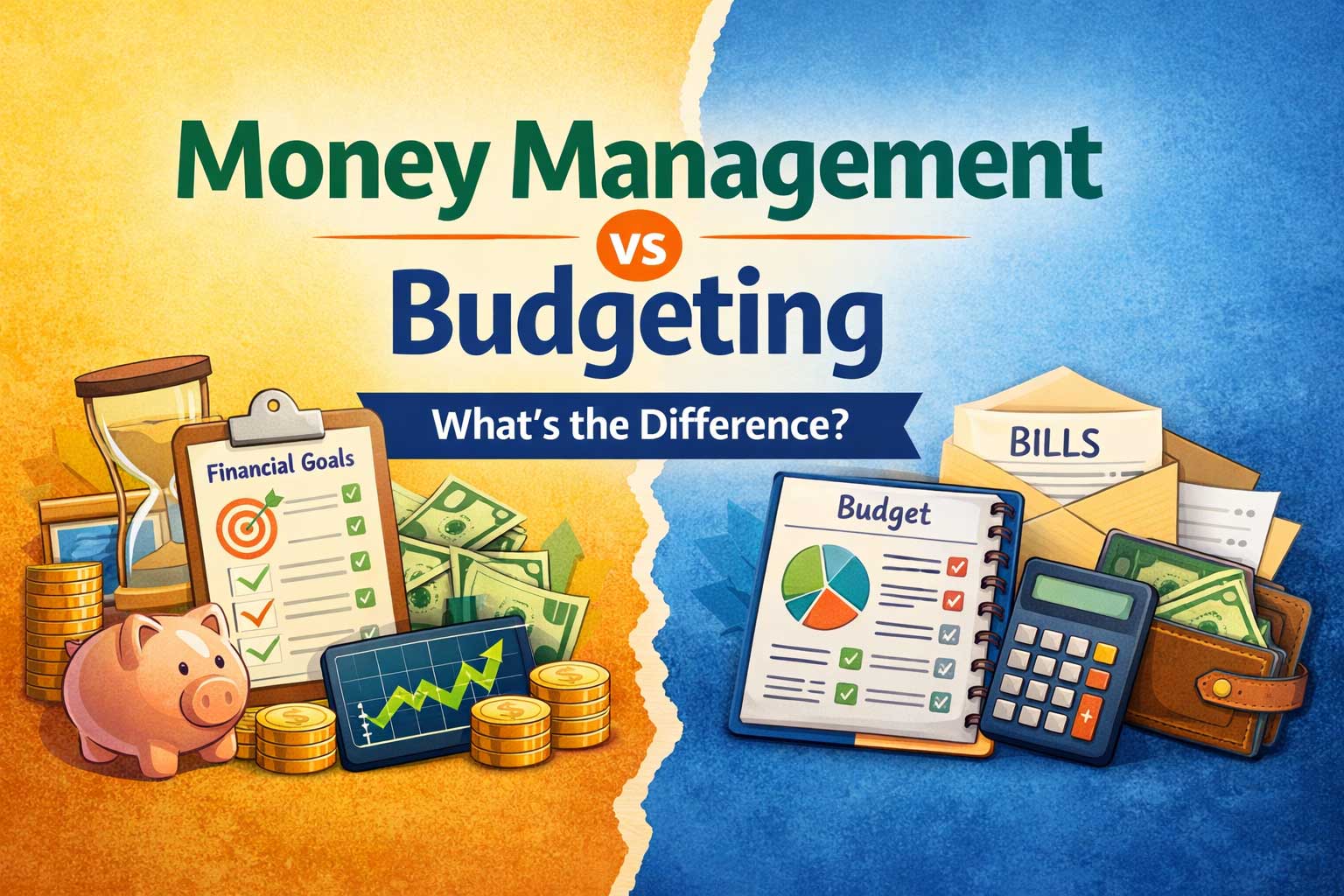
If you’ve ever told yourself, “I need to budget,” but still felt like your money disappears, you’re not alone. Many people treat budgeting as the entire solution—then feel discouraged when the plan doesn’t “stick.” The truth is that budgeting is powerful, but it’s only one part of a bigger picture.
That bigger picture is money management.
Think of it like health and fitness: a “meal plan” can help, but it’s not the same as an entire lifestyle of movement, sleep, stress management, and consistent habits. In the same way, a budget can help you control spending, but money management is the system that helps you control your financial life.
This article breaks down the difference clearly, explains why it matters, and shows you how to combine both in a practical way—whether you’re living paycheck to paycheck, trying to get out of debt, or aiming to build long-term wealth.
What Is Budgeting?
Budgeting is the process of planning how you will use your money over a specific period—usually weekly or monthly. A budget tells your money where to go before it goes there.
A typical budget answers questions like:
- How much income is coming in this month?
- What bills must be paid, and when?
- How much can I spend on groceries, transport, and eating out?
- How much will I save or put toward debt?
At its core, budgeting is about allocation. You assign your income to categories so you can stay within limits and avoid overspending.
What a Budget Helps You Do
- Prevent overspending (especially on variable expenses)
- Make sure essentials are covered first
- Plan for upcoming bills and irregular expenses
- Create structure and awareness around spending
- Free up money for savings and debt payoff
What Budgeting Is Not
Budgeting is not:
- A guarantee you’ll reach financial goals
- A replacement for saving systems, debt strategies, or investing plans
- A complete plan for long-term financial stability
- A cure for inconsistent income or unpredictable expenses (it can help, but often needs extra tools)
Budgeting is a tool—an important one—but still a tool.
What Is Money Management?
Money management is the broader process of organizing, directing, and optimizing your finances so you can meet current needs, reduce stress, and build future stability.
Money management includes budgeting—but it goes beyond it.
Money management answers bigger questions like:
- What are my financial goals over the next 1, 3, and 10 years?
- How do I build an emergency fund and protect myself from surprises?
- What system ensures my bills are always paid on time?
- How do I reduce debt efficiently without feeling trapped?
- How do I plan for big purchases and life changes?
- How do I grow wealth through long-term investing and smart decisions?
- How do I make money choices that match my values and lifestyle?
If budgeting is your monthly plan, money management is your financial operating system.
What Money Management Typically Includes
- Cash flow management (timing of income and expenses)
- Budgeting and spending control
- Saving systems (emergency fund, sinking funds, goal savings)
- Debt management strategy (payoff plans, interest optimization)
- Financial goal planning (short-, mid-, and long-term)
- Risk management (insurance, emergency planning)
- Long-term wealth building (investing strategy, retirement planning)
- Behavior and habit design (consistency, triggers, motivation)
- Review routines (weekly checks, monthly resets, annual planning)
Money management is not just about “not overspending.” It’s about building a life where your money supports you—predictably.
Money Management vs Budgeting: The Core Difference
Here’s the simplest way to remember it:
- Budgeting = a plan for your money
- Money management = a system for your financial life
Budgeting is one component inside money management, like a steering wheel inside a car. You can steer better with it—but the car still needs an engine, brakes, fuel, maintenance, and a map.
A Clear Comparison
Budgeting focuses on:
- Categories
- Spending limits
- Monthly tracking
- Short-term control
Money management focuses on:
- Systems and routines
- Priorities and goals
- Savings and protection
- Debt strategy and wealth building
- Long-term stability
Another Way to Say It
Budgeting is tactical. Money management is strategic.
Budgeting asks: “How should I spend this month’s paycheck?”
Money management asks: “How do I design my finances so I don’t panic every month?”
Why People Confuse Budgeting With Money Management
Most of us were taught budgeting as the main “adult money skill.” It’s common advice because it’s easy to say and easy to understand: “Make a budget.”
But budgeting is visible—it’s a spreadsheet, an app, categories, numbers. Money management includes invisible skills like:
- planning,
- behavior change,
- decision-making under stress,
- preparing for irregular expenses,
- balancing trade-offs,
- setting boundaries,
- and thinking long-term.
Many people “fail at budgeting” not because they’re bad with money, but because they’re trying to solve a system problem with a single tool.
Why the Difference Matters (More Than You Think)
Understanding the difference between money management and budgeting can change your results dramatically.
1) It Stops the Shame Cycle
When people think budgeting is everything, they interpret any overspending as a personal failure:
- “I can’t stick to a budget.”
- “I’m bad with money.”
- “I’ll never get ahead.”
But often the budget wasn’t supported by a system:
- irregular income,
- missing emergency fund,
- unpredictable expenses,
- emotional spending triggers,
- no review routine,
- no plan for “fun.”
Money management reframes the problem: you don’t need more willpower—you need better structure.
2) It Helps You Build Stability, Not Just Control
A budget can control spending for a month. Money management builds stability over years:
- emergency reserves,
- lower debt,
- better credit,
- calmer decisions,
- consistent progress.
3) It Makes You Goal-Oriented Instead of Restriction-Oriented
Many budgets feel like punishment: “Don’t spend. Don’t buy. Cut everything.”
Money management is different. It starts with:
- what matters to you,
- where you want to go,
- what you want your life to look like.
Then it builds a plan to get there.
4) It Prepares You for Real Life
Real life includes:
- car repairs,
- medical costs,
- family needs,
- seasonal expenses,
- job changes,
- travel,
- gifts,
- emergencies.
Budgeting alone often breaks under real life pressure. Money management expects real life and builds buffers.
Budgeting: What It Does Best (And Where It Struggles)
Budgeting Is Best For
1) Awareness
Tracking your spending reveals patterns you can’t fix if you can’t see.
2) Spending control
Budgets shine on variable categories like food, entertainment, shopping, and subscriptions.
3) Short-term decisions
A budget helps you decide:
- Can I afford this right now?
- What will I sacrifice if I buy it?
- How much is safe to spend this week?
4) Prioritizing essentials
Budgets protect rent, utilities, food, and transport first.
Budgeting Struggles When
1) Income is irregular
Freelancers, commission workers, and seasonal earners often feel like budgets “don’t work” because the plan changes constantly.
2) Expenses are unpredictable
If you don’t have sinking funds or buffers, every surprise breaks the budget.
3) The budget is too strict
When a plan ignores reality, it becomes something you avoid checking.
4) You rely on willpower
If your system requires constant self-control with no automation or guardrails, it’s likely to fail when you’re tired, stressed, or busy.
Budgeting works best when supported by money management systems.
Money Management: The Bigger Skill Set
Money management is what makes budgeting sustainable and effective. Here are the main “pillars” of strong money management.
Pillar 1: Cash Flow Management (Timing Matters)
Cash flow is about when money enters and leaves your accounts.
You can “afford” something monthly but still get hit with overdrafts if the timing is off. Cash flow management includes:
- aligning due dates with paydays,
- keeping a buffer in checking,
- planning for large bills,
- avoiding payment stacking (too many bills due in one week),
- using a bills account so essentials are always covered.
A perfect budget can still fail without cash flow planning.
Pillar 2: Spending Systems (Not Just Categories)
Spending control isn’t only “set a limit.” It’s creating friction and boundaries so spending matches your priorities, such as:
- separating “bills money” from “spending money”
- weekly spending allowances instead of monthly free-for-alls
- using cash or a dedicated card for certain categories
- unsubscribing and removing saved payment methods
- setting a waiting rule for non-essential purchases
Money management builds the environment that makes good decisions easier.
Pillar 3: Saving Systems (Emergency + Goals)
A budget might say “save 10%,” but money management answers:
- Where will the savings live?
- When will it happen?
- What is it for?
- How do I keep it from being spent?
Core saving structures include:
- Emergency fund (unexpected events)
- Sinking funds (expected-but-not-monthly costs like insurance, holidays, school fees)
- Goal funds (travel, home upgrades, new laptop, wedding, business launch)
Savings are less about intention and more about structure.
Pillar 4: Debt Strategy (Not Just Minimum Payments)
Debt management includes:
- understanding interest rates and payoff timelines
- choosing a payoff method (highest interest first vs smallest balance first)
- negotiating rates where possible
- avoiding new debt while paying off old debt
- using “rules” to stop sliding backward
A budget can include debt payments, but money management includes the strategy and protection that keeps you out of the same cycle.
Pillar 5: Protection and Risk Management
You can budget perfectly and still face financial disaster if you’re unprotected. Money management includes:
- emergency planning,
- appropriate insurance choices,
- keeping deductibles manageable,
- preparing for job loss or income drops,
- basic legal and documentation habits (beneficiaries, account access planning).
This isn’t glamorous—but it’s what makes finances resilient.
Pillar 6: Long-Term Wealth Building
Budgeting is mostly short-term. Money management includes long-term growth:
- investing consistently,
- aligning risk with time horizon,
- avoiding emotional decision-making,
- focusing on habits more than perfect timing.
Even if you’re not investing yet, money management keeps that goal in view and prepares for it.
Pillar 7: Review Routines and Adjustments
Your plan isn’t “set it and forget it.” Money management uses routines like:
- weekly money check (10–15 minutes)
- monthly reset (review spending, adjust categories, plan upcoming expenses)
- quarterly goal check
- annual planning (big expenses, income changes, long-term targets)
Budgets often fail because they’re created once and ignored. Money management makes review normal.
The Relationship Between Money Management and Budgeting
Here’s the best way to think of it:
- Money management is the umbrella.
- Budgeting is one of the strongest tools under it.
A budget without money management can feel restrictive and fragile.
Money management without budgeting can feel vague and inconsistent.
Used together, they create both control and progress.
Common Budgeting Methods (And Who They Work Best For)
If budgeting is part of the system, the next step is choosing a method that fits your life.
1) Zero-Based Budget (Give Every Dollar a Job)
You assign all income to categories: bills, savings, debt, spending—until you reach zero leftover.
Best for: people who want tight control, debt payoff focus, or clear structure
Watch out for: being too rigid if your month is unpredictable
2) The 50/30/20 Style Split
A flexible approach: needs, wants, and savings/debt.
Best for: beginners who want simplicity
Watch out for: “needs” can quietly grow until savings disappears
3) Pay Yourself First (Savings First)
You automate savings and debt payments first, then live on what remains.
Best for: people who prefer automation and fewer decisions
Watch out for: if bills are inconsistent, you need a bills buffer first
4) Weekly Spending Allowance
Instead of managing a whole month, you set a weekly amount for variable spending.
Best for: people who overspend early in the month
Watch out for: needs a clear separation between bills and spending money
5) Envelope or Category Wallet System
You allocate spending money into categories (digitally or with cash). When a category is empty, you stop.
Best for: people who need strong guardrails
Watch out for: requires set-up and consistent tracking
The “best” budget is the one you will actually use. Money management helps you choose the method that matches your behavior and reality.
The Real Reason Budgets Fail (And How Money Management Fixes It)
Most budgets don’t fail because the math is wrong. They fail because the plan doesn’t match real life.
Reason 1: No Buffer
Without a buffer, one surprise expense creates panic and forces you to borrow or steal from other categories.
Money management fix: build a starter emergency fund, then grow it.
Reason 2: No Plan for Irregular Expenses
Car repairs, medical costs, birthdays, annual fees—these are predictable over a year, even if the timing is unknown.
Money management fix: sinking funds and annual expense planning.
Reason 3: Budgeting Based on “Perfect Behavior”
If your budget assumes you’ll never eat out, never shop, never have fun, it’s not a plan—it’s a fantasy.
Money management fix: values-based budgeting that includes realistic enjoyment.
Reason 4: Emotional Spending Triggers
Stress, boredom, social pressure, and fatigue can override good intentions.
Money management fix: habit design, friction tools, and spending rules.
Reason 5: Too Much Complexity
If the system is too complicated, you’ll avoid it.
Money management fix: simplify categories, automate essentials, focus on a few key metrics.
Values-Based Money Management: The Missing Piece
Here’s where money management becomes more than numbers.
A budget is a plan. But a plan without purpose feels like restriction.
Money management starts by asking:
- What do I want money to do for me?
- What matters most in my life?
- What am I willing to say no to so I can say yes to something bigger?
A Simple Values Exercise
Write down:
- Your top 3 priorities (examples: stability, family, freedom, health, education, travel, business growth).
- The top 3 money drains that don’t really make you happy.
- One change you could make that would align spending with values.
This turns budgeting into a tool of intention, not punishment.
A Practical Framework: The 7-Part Money Management System
If you want a complete approach that includes budgeting but doesn’t depend on it alone, use this system.
Part 1: Know Your True Monthly Baseline
Start with the basics:
- average income (use conservative estimates if irregular)
- fixed expenses (rent, utilities, loan payments, insurance)
- variable essentials (food, transport)
- minimum debt obligations
- basic savings goal
This baseline tells you what you must cover before lifestyle spending.
Part 2: Build a Bills System
A strong bills system reduces late fees, stress, and decision fatigue.
Common approaches include:
- one account for bills, one for spending
- setting bill due dates after paydays
- keeping a buffer in checking
- automating minimum payments for essentials
The goal is to make “survival money” predictable.
Part 3: Create a Budget That Matches Real Behavior
Start simple:
- fewer categories
- realistic spending levels
- include fun spending
- include “miscellaneous” so small surprises don’t break the plan
A working budget beats a perfect budget you avoid.
Part 4: Add Sinking Funds for Irregular Costs
Make a list of non-monthly expenses:
- annual subscriptions
- insurance premiums
- repairs and maintenance
- holidays and gifts
- school-related costs
- travel
- clothing
- medical co-pays or planned treatments
Then divide by 12 and set aside monthly. This single step makes budgets far more stable.
Part 5: Create an Emergency Fund Plan
Start small if needed:
- first target: a small buffer that prevents panic
- next target: one month of essential expenses
- later target: multiple months based on stability and responsibilities
Emergency funds turn disasters into inconveniences.
Part 6: Use a Debt Strategy With Clear Priorities
Pick a method and commit:
- prioritize the highest interest debt for speed and savings
- or prioritize the smallest balance for motivation
- avoid adding new debt while paying off old debt by using spending rules and buffers
Debt payoff is rarely only math—it’s also behavior.
Part 7: Review and Adjust on a Routine
Set a rhythm:
- weekly: check balances, upcoming bills, spending pace
- monthly: reset categories, plan irregular expenses, adjust goals
- quarterly: review progress and update targets
- yearly: plan big expenses and set a financial theme for the year
Consistency beats intensity.
Key Metrics That Matter More Than Perfect Budgeting
If you want quick indicators that your money management is improving, track a few meaningful metrics.
1) Savings Rate
How much of your income is going to savings and investments (or debt payoff if you’re focused on that)?
Even a small consistent rate can transform your future.
2) Emergency Fund Coverage
How many months of essential expenses could you cover if income stopped?
More coverage generally means less stress and better decision-making.
3) Debt-to-Income Direction
Is your debt burden shrinking or growing over time?
The trend matters. Progress compounds.
4) Net Worth Trend
Net worth is what you own minus what you owe. You don’t need to obsess over it monthly, but checking periodically shows whether you’re building stability.
5) “Fixed Cost Pressure”
How much of your income is consumed by fixed commitments (rent, loans, subscriptions)?
Lower fixed pressure creates more freedom and resilience.
Budgeting helps with these metrics, but money management is what improves them sustainably.
Real-Life Examples: How Money Management and Budgeting Work Together
Example 1: The Paycheck-to-Paycheck Worker
Problem: The budget says “save,” but every month has surprises.
Money management solution:
- create a bills buffer
- start a small emergency fund
- build sinking funds for predictable irregular costs
- use weekly spending allowances
Once the system is stable, budgeting becomes easier and less stressful.
Example 2: The Freelancer With Irregular Income
Problem: The budget changes constantly.
Money management solution:
- base the budget on the lowest typical income month
- keep a larger buffer in a separate account
- pay yourself a “salary” from that buffer
- build sinking funds for taxes, slow seasons, and business expenses
Budgeting still exists, but cash flow management becomes the priority.
Example 3: The High Earner Who Still Feels Broke
Problem: Income is high, but lifestyle spending is high too.
Money management solution:
- define clear priorities and long-term goals
- automate savings and investing first
- reduce fixed cost pressure
- set rules for large purchases
- track a few metrics (savings rate, net worth trend)
Budgeting can help, but the real win is aligning money with intentional goals.
Common Myths That Keep People Stuck
Myth 1: “Budgeting Means I Can’t Have Fun”
A sustainable budget includes enjoyment. The goal is not deprivation—it’s direction.
Myth 2: “If I Earn More, I Won’t Need a Budget”
Higher income can create bigger spending. Systems still matter.
Myth 3: “I Failed Because I Overspent Once”
Money management expects mistakes and builds recovery:
- adjust categories
- learn patterns
- build buffers
- keep going
Myth 4: “I Need a Perfect Plan Before I Start”
You need a working plan, not a perfect one. Start simple and improve.
How to Know What You Need Right Now
Ask yourself these questions:
If You Mostly Need Budgeting
- Do I regularly overspend on variable categories?
- Do I feel unsure how much I can spend weekly?
- Do I want more awareness and control immediately?
If yes, budgeting is your first step.
If You Mostly Need Money Management Systems
- Do I have frequent “surprises” that break my budget?
- Do I rely on credit cards to handle irregular costs?
- Do I feel stressed even when I budget?
- Is my income inconsistent?
- Do I have no emergency fund or sinking funds?
If yes, you need money management structure first, then budgeting will work better.
Most people need both, but the order matters.
A Simple Action Plan You Can Start Today
Here’s a practical way to apply everything without feeling overwhelmed.
Step 1: Separate Essentials From Lifestyle Spending
Identify:
- bills and required payments
- essentials (food, transport)
- flexible spending (fun, shopping, dining)
Step 2: Create a Small Weekly Spending Limit
Start with a number you can maintain without constant tracking stress.
Step 3: Start One Sinking Fund
Pick the most common “surprise” expense and begin saving for it monthly.
Step 4: Build a Starter Emergency Fund
Even a small buffer reduces panic and makes budgeting realistic.
Step 5: Do a Weekly Check
Once per week, review:
- balances
- upcoming bills
- spending pace
This one habit is often the difference between chaos and control.
Frequently Asked Questions
Is budgeting necessary if I’m good with money?
Budgeting isn’t always required in a strict category-by-category way, but some form of planning and spending awareness usually exists. Many “naturally good” money managers use automation, rules, and high-level targets—which are still budgeting tools in a broader system.
What if I hate budgeting?
You can use lighter methods:
- weekly allowance
- pay yourself first
- simple category caps
- automated bills and savings
The key is still planning and awareness—just in a format you’ll stick with.
Can money management work without tracking every expense?
Yes. Many people succeed with:
- automation,
- separation of accounts,
- spending rules,
- weekly check-ins,
- and a few key metrics.
Tracking can help, but it’s not the only way.
What matters more: budgeting or saving?
Saving matters for stability, but budgeting often creates the space for saving. Money management makes saving consistent through systems, not just good intentions.
How long does it take to feel in control?
Some people feel relief in a week once bills and spending are separated. Larger stability (emergency funds, debt reduction) takes longer, but the stress reduction often begins early when your system becomes predictable.
Final Thoughts: Use Budgeting as a Tool, Not a Lifestyle
Budgeting is important, but it’s not the whole story.
- Budgeting helps you control your spending.
- Money management helps you build a life where money supports you—consistently.
When you stop treating budgeting as the only solution and start building a complete money management system, you’ll notice a shift:
- less panic,
- fewer surprises,
- more progress,
- and a clearer path toward your goals.
A working system doesn’t require perfection. It requires a plan you can live with, routines you can maintain, and buffers that protect you when life happens—because life always happens.
If you want to make this practical immediately, remember this simple formula:
Money management is the strategy. Budgeting is the tool. Use both—and your finances become much easier to lead.