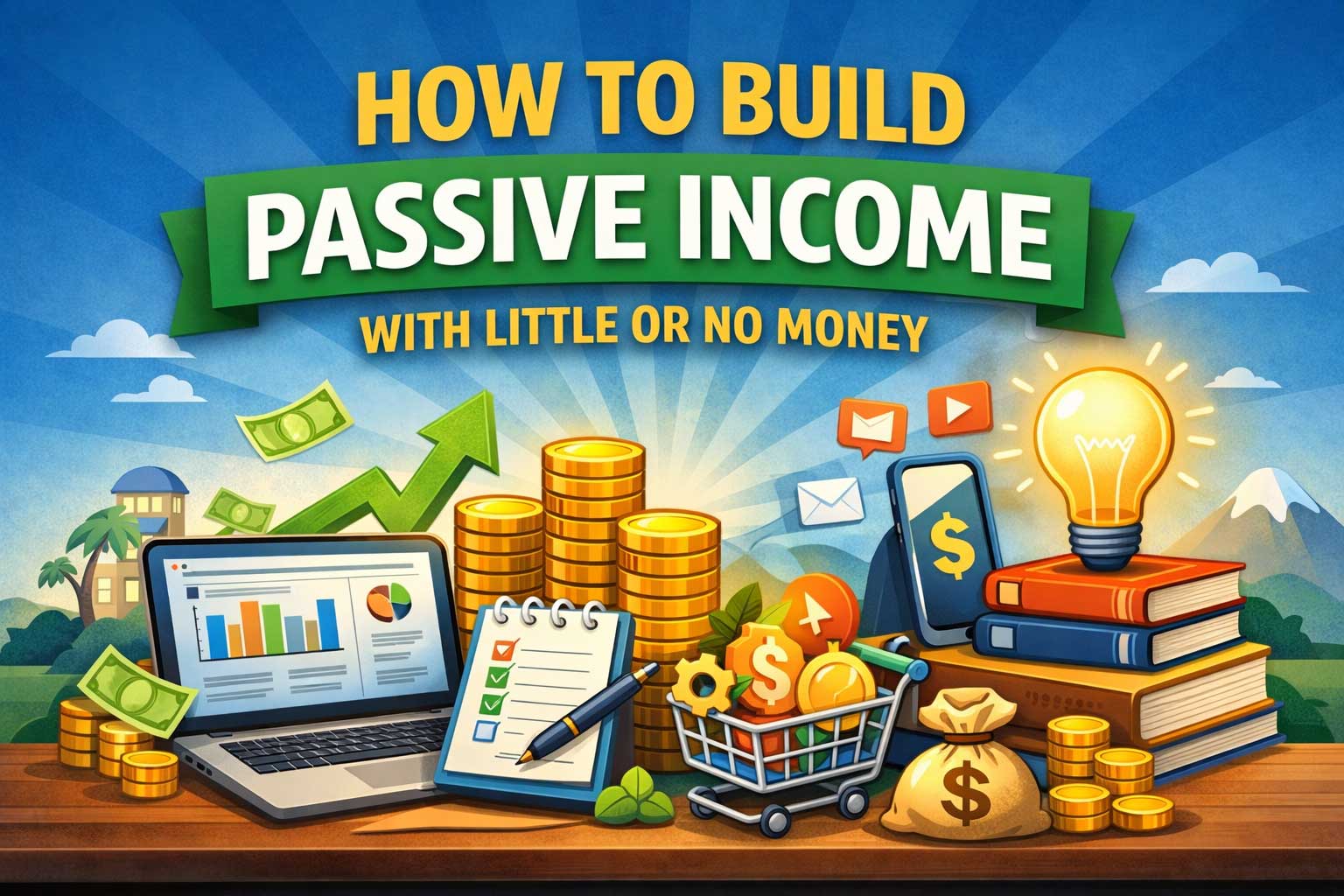
Passive income is often sold as a fantasy: press a button, wake up rich, repeat forever. Real passive income is different. It usually requires work upfront, then becomes easier to maintain later. The goal isn’t “zero effort.” The goal is less effort per dollar over time.
If you’re starting with little or no money, that doesn’t mean you can’t build passive income. It means your main starting resource is time, attention, skill, and consistency. You’ll “pay” with effort first, then gradually convert that effort into assets that earn without you showing up every hour.
This guide gives you a realistic roadmap, including:
- What passive income actually is (and what it isn’t)
- The best low-cost passive income models that work in the real world
- A framework to choose the right path for your situation
- Free or near-free tools and systems to run everything
- A step-by-step 90-day plan you can follow
- Common mistakes and how to avoid them
- FAQs to help you stay on track
What Passive Income Really Means (So You Don’t Waste Time)
Passive income is a spectrum
Most “passive” income streams sit somewhere between:
- Active income: You work → you get paid once (job, freelancing)
- Leverage income: You build once → it earns repeatedly (assets)
- True passive income: Money earns money (requires capital)
If you have little money, you’ll rely on leverage, not capital.
The “Asset” rule
To build passive income without money, you need to create at least one asset:
- A content library (articles, videos, email newsletter)
- A digital product (template, guide, course, prompts, spreadsheet)
- A distribution channel (audience you can reach repeatedly)
- A system (automation + repeatable process)
- A tool (simple app, calculator, plugin, script)
- A licensing item (photos, music, designs, code snippets)
Think of an asset like a small employee: you work once, it keeps working.
The 4 truths people avoid
- Upfront effort is unavoidable.
- Time-to-income is not instant.
- Consistency beats intensity.
- Distribution is everything. You can build something amazing and still earn nothing if nobody sees it.
The Best Mindset for Passive Income When You’re Broke
If you start with no money, the biggest danger is choosing an idea that needs money to get traction. The second biggest danger is choosing something that’s too complicated and quitting.
Use this mindset:
1) Build “unsexy” streams first
The fastest low-cost path is usually:
- Skill → service → product → passive
Example:
- You learn a skill (writing, design, spreadsheet templates)
- You do small paid work (even low fees)
- You package what you learned into a product
- The product sells repeatedly
It’s not glamorous, but it works.
2) Pick “low friction” offers
A low-friction offer is:
- Easy to create
- Easy to deliver
- Easy to understand
- Easy to sell
Examples:
- Resume templates
- Budget spreadsheets
- Notion dashboards
- Short guides
- Checklists
- Prompt packs
- Stock design bundles
3) Use the “one channel, one niche” rule
Don’t spread across five platforms. Pick:
- One niche (one clear audience)
- One channel (one place to publish)
- One offer (one monetization method)
You can expand later. Early focus is your unfair advantage.
A Simple Framework to Choose the Right Passive Income Path
Use the S.A.F.E. framework:
S — Skills you can learn quickly
Pick skills with fast learning curves:
- Writing (SEO, newsletters, scripts)
- Design (simple templates, thumbnails, brand kits)
- Video editing (short form repurposing)
- Spreadsheet building (budgets, trackers, calculators)
- Basic no-code building (forms, automations)
- Simple coding (micro-tools, scripts)
A — Audience you can reach
Ask:
- Can you speak to a specific group?
- Do you understand their pain?
- Can you consistently publish helpful content?
If yes, content-based streams work great.
F — Friction level
Low friction means:
- No inventory
- No upfront spend
- No complex logistics
- No approvals or gatekeepers
E — Earn model clarity
A good model has clear math:
- “If I publish X pieces, I can sell Y units.”
- “If I get Z views, I can earn A.”
If you can’t explain the math, it’s easier to quit.
The 7 Most Realistic Passive Income Models with Little or No Money
Below are models that don’t require cash to start. Some require time, some require skill, and all require consistency.
1) Content → Affiliate Income (Zero Cost to Start)
Best for: people who can teach, review, compare, or explain
Time to first income: usually weeks to months
Reality check: you need views, trust, and patience
How it works
You create helpful content around problems people already have:
- “How to choose X”
- “Best X for Y”
- “X vs Y”
- “Mistakes beginners make with X”
- “Checklist for X”
- “Step-by-step setup for X”
Then you recommend tools or products that genuinely help.
What makes it work with no money
Your “investment” is:
- writing or filming
- learning what people search for
- building a library of content
Key success principles
- Choose a niche where people buy things (not just browse)
- Write with intent: solve a problem completely
- Build trust: be honest about who it’s for and who it’s not for
- Focus on evergreen content that stays relevant
Practical niche examples
- Budgeting and money habits
- Productivity and organization
- Career and resumes
- Fitness routines at home
- Language learning
- Study systems
- Small business tools
- Content creation workflows
A no-money action plan
- Pick 20 problem-based topics
- Publish 2 per week for 10 weeks
- Add simple calls-to-action: “If you want the tools I use…”
- Collect emails (free lead magnet)
- Improve your top 5 posts monthly
The big lesson: affiliate income isn’t passive at first. But once you have a library of helpful pages or videos, it becomes more passive over time.
2) Digital Products (Templates, Guides, Packs)
Best for: organized people, creators, and problem-solvers
Time to first income: days to weeks
Reality check: your product must save time or reduce stress
Digital products are one of the best “no money” passive income methods because:
- No shipping
- No inventory
- No customer service nightmare (if done right)
- Easy to improve and re-sell
What sells best for beginners
Start with simple, specific products:
- Budget templates (monthly budget, debt payoff tracker)
- Meal planning templates
- Habit trackers
- Client onboarding packs (for freelancers)
- Social media content calendars
- Resume and cover letter templates
- Interview prep kits
- Study planners
- Small business invoice/quote templates
- Notion dashboards or spreadsheet systems
The “painkiller” rule
A product sells when it’s a painkiller, not a vitamin.
Painkiller examples:
- “Debt payoff tracker that shows your payoff date instantly”
- “Job interview answer bank for 30 common questions”
- “Freelancer contract + invoice + onboarding system in one pack”
Vitamin examples:
- “Cute planner aesthetic pack” (harder to sell unless you already have an audience)
How to create your first product with no money
- Choose a problem you’ve experienced
- Build the simplest solution (version 1)
- Add clear instructions (so refunds drop)
- Create 5 example use cases
- Price modestly and improve based on feedback
The big advantage
Digital products can become semi-passive because:
- You make it once
- You sell it repeatedly
- You automate delivery
3) Print-on-Demand Designs (Low Cost, Low Risk)
Best for: people who can design or create simple text-based slogans
Time to first income: weeks to months
Reality check: competition is high; uniqueness matters
Print-on-demand lets you sell designs on products (shirts, mugs, posters) without buying inventory. You earn a margin per sale.
What works without spending money
To avoid paid ads, you need:
- niche designs for specific audiences
- organic distribution (content, social, communities)
- consistent uploading
Beginner-friendly strategy
- Avoid generic designs (too competitive)
- Focus on micro-niches:
- specific careers
- hobbies
- local culture humor
- niche sports
- inside jokes that a group instantly “gets”
A realistic approach
- Upload consistently for 60–90 days
- Track what gets views
- Double down on the top 10%
It’s not instant, but once designs rank and get discovered, it can become more passive.
4) Self-Publishing (Low Cost Royalties)
Best for: writers, educators, niche experts
Time to first income: weeks to months
Reality check: quality + niche specificity wins
You don’t need to write a 300-page book. Many successful self-publishing products are:
- short, practical guides
- workbooks
- journals
- checklists
- niche reference manuals
The “micro-book” strategy
Write a focused guide like:
- “30-day meal prep plan for busy parents”
- “Interview answers for entry-level IT roles”
- “Beginner personal finance workbook”
- “Daily English speaking practice prompts”
Make it specific, actionable, and structured.
Why it can be passive
A book can sell while you sleep once:
- the listing is optimized
- reviews accumulate
- the content continues to solve a problem
5) YouTube or Short-Form Video → Long-Term Ad and Product Income
Best for: people willing to be consistent and learn content packaging
Time to first income: months
Reality check: consistency and clarity beat fancy gear
You don’t need expensive equipment. You need:
- clear audio
- useful content
- strong titles and hooks
- repetition
Best content types for beginners
- Tutorials
- Mistake lists
- Step-by-step guides
- Product comparisons (honest, helpful)
- Case studies (“I tried X for 30 days”)
- Personal finance explainers
- Career improvement strategies
How passive income comes later
Videos can keep earning for months or years if they target evergreen topics.
6) Sell a “Tiny Tool” (Micro-Utility That Solves One Problem)
Best for: builders, spreadsheet lovers, simple coders, no-code creators
Time to first income: weeks to months
Reality check: simple tools win more often than complex apps
A “tiny tool” could be:
- a calculator
- a checklist generator
- a template builder
- a planning tool
- a tracker
- a small automation
- a simple dashboard
Examples (money niche)
- Debt payoff calculator + printable plan
- Savings goal planner
- Budget category recommender
- Subscription audit tracker
- Emergency fund timeline planner
How to monetize without money
- Offer free basic version
- Sell premium template pack
- Sell advanced features
- Bundle with coaching or community later
This can become very passive once it’s stable.
7) Licensing and Royalties (Photos, Music, Graphics, Code)
Best for: creatives who can produce many assets
Time to first income: months
Reality check: volume and consistency matter
This is a “portfolio” approach:
- you publish many assets
- each one earns small amounts
- combined, they can become meaningful
The key is building a pipeline:
- create → upload → repeat
- track what sells → create more of it
The Skill-to-Passive Ladder (Best Strategy When You Have No Money)
If you’re starting from zero, here’s the most reliable path:
Step 1: Learn one monetizable skill (2–4 weeks)
Pick one:
- writing (SEO, newsletters)
- design templates (Canva-style)
- spreadsheets (budgets, trackers)
- video editing
- basic web/no-code building
Step 2: Use the skill actively (2–8 weeks)
Earn your first small money through:
- freelancing
- contract gigs
- small packages
- one-off projects
This stage is not passive. It’s funding and learning.
Step 3: Turn what you did into an asset (4–12 weeks)
Convert your work into:
- a template pack
- a guide
- a toolkit
- a mini-course
- a productized service with automation
- a library of content
Step 4: Build distribution (ongoing)
Pick one channel and publish consistently:
- blog content
- YouTube videos
- short-form clips
- newsletter
Step 5: Optimize and stack streams
Once you have one stream working, add another:
- product + affiliate
- content + templates
- tool + premium features
This is how you go from “side cash” to “real passive income.”
What to Build: 12 Low/No-Money Passive Income Ideas That Actually Work
Here are practical ideas you can start with almost nothing.
1) Budget and finance templates
- Monthly budget spreadsheet
- Debt payoff tracker
- Savings goal planner
- Bill due-date calendar
- “No-spend challenge” tracker
Why it sells: money stress is constant, and organization reduces anxiety.
2) Job search kits
- Resume templates
- Cover letter frameworks
- Interview answers bank
- Networking message scripts
Why it sells: job seekers will pay for confidence and speed.
3) Notion dashboards (or spreadsheet dashboards)
- Personal finance hub
- Habit tracker
- Student planner
- Freelance client tracker
Why it sells: people want plug-and-play organization.
4) Lesson plans and study packs
- language learning prompts
- printable worksheets
- spaced repetition guides
- exam prep systems
Why it sells: education is evergreen.
5) Content repurposing packs for creators
- caption templates
- hook libraries
- content calendar
- script frameworks
Why it sells: creators are time-poor, not idea-poor.
6) Simple niche newsletters
- personal finance habits
- local deals and saving strategies
- career growth tips in a niche profession
Why it sells: trust compounds.
7) Niche “how-to” content library
Create 50–100 pieces over time. Monetize with:
- ads (later)
- affiliate offers
- products
8) Printable planners
- meal planners
- family chore charts
- cleaning schedules
- workout trackers
9) A mini course or email course
Teach one result:
- “Build a budget in 60 minutes”
- “Plan debt payoff in 30 days”
- “Land interviews with better answers”
10) Stock digital assets
- icons
- banners
- social templates
- slide decks
11) A micro-tool
- savings calculator
- budget health score quiz
- goal planner generator
12) A bundle strategy
Bundles increase value fast:
- “Budget toolkit bundle”
- “Job search bundle”
- “Creator starter bundle”
Bundles often sell better than single items because people feel they’re getting a complete solution.
The 90-Day Plan to Build Passive Income from Scratch (No Money Needed)
Here’s a realistic plan you can follow without guessing.
Days 1–7: Choose your lane and your audience
Pick one audience:
- beginners in personal finance
- students
- job seekers
- new freelancers
- small business owners
- busy parents
- creators
Pick one monetization method:
- digital product
- affiliate + content
- tiny tool + product
- licensing/royalties
Pick one channel:
- blog
- short videos
- YouTube
- newsletter
Rule: one channel, one niche, one offer.
Days 8–21: Build your first asset (version 1)
Your first asset should be simple:
- a template
- a tracker
- a checklist
- a short guide
Make it usable, not perfect.
Minimum requirements:
- Clear title (what result it provides)
- Simple instructions
- Example filled-out version
- Common mistakes section
- FAQ section inside the product
Days 22–45: Publish content that sells your asset indirectly
Create content that naturally leads to your product:
- “How to do X step-by-step”
- “Mistakes to avoid when doing X”
- “A simple system for X”
- “Checklist for X”
Your content should solve the problem even without the product, but the product should make it faster and easier.
Target output in this phase:
- 10–15 content pieces (blog posts or videos)
- 1 lead magnet (free mini template or checklist)
- 1 simple email sequence (welcome + value + offer)
Days 46–75: Improve conversion and expand your product
Now you optimize.
Upgrade your product by adding:
- better formatting
- extra examples
- additional templates
- a quick-start guide
- troubleshooting tips
Then build:
- Product #2 (a companion)
- Or a bundle (Product #1 + #2 together)
Days 76–90: Scale distribution and stack income
Choose one:
- Double your content output
- Repurpose content into multiple formats
- Create a second channel only if the first is stable
- Add an affiliate layer if your niche supports it
By day 90, you should have:
- 1–2 products
- 20+ pieces of content
- a basic funnel (freebie → email → offer)
- a clear routine you can maintain
That’s a real foundation.
How to Market Without Money (The Distribution System)
You don’t need ads. You need consistency and smart structure.
The “Content Flywheel”
- Create one core piece (article or video)
- Turn it into:
- short clips
- a checklist
- an email
- a carousel-style post (conceptually)
- Publish across your chosen channel(s)
- Point people to your lead magnet
- Sell your product via email and content
The trust formula
Trust is built when:
- your advice works
- you explain clearly
- you show examples
- you admit tradeoffs
- you stay consistent
If people trust you, passive income becomes much easier.
Common Mistakes That Keep People Broke (And How to Avoid Them)
Mistake 1: Choosing “easy money” over “real assets”
If it sounds effortless and fast, it’s usually:
- unstable
- saturated
- or risky
Choose boring, proven models.
Mistake 2: Building without distribution
A great product with no audience is a hidden product.
Fix:
- publish consistently while building
- start collecting emails early
Mistake 3: Trying to be too broad
“Personal finance” is huge.
“Budgeting for young adults paid biweekly” is specific.
Specific wins early.
Mistake 4: Overbuilding instead of shipping
Version 1 should be useful, not perfect.
Perfection delays feedback. Feedback creates sales.
Mistake 5: Quitting before compounding starts
Passive income often feels like nothing is happening… until it suddenly does.
Stay long enough for the content library and product reviews to compound.
How to Make Passive Income Feel More Passive Over Time
If you don’t design your income stream well, it becomes a second job. The goal is to reduce your required effort.
Add automation and boundaries
- Use pre-written replies for common questions
- Use simple onboarding instructions
- Use a “start here” page inside your product
- Keep your offer straightforward
Focus on evergreen assets
Evergreen topics:
- budgeting systems
- saving strategies
- debt payoff plans
- productivity routines
- job interview prep
- resume formatting
Trendy topics can spike but fade.
Improve your top winners, ignore the rest
The 80/20 rule is real:
- 20% of your content will drive 80% of results
- 20% of your products will drive most revenue
Update winners. Don’t waste time polishing losers.
Practical Examples of Passive Income Paths (So You Can Copy the Structure)
Example A: Personal finance template seller
- Niche: beginners who struggle to save
- Channel: blog or short videos
- Product: “Monthly budget + savings goal tracker”
- Lead magnet: “Free 7-day saving challenge tracker”
- Upsell: “Debt payoff bundle”
- Passive layer: affiliate tools used for budgeting (optional)
Example B: Career job kit creator
- Niche: entry-level job seekers
- Channel: short videos
- Product: resume + cover letter + interview answers pack
- Lead magnet: free resume checklist
- Passive layer: a mini email course “7 days to better interviews”
Example C: Tiny tool + template bundle
- Niche: freelancers
- Tool: rate calculator
- Product: invoice + proposal + onboarding templates
- Lead magnet: “pricing checklist”
- Passive layer: educational content around pricing and clients
The pattern is always:
problem → free value → simple asset → repeated sales
A Reality-Based Passive Income Checklist
Use this checklist before you commit to any idea:
Idea validation (no money required)
- Can I describe the audience in one sentence?
- Can I name their top 3 pains?
- Can I create a simple solution in 7–14 days?
- Can I create 20 content topics that lead to it?
- Can I explain how it earns money in one paragraph?
Product validation
- Does this save time, reduce stress, or increase results?
- Is it easy to use without my help?
- Does it include examples and instructions?
- Can I bundle it with another product later?
Distribution validation
- Can I publish 2 times per week for 90 days?
- Do I enjoy the topic enough to stay consistent?
- Can I improve one piece of content weekly?
If you can say “yes” to most of these, you’re in a good spot.
FAQs: Building Passive Income with Little or No Money
Is passive income possible with zero money?
Yes, but it usually starts as active effort that creates assets (content, products, tools). If you have no money, you “invest” time and skill first, then compound results over months.
What’s the fastest passive income method without money?
Often:
- digital templates
- simple guides
- content + affiliate
Speed depends on how quickly you can create something useful and get it in front of people.
How long does it take to make real money?
If you’re consistent:
- Some people earn small amounts in weeks (usually from digital products)
- More stable passive income often takes months
- Bigger compounding results usually take 6–12 months of consistent output
Do I need an audience first?
Not always. You can build an audience while building the product by publishing content. But having an audience helps a lot. That’s why content and email lists are so powerful.
What should I avoid?
Avoid anything that:
- promises guaranteed fast results
- requires you to recruit people as the main business model
- depends on paid ads before you’re profitable
- is confusing to explain in simple terms
What if I’m not good at writing or design?
Choose a skill that fits you:
- spreadsheets
- organizing systems
- researching and summarizing
- speaking on video
- building simple tools
You can also improve quickly with consistent practice.
Conclusion: The Real Way to Build Passive Income When You’re Starting From Zero
Building passive income with little or no money isn’t about finding a magic trick. It’s about turning effort into assets and letting those assets compound.
Here’s the simplest path to remember:
- Pick one niche and one channel
- Solve one painful problem
- Create one simple asset (template, guide, tool)
- Publish consistently to distribute it
- Improve what works and bundle to scale
If you do that for 90 days, you won’t just have “an idea.” You’ll have a real system—one that can grow into multiple income streams over time.