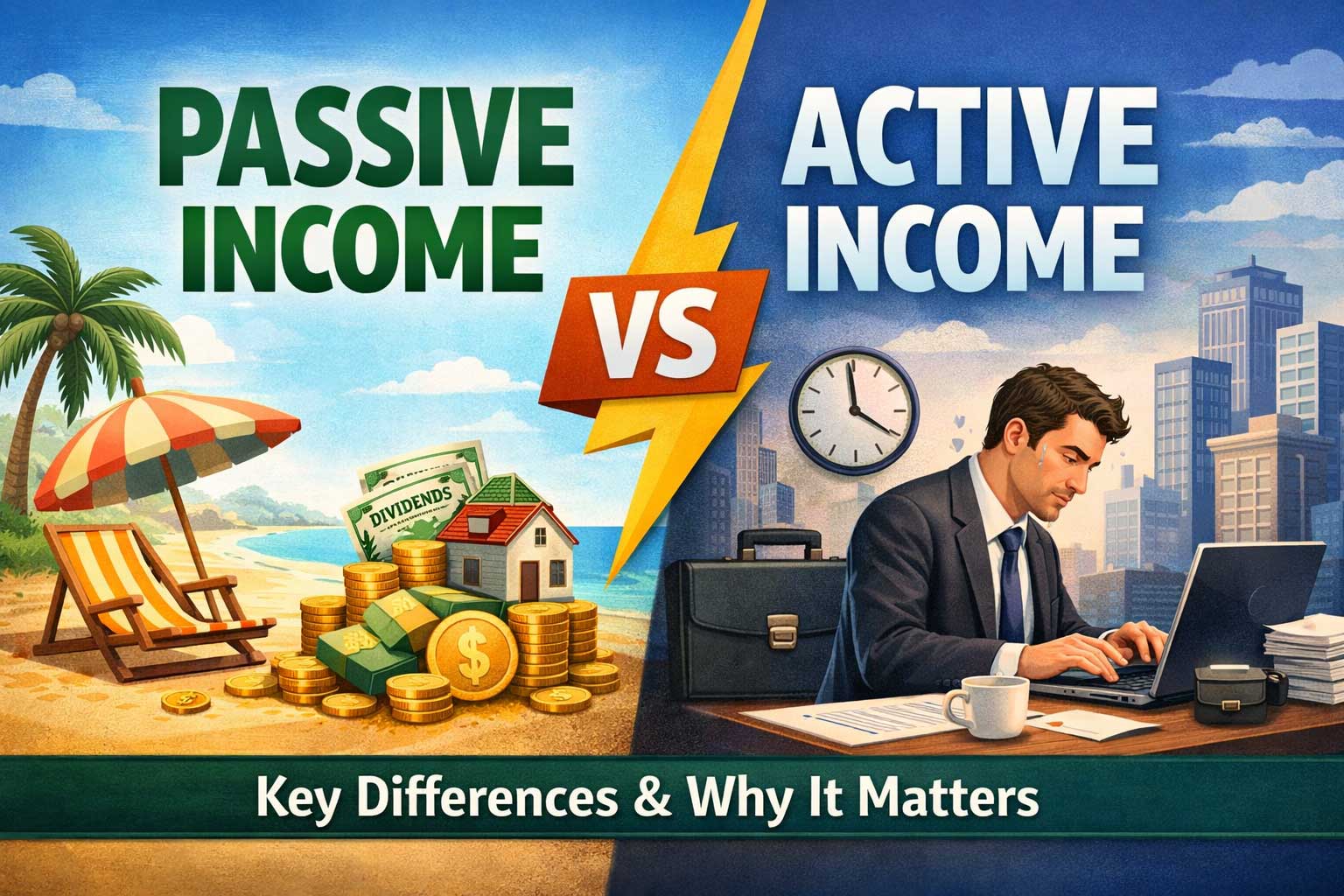
Most people grow up learning one primary rule about earning: work first, get paid later. That rule isn’t wrong—active income is the backbone of most households, businesses, and entire economies. But it’s incomplete. There’s another rule that becomes increasingly important as you aim for stability, wealth, and freedom: build systems and assets that keep paying you even when you’re not working.
That second rule is the heart of passive income—and it’s why the difference between passive and active income is more than a finance buzzword. It can shape how you choose a career, how you invest, how you spend your time, and how resilient you are when life throws surprises.
Still, this topic is often misunderstood. “Passive” is frequently marketed as “easy,” “instant,” or “risk-free.” In reality, most passive income takes one of two forms:
- Money working (investments that generate returns), or
- Past work working (systems, assets, or rights that keep producing value).
Meanwhile, active income is the more familiar engine: you trade time, skill, or effort for pay—whether as an employee, freelancer, or business owner actively operating day-to-day.
This guide will break down the key differences between passive income and active income, explain why the distinction matters, and show you how to build a balanced plan that fits your goals, personality, and risk tolerance. You’ll leave with practical frameworks—not hype.
What Is Active Income?
Active income is money you earn by performing work that requires your ongoing time, attention, or direct effort. If you stop working, the income typically stops too.
Common examples of active income
- Salaries and wages (hourly or monthly pay)
- Overtime pay
- Commissions tied to current sales activity
- Freelancing fees for projects
- Consulting retainers that require ongoing delivery
- Service businesses (cleaning, repairs, agency services)
- Running a shop or restaurant where you manage operations
- Gig work and delivery driving
- Performance-based income tied to your current output
Why active income is powerful
Active income has strengths that people often overlook:
- Fastest path to cash flow: You can usually start earning active income immediately.
- Skill-to-income leverage: Improve your skills and you often increase your pay.
- Predictability (sometimes): A stable job can be consistent and budget-friendly.
- Low complexity: “Work → get paid” is straightforward compared to building assets.
The main limitation
Active income is often constrained by:
- Time (limited hours in the day)
- Energy and health (burnout and life events matter)
- Demand (clients, customers, or employers can change)
- Location and availability (many roles require presence or fixed schedules)
Even high earners can feel trapped if their income depends on continuous work. That’s where passive income becomes an important complement.
What Is Passive Income?
Passive income is money you earn with minimal ongoing effort relative to the income produced, often after an upfront investment of time, money, or both.
A practical definition is:
Passive income is income that continues even when your direct work input is reduced, because it’s produced by assets, systems, or rights you built or purchased earlier.
Common examples of passive income
- Dividends from stocks (where available)
- Interest from bonds or savings products
- Rental income from property (though it’s often semi-passive)
- Royalties from books, music, photography, patents, licensing
- Income from digital products (templates, courses, software) after launch
- Affiliate income from content that keeps receiving traffic (often semi-passive)
- Profit shares or equity distributions from businesses you don’t operate daily
- Automated businesses with strong systems and hired operators
The truth: most “passive” income is semi-passive
Many passive income streams still require:
- maintenance,
- customer support,
- updates,
- marketing,
- compliance and taxes,
- troubleshooting.
The better way to think is:
- Active income: you are the engine.
- Passive income: you build or buy the engine.
Some passive engines run smoothly with minimal work. Others require periodic tuning. The goal is not zero effort—it’s less dependence on your daily labor.
Passive vs Active Income: The Core Differences
Below are the most important differences that actually affect your life and long-term wealth.
1) Time dependence: “Paid for hours” vs “Paid for ownership”
- Active income is usually paid for time, presence, or output today.
- Passive income is paid for ownership, systems, or value created in the past.
Why it matters:
If your income is fully time-dependent, your earnings are vulnerable to interruptions: illness, family emergencies, layoffs, burnout, or economic downturns.
Passive income can act like a second leg under your financial table. It doesn’t replace active income immediately, but it increases stability over time.
2) Scalability: linear growth vs compounding potential
- Active income often scales linearly. Earn more by working more or charging more.
- Passive income can scale nonlinearly. One asset can serve many people.
A freelancer might earn more by raising rates or adding clients—both require ongoing work. A digital product might take weeks to create but could sell thousands of times with relatively small ongoing effort.
Why it matters:
Scalable income streams can change your ceiling. Active income often has a ceiling tied to your capacity; passive income can raise that ceiling by decoupling earnings from hours.
3) Upfront cost: immediate pay vs delayed payoff
- Active income usually pays quickly.
- Passive income often requires upfront investment (money, time, or risk) before results appear.
Why it matters:
Many people quit too early on passive income because it doesn’t pay fast. The timeline mismatch is the most common reason passive income plans fail: people treat it like a paycheck instead of an asset-building project.
4) Risk profile: job risk vs asset risk
- Active income risks include job loss, client churn, skills becoming outdated, or industry shifts.
- Passive income risks include market volatility, platform changes, tenant issues, maintenance costs, regulatory changes, and poor investment choices.
Why it matters:
Passive income is not automatically safer. It’s safer when it’s diversified and built on strong fundamentals. A single rental property in a weak market can be riskier than a stable job. A single “automated” online business dependent on one traffic source can collapse overnight.
5) Control: employer/client control vs system control
- Active income can be controlled by employers, contracts, or client demands.
- Passive income depends on the rules of the asset: leases, market conditions, platform policies, or investment returns.
Why it matters:
Passive income often increases autonomy, but it doesn’t eliminate external forces. The difference is that you can build multiple engines instead of relying on one boss or one client.
6) Lifestyle impact: fixed schedules vs flexibility
- Active income can require specific hours and availability.
- Passive income can provide flexibility, especially when it covers essentials.
Why it matters:
Flexibility is not just about vacations. It’s about having choices:
- taking care of family,
- changing careers,
- starting a business,
- learning new skills,
- relocating,
- reducing stress and burnout.
Passive income becomes meaningful when it gives you options, not just extra cash.
7) Tax treatment: often different, but depends on country and structure
In many places, active income (salary) can be taxed differently than investment income, dividends, capital gains, or rental profits. The rules vary widely.
Why it matters:
Your net income is what you keep. Two people earning the same gross amount can end up with very different take-home income depending on:
- income type,
- allowable deductions,
- business structures,
- local tax laws.
Because rules differ, treat this as a planning factor and consult local professionals for specifics.
A Simple Comparison Table
| Category | Active Income | Passive Income |
|---|---|---|
| Main driver | Time and effort today | Ownership, systems, or assets |
| If you stop working | Usually stops quickly | Often continues (may reduce) |
| Speed to start earning | Fast | Often slow at first |
| Scalability | Often limited by hours | Can scale with systems/assets |
| Risk type | Employment/client risk | Market/asset/platform risk |
| Predictability | Often stable (job-based) | Can be variable (market-based) |
| Best use | Paying bills now | Building long-term freedom |
The Most Important Reason This Difference Matters
It matters because active income builds your present, while passive income helps protect your future.
Active income is how you:
- pay rent or mortgage,
- buy groceries,
- support your family,
- invest and build savings,
- fund business ideas.
Passive income is how you:
- reduce reliance on your job,
- create resilience in tough times,
- accelerate wealth building,
- buy back time.
A strong financial life usually includes both. The goal for most people is not “quit your job tomorrow.” The goal is to gradually shift from 100% active dependence to a balanced income mix where passive income covers an increasing share of your needs.
The Passive Income Myth: “Make Money While You Sleep” (What It Really Means)
You can make money while you sleep. But you can’t usually make money while you sleep without doing anything while you’re awake.
A more accurate phrase is:
Build assets that keep producing value without requiring your constant presence.
Passive income often requires one or more of these upfront investments:
- Capital (money invested)
- Creation (time spent building an asset)
- Credibility (trust built with an audience or clients)
- Code/System (automation and process design)
And it often requires ongoing “light work”:
- updating a product,
- responding to customer issues,
- maintaining a property,
- adjusting investments.
Passive does not mean effortless. It means less time-dependent once the system is built.
Types of Active Income (And How to Strengthen Them)
Before chasing passive income, it’s smart to build a stable active income base. Here are major active income categories and how to increase them.
1) Employment income
You trade your labor and skills for a consistent paycheck.
How to improve it:
- Build rare, valuable skills (technical, sales, leadership)
- Learn negotiation and performance documentation
- Switch roles or companies strategically
- Add certifications only when they truly raise market value
- Track measurable wins (revenue, savings, efficiency)
2) Self-employment and freelancing
You trade skills for client fees.
How to improve it:
- Specialize in a high-value niche
- Productize services into clear packages
- Raise rates based on outcomes, not hours
- Build a referral pipeline
- Create systems to deliver faster and better
3) Business owner-operator income
You manage a business that depends on your involvement.
How to improve it:
- Standardize processes
- Train employees or contractors
- Track profitability per product/service line
- Reduce dependency on you by building a management layer
- Build repeatable marketing channels
This category can evolve into semi-passive if you build a business that runs with a team and strong systems.
Types of Passive Income (From Most Passive to Least Passive)
Let’s rank common passive income streams by how “hands-off” they can be (though personal results vary widely).
A) More passive (typically)
1) Broad-market investing
- Index funds or diversified portfolios (where available)
- Long-term investing for growth and dividends
Why it’s passive:
Once set up, investing can be automated with recurring contributions and periodic rebalancing.
Key realities:
- Returns fluctuate
- Requires long timeline
- Best built consistently over years
2) Interest-bearing instruments
- Savings products, bonds, money-market-like instruments (depending on country)
Why it’s passive:
Low maintenance once purchased.
Key realities:
- Returns may not beat inflation
- Rate risk and currency risk can matter
B) Semi-passive (common and realistic)
3) Rental properties
Why it’s semi-passive:
Even with property management, you handle decisions, repairs, vacancies, and legal compliance.
Key realities:
- Can be strong cash flow if purchased well
- High upfront capital
- Market and tenant risks
4) Digital products
- Templates, paid downloads, courses, premium tools
- Software subscriptions
Why it’s semi-passive:
After launch, income can continue, but marketing, updates, and support often remain.
Key realities:
- Upfront effort can be huge
- Requires audience or marketing skill
- Can scale extremely well once proven
5) Royalties and licensing
- Books, music, designs, photos, patents, brand licensing
Why it’s semi-passive:
You create once, earn repeatedly—if distribution and demand exist.
Key realities:
- Not guaranteed
- Often requires portfolio volume
- Income can be uneven
C) Often misunderstood “passive” (actually active unless automated deeply)
6) Content monetization
- Ads, sponsorships, affiliate earnings from blogs or channels
Why it’s often active:
Content requires ongoing creation and distribution to maintain growth. Some older content can earn passively, but most creators keep producing.
Key realities:
- Platform risk is real
- Traffic can be volatile
- Best treated as building a media asset over time
7) “Automated” e-commerce or dropshipping
Why it’s usually active:
Customer support, refunds, supplier issues, ads, and operations can be constant.
Key realities:
- Can become semi-passive with a team
- Often stressful in early stages
Why Passive vs Active Income Matters for Your Financial Plan
This difference impacts almost every major money decision.
1) Emergency resilience
If you lose a job and have:
- 0 passive income, you rely entirely on savings and quick re-employment.
- some passive income, your runway lengthens.
- enough passive income to cover essentials, you can job-search calmly and strategically.
Even small passive streams reduce financial panic.
2) Retirement planning (and “mini-retirements”)
Traditional retirement assumes:
- work hard for decades,
- retire later.
A passive-income-aware plan introduces another option:
- build assets gradually,
- reduce work intensity earlier,
- take breaks without financial collapse.
You don’t need to fully retire to benefit. Many people want:
- fewer hours,
- more flexibility,
- the ability to say no.
Passive income helps you negotiate with life.
3) Wealth building and compounding
Compounding is easier when you consistently invest surplus income. Active income creates the surplus; passive income can amplify it.
A powerful cycle looks like this:
- Earn active income
- Control spending
- Invest surplus into assets
- Assets generate passive income
- Passive income gets reinvested
- Compounding accelerates
The reason this matters is that wealth often grows slowly, then quickly. Passive income is frequently the mechanism behind that acceleration.
4) Career choices and bargaining power
When you’re dependent on one paycheck, you may tolerate:
- bad management,
- poor culture,
- low growth,
- stress.
When you have even a small passive base, you gain leverage:
- negotiate a raise,
- change industries,
- start a business,
- go back to school,
- relocate.
Passive income isn’t just money; it’s power to choose.
The “Spectrum” Model: Income Is Rarely 100% Passive or 100% Active
Instead of two boxes, think of a spectrum:
- Fully active: hourly work, gig jobs
- Mostly active: consulting, freelance projects
- Hybrid: agency owner with a team, subscription services with support
- Mostly passive: diversified investments, royalties
- Nearly passive: some long-term investments with minimal management
Most real-world incomes combine multiple points on the spectrum. The practical goal is to shift over time toward more resilient, less time-dependent streams—without falling for unrealistic promises.
The Hidden Trade-Off: Cash Flow Today vs Freedom Tomorrow
This is the real decision underneath passive vs active income.
- If you focus only on active income, you may have strong cash flow but limited freedom.
- If you focus only on passive income too early, you may struggle with cash flow and quit.
The winning strategy for most people is sequencing:
- Stabilize active income and expenses
- Build emergency savings
- Invest and build passive foundations
- Add scalable semi-passive projects
- Diversify so no single stream controls your life
A Practical Framework: The Income Mix Formula
A useful target is to plan income like a portfolio:
Step 1: Start with stability
Aim to cover essential expenses with your most reliable source (often active income).
Essentials include:
- housing
- utilities
- food
- basic transportation
- minimum debt payments
- basic healthcare
Step 2: Build a passive “floor”
Your passive floor is the amount your assets produce reliably.
At first it might be:
- a small amount of dividends/interest,
- a tiny digital product income,
- a modest royalty stream.
The first goal is not “financial freedom.” It’s financial traction.
Step 3: Build a growth engine
Choose one scalable path based on your strengths:
- investing consistently (steady and long-term),
- building a product (high effort upfront, scalable),
- real estate (capital intensive, potentially strong cash flow),
- a systemized business (requires leadership and process).
Step 4: Diversify once you have proof
Once you have one working engine, diversify so you’re not dependent on:
- one tenant,
- one platform,
- one product,
- one employer.
Diversification is what turns income into stability.
Passive Income vs Active Income in Real Life: Scenarios
Scenario 1: The high-income professional with no passive income
- Strong salary, lifestyle grows with salary
- Little investing, low savings rate
- High dependence on job
Risk: a layoff or burnout causes a financial shock.
Solution: increase savings rate, automate investing, build passive floor.
Scenario 2: The freelancer with unstable cash flow
- High earning months and low earning months
- Income tied to finding clients and delivering work
- Time pressure is constant
Risk: client churn and fatigue.
Solution: productize services, create retainers, build a small digital product, invest consistently.
Scenario 3: The “passive income chaser” with no active base
- Jumps between side hustles
- Doesn’t build skills deeply
- Quits projects quickly
Risk: financial stress makes them abandon the process.
Solution: stabilize active income, choose one passive strategy, commit long enough to validate it.
Scenario 4: The balanced builder
- Stable job or reliable business
- Regular investing
- One semi-passive project growing slowly
Outcome: steady progress without desperation.
This is what passive success often looks like: boring, consistent, and powerful over time.
How to Transition from Active Income to More Passive Income (Step-by-Step)
You don’t need a dramatic leap. You need a system.
Step 1: Know your numbers
You should be able to answer:
- How much do I spend each month (essentials vs lifestyle)?
- How much do I save or invest?
- How many months of emergency savings do I have?
- What is my current passive income (even if small)?
Clarity creates control.
Step 2: Build a margin (the “wealth gap”)
Passive income requires investment. Investment requires margin.
Margin can come from:
- reducing expenses,
- increasing active income,
- both.
If you have no margin, passive income becomes fragile because you’ll be forced to sell assets or quit projects early.
Step 3: Choose one passive path that fits you
Pick based on your constraints:
If you have little money but time and skill:
- build a product, build content as a long-term asset, build a systemized service.
If you have money but limited time:
- automated investing, diversified portfolios, possibly real estate with management.
If you have both time and money:
- combine investing with a scalable semi-passive asset.
If you have neither right now:
- focus on increasing active income first. That is not failure; it is strategy.
Step 4: Commit to a realistic timeline
A practical expectation:
- Investing-based passive income: meaningful results often take years.
- Product/content-based income: often 6–24 months to build traction.
- Real estate: can produce sooner if purchased well, but requires capital and management.
- Systemized business: typically years to build and stabilize.
The timeline isn’t meant to discourage you—it’s meant to prevent quitting early.
Step 5: Automate what you can
Automation reduces the “active” component:
- automatic investment contributions,
- scheduled content publishing,
- customer support templates,
- hiring freelancers for repeat tasks,
- property management systems,
- documented processes.
If your passive income stream requires constant firefighting, it’s not passive enough yet.
The “Passive Income Quality” Checklist
Before you call something passive, test it:
- Does it earn without daily input?
- Is it diversified or dependent on one source?
- Is the income stable or volatile?
- Does it require support, updates, or maintenance?
- Can it be automated or delegated?
- What is the worst-case scenario and can you survive it?
- Is it legal, sustainable, and ethically solid long-term?
High-quality passive income is not just profitable; it’s durable.
Mistakes People Make When Comparing Passive vs Active Income
Mistake 1: Treating passive income like a paycheck
Passive income behaves like an asset. It grows slowly, then more noticeably.
Mistake 2: Choosing the “cool” strategy instead of the right one
Some people choose real estate because it’s popular, but they hate maintenance and tenant issues. Others build content but dislike long-term consistency.
Choose what matches your strengths and constraints.
Mistake 3: Underestimating risk
Passive income can feel safer because it sounds automated. But market risk is real. Platform risk is real. Tenant risk is real. Build with risk management, not optimism.
Mistake 4: Not reinvesting early profits
Many passive streams become meaningful only when you reinvest:
- reinvest dividends,
- reinvest product profits into marketing,
- reinvest rental profits into reserves and improvements.
Early reinvestment can be the difference between a hobby and a durable engine.
Mistake 5: Overcomplicating too soon
A simple plan executed for years beats a complex plan abandoned in months.
How to Decide What Matters Most to You
Ask yourself:
1) Do you want money now or freedom later?
Most people need both, but one may be urgent.
2) What is your risk tolerance?
- If you can’t handle volatility, prioritize stable income and conservative investing.
- If you can handle uncertainty, you may pursue scalable projects.
3) Do you prefer building or buying?
- Building: products, content, businesses (time-intensive).
- Buying: investments, property (capital-intensive).
4) How much time do you have weekly?
Even 5–7 hours per week can work, but you must choose strategies that fit that reality.
5) Do you want to manage people or not?
Systemized businesses often require hiring and management. Investing usually doesn’t.
Your best plan is the one you can stick with.
A Balanced Strategy That Works for Most People
Here’s a practical “middle path” that avoids extremes:
Phase 1: Strengthen active income
- Increase skills
- Raise earning power
- Stabilize cash flow
Phase 2: Build safety
- Emergency fund (common target is multiple months of essentials)
- Insurance and basic risk coverage (as appropriate)
Phase 3: Automate investing
- Consistent contributions
- Long-term mindset
- Diversification
Phase 4: Add one semi-passive project
Pick one:
- digital product,
- licensing/royalties,
- a systemized business component,
- rental property (if it fits your capital and temperament).
Phase 5: Diversify and optimize
- Reduce dependence on one source
- Improve systems
- Reinvest intelligently
This approach keeps you financially stable while you build freedom.
Why It Matters Emotionally (Not Just Financially)
Money isn’t only math. It’s stress, confidence, and choices.
When all income is active, many people feel:
- pressure to always be available,
- fear of losing income,
- guilt when resting,
- anxiety about the future.
When passive income grows—even slowly—people often feel:
- calmer decision-making,
- greater patience,
- improved negotiation power,
- the ability to plan long-term.
Passive income matters because it can reduce financial anxiety and expand your options, which improves the quality of your life even before you reach big milestones.
Frequently Asked Questions
Is passive income better than active income?
Not inherently. Active income is usually the foundation that supports your life and funds investing. Passive income becomes powerful as a stabilizer and a freedom-builder. The best approach is often a mix.
Can passive income replace a full-time salary?
Yes, but it typically requires time, capital, or both. Many people reach partial replacement first (covering a portion of expenses) before full replacement becomes realistic.
Is rental income passive?
It can be semi-passive, especially with management help, but rentals still involve vacancies, maintenance, and legal responsibilities.
Are dividends guaranteed?
No. Companies can reduce or stop dividends, and market prices can fluctuate. Diversification and long time horizons reduce risk but don’t eliminate it.
What’s the easiest passive income to start?
For many people, the simplest is automated investing (because it’s straightforward to maintain once set up). However, “easiest” depends on your local options and financial situation.
What if I have no money to invest?
Then your first passive asset may be a skill-based system: a productized service, a digital product, or content that compounds over time. But it still helps to build active income first so you can sustain the process.
The Bottom Line: Why Passive vs Active Income Really Matters
The key difference is not a buzzword. It’s a life design principle.
- Active income pays for your present.
- Passive income helps protect your future and expands your choices.
Active income is essential. Passive income is transformative—when built patiently, ethically, and strategically.
If you want a practical takeaway, use this rule:
Don’t rush to “escape” work. Build income engines that reduce your dependence on any single source, so your money supports your life—not the other way around.
Start where you are:
- strengthen active income,
- create margin,
- invest consistently,
- build one asset that can earn without constant labor,
- and let time do what time does best: compound.