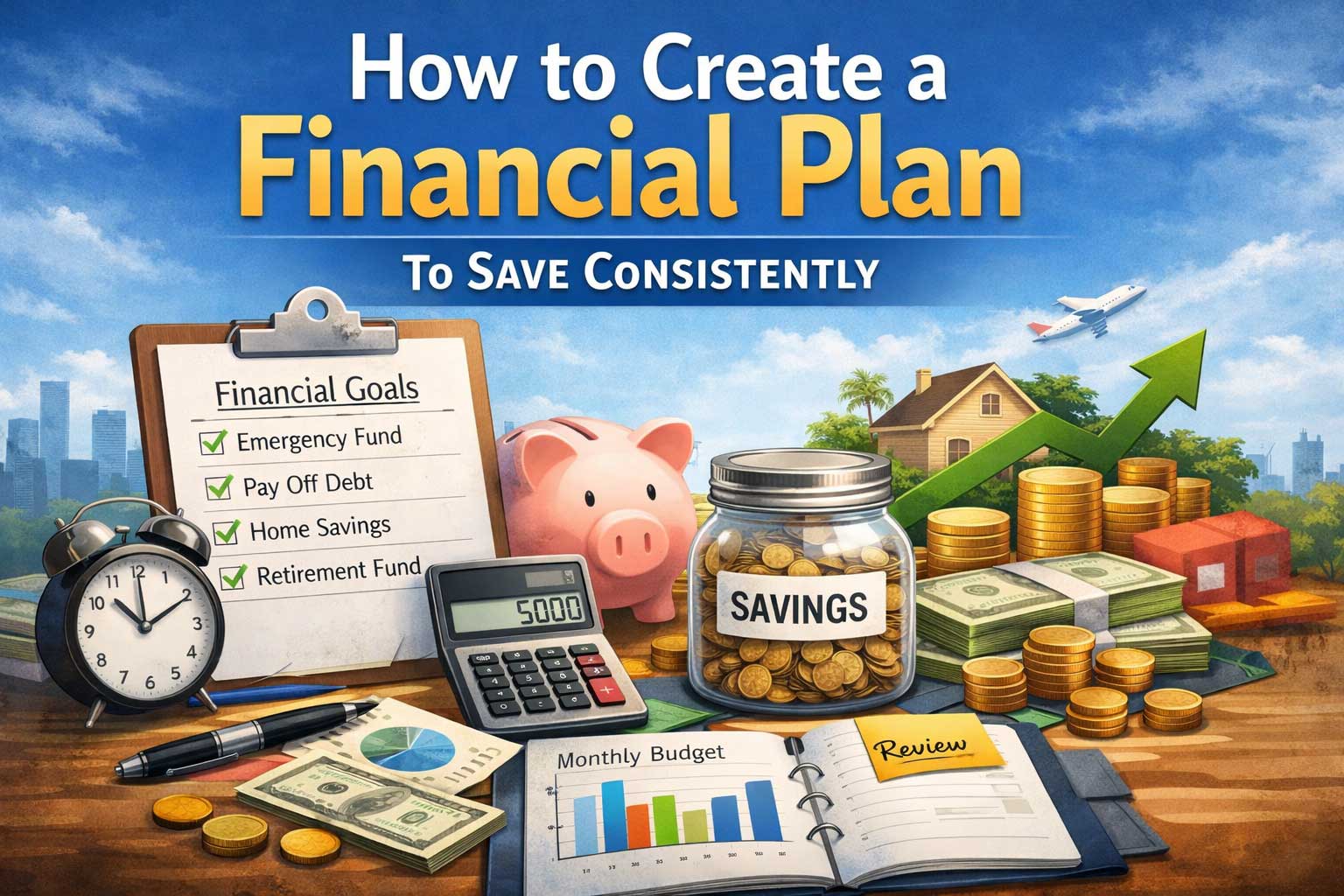
Saving consistently isn’t about having perfect willpower or earning a huge salary. It’s about building a system that makes saving the default outcome of your everyday decisions. A strong financial plan turns “I should save more” into specific steps: how much to save, where it will come from, when it will happen, and what you’ll do when life gets messy.
Most people don’t fail at saving because they’re lazy or irresponsible. They fail because their plan is vague, unrealistic, or not designed for real life. A plan that depends on motivation will break the first time you face an unexpected bill, a busy month, or a tempting purchase. A plan that depends on systems—automation, clear priorities, realistic numbers, and regular check-ins—keeps working even when your mood changes.
This guide walks you through building a full financial plan from scratch, with enough detail to actually use it. You’ll learn how to set goals you’ll stick to, create a budget that doesn’t feel like punishment, choose savings targets that match your income, and build habits that keep you consistent for years—not weeks.
Why Consistent Saving Feels Hard (And How a Plan Fixes It)
Before building the plan, it helps to understand why saving often fails:
1) Your brain treats saving like a loss
When you move money into savings, it can feel like you’re losing spending power. That “loss” feels immediate, while the benefit feels distant. A plan reduces this pain by making saving automatic and by connecting each saved dollar to a meaningful goal.
2) You’re trying to save what’s “left over”
Leftover saving rarely works because spending expands to fill what’s available. A solid plan flips the order: saving happens first, then spending adjusts.
3) Your goals are unclear or too big
“Save more money” isn’t a goal. It’s a wish. A plan makes goals specific, measurable, and connected to your actual monthly cash flow.
4) You don’t have buffers for real life
Surprises aren’t rare—they’re normal. A financial plan expects irregular expenses and includes safety nets so one bad month doesn’t erase progress.
5) You lack a tracking and review routine
What you don’t measure drifts. A plan builds simple tracking and monthly reviews so you stay aligned without obsessing.
What a Financial Plan Actually Is
A financial plan is not just a budget. It’s a complete system that includes:
- Your goals (what you’re saving for and why)
- Your cash-flow plan (where the money will come from)
- Your savings strategy (where savings go and how they grow)
- Your risk protection (emergency fund, insurance, stability)
- Your debt strategy (if debt exists, how to eliminate it)
- Your investing direction (long-term wealth building)
- Your habits and check-ins (how you maintain consistency)
Think of a budget as one tool. A financial plan is the toolbox and the schedule for using it.
Step 1: Define Your “Why” and Turn It Into Real Goals
Consistent saving requires emotional clarity. You need a reason that matters to you—not a generic idea of “being responsible.”
Start with your personal “why”
Ask yourself:
- What would feeling financially secure change about my life?
- What problems would money solve for me?
- What do I want my future to look like in 1 year, 3 years, and 10 years?
Now convert the “why” into goals in three categories.
The 3-goal framework that makes saving stick
1) Safety goals (non-negotiable)
These protect you from chaos:
- Emergency fund
- Health expenses buffer
- Basic insurance deductibles
2) Stability goals (quality of life)
These reduce stress long-term:
- Pay off high-interest debt
- Build a consistent monthly savings habit
- Reduce reliance on credit
3) Growth goals (future wealth and freedom)
These build a better life:
- Home down payment
- Retirement investing
- Education, business, or relocation fund
Make goals measurable with the “Amount + Date” rule
Instead of: “Save for a house”
Write: “Save 240,000 in 36 months for a down payment.”
Now your brain can plan.
Break every goal into a monthly number
Monthly goal contribution = Goal amount ÷ Months until deadline
Example:
- Goal: 60,000 in 12 months
- Monthly contribution: 60,000 ÷ 12 = 5,000 per month
This simple conversion turns dreams into a plan.
Step 2: Know Your Real Numbers (Not Just Your Guess)
A financial plan must be built on reality. If your numbers are wrong, your plan will feel “impossible,” and you’ll quit.
Calculate your monthly take-home income
Use your net income (after taxes and deductions). If your income varies, estimate it safely:
- Take the last 6 months of income
- Add them up
- Divide by 6
- Then reduce by 5–10% to be conservative
This prevents overplanning based on a “good month.”
Track spending using categories that match real life
Don’t overcomplicate. You need clarity, not perfection. Use these categories:
Fixed essentials
- Rent or mortgage
- Utilities
- Basic groceries
- Transportation
- Minimum debt payments
Variable essentials
- Household items
- Gas or transit
- Health expenses
Lifestyle
- Eating out
- Shopping
- Entertainment
- Subscriptions
Irregular expenses
- Car repairs
- Medical visits
- Gifts
- Annual fees
- Holidays
Savings and investing
- Emergency fund
- Sinking funds
- Retirement
- Big goals
The “irregular expense” mistake that breaks most plans
People forget annual or occasional bills, then feel like they “failed” at saving when those bills arrive.
Fix this by creating sinking funds—small monthly amounts set aside for predictable irregular expenses.
Example sinking funds:
- Car maintenance
- Annual insurance
- Family events
- Home repairs
- Travel
- School costs
A plan that accounts for irregular expenses is a plan that survives real life.
Step 3: Build a Budget That Makes Saving Automatic
A budget should create freedom, not shame. Your goal is consistency, not perfection.
Use a “Simple Budget Structure” that prioritizes savings
A great starting structure:
- Essentials (needs)
- Savings (pay yourself first)
- Lifestyle (wants)
If you do wants first, savings becomes optional.
Choose a budget method that fits your personality
Option A: Percentage-based structure (good for beginners)
A common starting point:
- 50–60% essentials
- 10–20% savings
- 20–30% lifestyle
If your essentials are higher right now (rent, family support), don’t panic. Start smaller on savings and improve over time.
Option B: Zero-based budgeting (best for control)
Every dollar has a job:
Income – Expenses – Savings = 0
This doesn’t mean you spend everything. It means you assign everything—especially savings.
Option C: “Anti-budget” (best if you hate budgeting)
Set a savings amount first. Pay bills. Spend the rest guilt-free.
This works surprisingly well if your savings is automated and your bills are stable.
Step 4: Decide Your Savings Targets the Smart Way
Saving “as much as possible” sounds good, but it’s not a plan. A plan uses targets that are ambitious and sustainable.
The 3-layer savings system
To save consistently, split savings into three layers:
Layer 1: Emergency fund (stability)
Your first mission is a safety cushion.
Start with:
- Starter emergency fund: 1 month of essentials
Then build toward: - Full emergency fund: 3–6 months of essentials
(Use 6 months if your income is unstable or you have dependents.)
Layer 2: Sinking funds (predictable irregular costs)
These prevent emergencies from becoming debt.
Layer 3: Goal savings + investing (growth)
This builds your future: down payment, retirement, business, education.
How much should you save each month?
Start with what you can do consistently—even if it’s small. Consistency beats intensity.
A strong progression:
- Month 1–2: Save 5% of income consistently
- Month 3–6: Increase to 10%
- Month 6–12: Increase to 15–20% (if possible)
If you can’t increase yet, focus on building buffers and reducing financial leaks first.
Step 5: Create the Cash-Flow System (So Saving Happens Without Thinking)
A budget is theory. Cash flow is execution.
Use separate “buckets” for different purposes
You don’t need a complicated setup, but separation helps avoid accidental spending.
A simple system:
- Bills account: rent, utilities, minimum payments
- Spending account: groceries, lifestyle, variable costs
- Savings accounts: emergency, sinking funds, goals
- Investing account: long-term investments (if applicable)
Even if you keep everything in one bank, you can create “mental buckets” using labeled categories.
Pay yourself first (the rule that changes everything)
Set savings to happen on payday automatically.
Example:
- Payday arrives
- Automatic transfer to emergency fund and goals runs the same day
- Then bills and spending happen
This removes the decision point where people usually fail.
Align your bill due dates with paydays (if possible)
Many companies allow you to change due dates. Matching them to paydays reduces late fees and stress.
Step 6: Eliminate the Biggest Threat to Consistent Saving: High-Interest Debt
If you’re carrying high-interest debt, saving can feel like walking up a hill in the rain. Your plan should balance saving and debt payoff in a way that keeps you motivated and financially safe.
The “balanced priority” approach
- Build a starter emergency fund (so you don’t add more debt)
- Pay off high-interest debt aggressively
- Build full emergency fund
- Invest and save for goals
Choose a debt payoff strategy you can stick with
Debt snowball (best for motivation)
Pay smallest balances first to build momentum.
Debt avalanche (best mathematically)
Pay highest interest first to reduce total cost.
The best method is the one you’ll actually follow for 12+ months.
Step 7: Add an Investing Plan (So Your Savings Actually Builds Wealth)
Saving protects you. Investing grows you. If your plan is only savings, you may feel stuck long-term.
When should you start investing?
Common starting point:
- You have a starter emergency fund
- High-interest debt is under control or being actively reduced
- You can invest consistently without needing to withdraw frequently
Keep investing simple and consistent
Investing doesn’t need constant complexity. The purpose of your plan is consistency.
Core principles:
- Invest regularly (monthly or per paycheck)
- Focus on long-term goals
- Avoid reacting emotionally to short-term changes
- Use a diversified approach appropriate to your risk tolerance
Even small consistent investing over years can create massive differences compared to waiting.
Step 8: Build Your “Consistency Engine” With Automation and Habit Design
Most people think consistent saving is about discipline. In reality, it’s about environment design.
Automation checklist (set once, benefit forever)
- Automatic transfer to emergency fund
- Automatic transfer to sinking funds
- Automatic transfer to goal savings
- Automatic investing contributions
- Automatic bill payments (at least for fixed bills)
Use the “raise your savings” rule
Any time your income increases, commit a portion to savings before lifestyle expands.
A powerful rule:
- Save 50% of any raise or bonus
You still enjoy more money, but you also level up your future.
Create “friction” for spending
You want saving to be easy and spending to require a pause.
Examples:
- Keep goal savings in a separate account
- Remove saved payment cards from shopping apps
- Add a 24-hour rule for non-essential purchases
- Use a weekly spending limit for lifestyle
Friction isn’t punishment. It’s protection.
Step 9: Plan for Real Life With Buffers, Not Perfection
Your plan must survive:
- Unexpected medical costs
- Family obligations
- Seasonal spending (holidays, travel)
- Bad months at work
- Motivation drops
Add a “life happens” buffer
Include a small monthly category (even 1–3% of income) for surprises. This reduces the chance you’ll pull from savings.
Use the “two-month rule” for consistency
You’re not failing if you have a bad month. You’re only failing if you stop.
Rule:
- If you miss your savings target one month, your job is to restart next month, even if smaller.
Consistency is the skill. Perfect months are rare.
Step 10: Track Progress With a Simple Monthly Review
A financial plan works when you maintain it. You don’t need daily tracking. You need a simple rhythm.
Monthly review (30–45 minutes)
Once a month, review:
- Did I save what I planned? If not, why?
- What expenses surprised me?
- What category needs adjusting?
- Is my goal timeline still realistic?
- What’s one improvement for next month?
The “3 numbers” dashboard (simple and powerful)
Track:
- Savings rate: saved amount ÷ income
- Emergency fund months: emergency fund ÷ monthly essentials
- Debt progress: total debt this month vs last month
This keeps your plan focused without overwhelm.
A Complete Example Financial Plan (You Can Copy This Structure)
Imagine:
- Net income: 50,000 per month
- Essentials: 28,000
- Debt payments: 5,000
- Lifestyle: 10,000
- Remaining: 7,000
A realistic plan might look like:
Savings
- Emergency fund: 3,000
- Sinking funds: 2,000
- Goal savings (travel, education, home): 2,000
Total savings: 7,000 per month (14% savings rate)
After 12 months:
- Emergency fund: 36,000 (plus interest if any)
- Sinking funds: 24,000 available for irregular costs
- Goal savings: 24,000 toward a major goal
This person doesn’t need heroic willpower. They need automation and monthly reviews.
Common Mistakes That Kill Consistent Saving (And the Fix)
Mistake 1: Setting savings goals too high too fast
Fix: Start with a smaller number you can maintain for 3 months, then increase.
Mistake 2: Ignoring irregular expenses
Fix: Create sinking funds and budget monthly for annual/seasonal costs.
Mistake 3: Not having an emergency buffer
Fix: Build at least 1 month of essentials as fast as possible.
Mistake 4: Treating saving like deprivation
Fix: Include lifestyle spending intentionally. A plan you hate will not last.
Mistake 5: Never reviewing the plan
Fix: Schedule one monthly money date and adjust without guilt.
Frequently Asked Questions
How do I save consistently if my income is irregular?
Use a conservative income estimate and base your plan on the “lowest normal month.” In higher-income months, allocate extra money in a specific order: catch up savings, fill sinking funds, pay down debt, then invest or build goal savings.
Should I save or pay off debt first?
Do both in stages. Build a starter emergency fund first, then attack high-interest debt while saving a smaller consistent amount to maintain the saving habit.
What if I can only save a tiny amount?
That’s still valuable. Saving is a skill. Start small, automate it, and grow it. The habit matters more than the starting amount.
How often should I change my financial plan?
Review monthly, adjust as needed, and do a deeper rebuild once or twice a year—especially after major life changes.
How do I stay motivated long-term?
Stop relying on motivation. Rely on systems: automation, visible progress tracking, and goals tied to your real “why.” Motivation comes and goes; systems stay.
A Strong Financial Plan Is a Living System
A financial plan that helps you save consistently is not a strict set of rules. It’s a living system that adapts while protecting your priorities. You will have unexpected expenses. You will have months where you save less. That doesn’t mean the plan failed. It means you’re human—and your plan was designed for humans.
The real win is this: once you build the system, saving stops being a constant battle. It becomes your default behavior. Your money starts moving in a direction you chose, not a direction your impulses selected for you.
If you want the simplest version to remember, it’s this:
- Define goals with dates and monthly numbers
- Build a budget that pays savings first
- Use sinking funds so surprises don’t derail you
- Automate transfers so saving is effortless
- Review monthly and adjust without shame
Do that, and consistent saving becomes not just possible—it becomes normal.