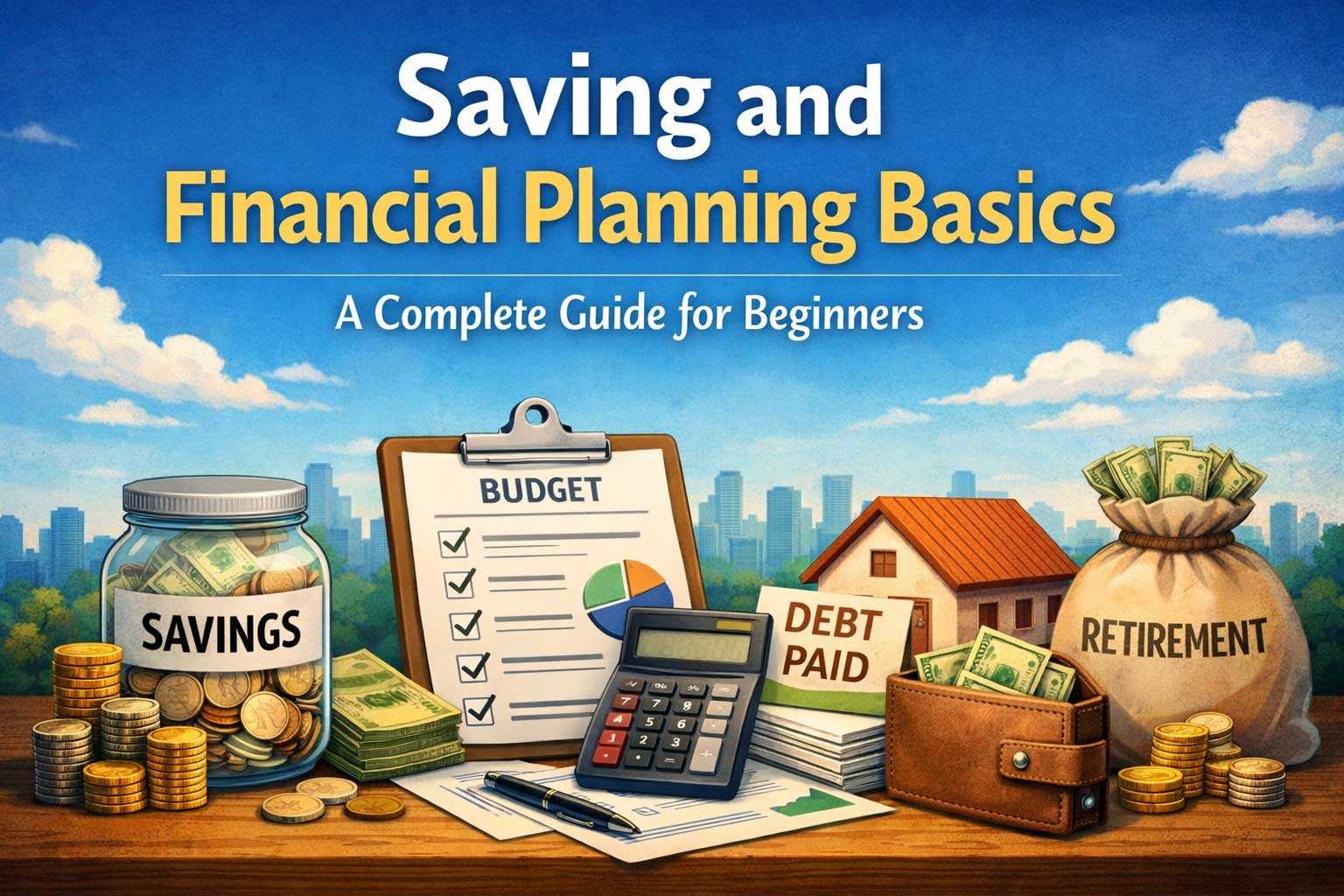
Saving money and making a financial plan can feel intimidating at first—especially if you think you need a high income, a finance degree, or perfect self-control. You don’t. What you need is a simple system you can repeat every month, plus a clear understanding of what matters most.
This guide is designed for beginners. It starts from the ground floor (how to set goals, track spending, and build an emergency fund) and moves step-by-step toward the bigger picture (debt strategy, investing basics, insurance, and a long-term plan). You’ll also get templates, checklists, and practical examples so you can apply the ideas immediately.
If you do nothing else after reading this, do these three things:
- Know where your money is going.
- Build a small emergency cushion.
- Automate one savings goal.
Those three actions alone can change your financial life.
What Saving and Financial Planning Really Mean (In Plain English)
Saving basics
Saving is setting aside money you will need later instead of spending it now. Savings can be short-term (next month, next year) or long-term (five years, retirement). The purpose is stability, flexibility, and security.
Financial planning basics
Financial planning is the bigger strategy. It’s deciding:
- What you want your money to do for your life
- When you want it
- How you’ll get there
- How you’ll protect progress along the way
Saving is one tool inside a financial plan. Planning is the map; saving is one of the vehicles.
A beginner-friendly definition
A realistic financial plan answers five questions:
- What do I earn?
- What do I spend?
- What do I owe?
- What do I own?
- What do I want next—and what’s the timeline?
The Core Principles Beginners Need (The “No Confusion” Rules)
1) You don’t need perfection; you need consistency
Most people fail because they try to “fix everything” in one month. A plan that’s 70% consistent beats a plan that’s 100% perfect for two weeks.
2) Your plan must match your real life
If your plan assumes you’ll never eat out, never travel, never buy gifts, and never face surprise bills, it will collapse. A good plan includes reality.
3) Saving isn’t just about cutting spending
Cutting spending helps, but the strongest long-term results come from:
- increasing income over time (skills, negotiation, side income)
- using systems (automation, categories, rules)
- avoiding expensive mistakes (bad debt, lack of insurance, no emergency fund)
4) Financial progress comes from avoiding the “big leaks”
A few major categories usually do most of the damage or most of the help:
- housing
- transportation
- food
- debt interest
- lifestyle inflation
- recurring subscriptions and “small” purchases that add up
5) Your plan needs both offense and defense
- Offense: saving, investing, earning more
- Defense: emergency fund, insurance, risk management, avoiding high-interest debt
Step 1: Get a Clear Starting Point (Your Financial Snapshot)
Before you set goals, you need a simple snapshot of your current situation.
A) Calculate your monthly take-home pay
List what actually lands in your bank account each month after taxes and deductions.
If income varies:
- Take the average of the last 3–6 months, or
- Use a “low month” as your baseline and treat extra income as a bonus
B) List your essential monthly expenses
These are non-negotiable bills you must pay to stay stable:
- housing (rent/mortgage)
- utilities
- basic groceries
- transportation to work
- minimum debt payments
- basic insurance
- necessary childcare
C) List your debts
For each debt, write:
- balance
- interest rate
- minimum payment
- due date
D) List your savings and assets
- checking and savings balances
- emergency fund (if any)
- retirement accounts (if any)
- investments (if any)
E) Identify your “cash flow gap”
Cash flow gap = take-home pay − essential expenses − minimum debt payments
If this is negative, you’re not broken—you just need a stabilization plan first (we’ll cover this). If it’s positive, you can start building savings right away.
Step 2: Set the Right Goals (So Saving Has a Purpose)
Saving without goals can feel like deprivation. Saving with goals feels like progress.
The three types of goals
- Short-term goals (0–12 months): emergency buffer, bills, gifts, travel, repairs
- Mid-term goals (1–5 years): car upgrade, moving, education, wedding, business launch
- Long-term goals (5+ years): retirement, financial independence, buying property, family security
A beginner goal framework that works
Use this simple format:
- Goal name: What you want
- Target amount: How much you need
- Timeline: When you need it
- Monthly amount: Target ÷ months
Example:
- Goal: Emergency Fund
- Target: 1,500
- Timeline: 6 months
- Monthly saving: 250
Make goals emotionally real
Add a “why” to each goal:
- “I want an emergency fund so one bad week doesn’t become a bad year.”
- “I want a moving fund so I can relocate without stress.”
- “I want retirement savings so future-me has choices.”
A helpful rule: prioritize stability before luxury
Most beginners should aim for:
- emergency buffer
- high-interest debt strategy
- consistent investing
- lifestyle upgrades (with cash)
Step 3: Build a Budget That Actually Works (Without Feeling Punished)
A budget isn’t a prison. It’s a plan for your money so you can stop wondering where it went.
Choose a budgeting style you’ll stick to
There’s no single “best” budget—only the one you can repeat.
Option 1: The simple percentage method
A classic structure:
- Essentials (needs)
- Lifestyle (wants)
- Savings and debt payoff (future)
You can adjust the percentages based on your income and cost of living. The purpose is balance, not perfection.
Option 2: Zero-based budgeting (best for control)
Every dollar gets a job:
Income − expenses − savings − debt = 0
This doesn’t mean you spend everything. It means you assign everything (including savings).
Option 3: “Pay yourself first” (best for beginners)
Automate savings first, then live on the rest.
This method works well if your spending is already reasonable.
Option 4: The “two-account” system (best for simplicity)
- Account A: bills + savings automation
- Account B: spending money (weekly transfer)
When spending money is gone, you stop. No complex tracking needed.
Step 4: Master the Most Important Skill—Cash Flow Control
You can’t save what you don’t control. The key is learning to manage monthly cash flow.
The 7-day money audit (fast and effective)
For one week:
- track every expense (yes, every one)
- label it as “essential,” “nice-to-have,” or “waste”
- total each category
You’re not judging yourself. You’re collecting data.
Find your “leak”
Most people have one or two areas where money quietly disappears:
- frequent delivery
- multiple subscriptions
- convenience spending
- impulse online shopping
- expensive car costs relative to income
Fixing one leak can free up a meaningful monthly savings amount.
Create spending rules instead of relying on willpower
Examples:
- “I wait 48 hours before buying anything non-essential over a certain amount.”
- “I only eat out on set days.”
- “I pause subscriptions I haven’t used in 30 days.”
- “I use a weekly spending allowance.”
Rules reduce decision fatigue.
Step 5: Build an Emergency Fund (The Foundation of All Plans)
An emergency fund protects you from turning problems into debt.
What counts as an emergency?
True emergencies include:
- medical costs
- essential car repair
- urgent travel for family crisis
- job loss or reduced income
- home repairs that prevent damage
Not emergencies:
- planned holidays
- sales and discounts
- new gadgets
- “I’m bored” spending
How much should beginners save?
Start with these milestones:
- Starter cushion: 250–500 (stops small crises)
- Mini emergency fund: 1,000 (covers many common surprises)
- Core emergency fund: 1–3 months of essential expenses
- Full emergency fund: 3–6 months of essential expenses (common long-term target)
If your income is unstable, lean toward the higher end over time.
Where to keep it
Emergency money should be:
- safe
- easy to access
- separate from everyday spending
Keep it in a dedicated savings account so you’re not tempted to use it casually.
How to build it fast
- automate a weekly transfer
- temporarily reduce discretionary spending
- direct windfalls (bonus, gifts, refunds) to the fund
- sell unused items
- take short-term extra work if realistic
Even small progress matters. Your emergency fund is your financial shock absorber.
Step 6: Understand Debt (And Choose a Strategy That Works)
Debt isn’t automatically “bad,” but high-interest debt can quietly destroy your ability to save.
The two types of debt
High-interest consumer debt (often credit cards) usually works against you.
Lower-interest debt (some student loans, mortgages) can be manageable depending on terms, stability, and goals.
Two popular payoff methods
Method 1: Debt avalanche (mathematically best)
Pay extra toward the highest interest rate first, while paying minimums on the rest.
Method 2: Debt snowball (motivation best)
Pay extra toward the smallest balance first, while paying minimums on the rest. Quick wins keep you consistent.
Choose the one you’ll actually follow.
A beginner-friendly approach
- Build a starter emergency cushion (so you don’t go deeper into debt)
- Pay minimums on all debts
- Pick one debt and focus extra payments
- When it’s cleared, roll that payment into the next debt
Avoid the debt trap cycle
Common cycle:
unexpected expense → credit card → minimum payments → interest grows → less room to save → more credit card use
Emergency funds break this cycle.
Step 7: Learn the Basics of Saving “Buckets” (So You Don’t Steal From Your Goals)
Beginners often have one savings account and keep pulling money out. A better system is saving buckets.
The three-bucket savings system
- Emergency fund bucket: emergencies only
- Short-term goals bucket: planned spending (gifts, travel, repairs)
- Long-term bucket: investing and retirement (grows over years)
If you mix all money together, it’s easier to rationalize spending it.
Sinking funds (a game-changer)
A sinking fund is money you save monthly for predictable expenses:
- car maintenance
- annual bills
- holidays and gifts
- medical visits
- home repairs
- back-to-school expenses
This makes “surprise” expenses less surprising.
Step 8: The Beginner’s Guide to Investing (Without Getting Overwhelmed)
Saving protects you. Investing grows you.
Saving vs investing (simple difference)
- Saving: low risk, easy access, slower growth
- Investing: higher risk, long-term focus, potential higher growth
If you’ll need the money soon, don’t invest it. If it’s for the distant future, investing becomes important.
The power of time (why beginners should start early)
Time helps because money can grow on top of money. Starting small but early can beat starting big but late.
Risk isn’t “bad”—it must be managed
Risk means your investment value can go up and down. The key is matching risk to:
- your timeline
- your stability
- your comfort level
Beginner investing principles
- Invest for the long term
- Diversify (don’t depend on one thing)
- Keep costs low (fees matter over decades)
- Avoid trying to time the market
- Automate regular contributions
What to invest in (conceptually)
Many beginners do well with diversified funds rather than picking individual stocks. The idea is to spread risk across many companies or assets.
A simple beginner sequence
- Emergency fund starter cushion
- Pay off or control high-interest debt
- Start retirement investing consistently
- Increase contributions as income grows
Common beginner investing mistakes
- investing money you might need within a year
- panic selling during market drops
- chasing “hot” trends
- investing without understanding fees
- skipping investing for years while waiting to “learn everything”
You can start simple and learn as you go.
Step 9: Retirement Planning Basics (Even If Retirement Feels Far Away)
Retirement planning isn’t about age. It’s about building future freedom.
Why retirement savings matters
If you don’t save for retirement, future-you may have limited choices. Retirement savings is like building a personal safety net for later life.
Start with what’s available to you
Depending on your country and job situation, you may have:
- employer-sponsored retirement plans
- individual retirement accounts
- government pension systems
- personal investment accounts
If your employer offers a matching contribution, that can be extremely valuable. If you don’t have an employer plan, you can still build retirement savings through personal investing.
How much should you save?
Beginners often start with a small, consistent percentage and increase gradually:
- start low enough that you can stick with it
- increase after raises or debt payoff
- aim for steady progress, not instant perfection
Step 10: Protect Your Plan With Insurance (The Part Most People Skip)
Insurance is not exciting, but it prevents financial disasters.
Why protection matters
A single major event can undo years of savings:
- medical emergency
- accident
- disability
- property damage
- family loss
Common types of protection (general overview)
- health coverage: reduces medical cost risk
- disability coverage: protects income if you can’t work
- life coverage (for dependents): protects family if you die
- property coverage: protects home or belongings
- auto coverage: protects against accidents and liability
You don’t need every type at maximum coverage immediately, but you should understand the risks you face and what would financially break you.
Step 11: Financial Planning 101 (Your Simple Step-by-Step Blueprint)
A financial plan doesn’t need to be complicated. Here’s a structure you can build in one weekend.
Step A: Define your financial values
Ask:
- What do I want money to do for me?
- What does “security” look like?
- What is worth spending on?
- What is not worth spending on?
Values guide decisions.
Step B: Set your priorities
Most beginner plans follow this order:
- Stabilize cash flow
- Build emergency fund
- Eliminate high-interest debt
- Start consistent investing
- Save for mid-term goals
- Increase investing and long-term protection
Step C: Pick 3 goals maximum at one time
If you chase 10 goals at once, you’ll make no progress. A smart set is:
- one stability goal (emergency fund)
- one debt or cash-flow goal
- one future goal (investing or a specific savings target)
Step D: Choose your “money system”
Pick one:
- two-account system
- zero-based budget
- pay-yourself-first automation
The best system is the one you’ll follow without constant stress.
Step E: Automate your plan
Automation removes daily discipline requirements. Automate:
- emergency savings transfer
- sinking fund transfers
- investment contributions
- bill payments where possible
Step F: Create a review schedule
Your plan should be reviewed:
- weekly (10–15 minutes)
- monthly (30–60 minutes)
- yearly (a bigger life-planning review)
Step 12: How to Save More Without Feeling Miserable
Saving isn’t just “cut everything.” Here are practical, sustainable methods.
Method 1: The “swap, don’t delete” strategy
Instead of removing joy, change the version:
- cook a favorite meal at home instead of restaurant
- choose one streaming service instead of three
- do free local activities on weekends
Method 2: The “fixed fun” budget
Give yourself a set fun amount each week. Spend it guilt-free. When it’s gone, it’s gone.
Method 3: Cut invisible spending
Invisible spending is money you don’t feel:
- unused subscriptions
- fees
- impulse online purchases
- convenience upgrades
Cleaning this up can fund savings with minimal pain.
Method 4: Use “one raise rule”
Every time income increases:
- keep lifestyle mostly the same
- allocate a portion of the raise to savings or investing
This prevents lifestyle inflation from stealing your future.
Method 5: Reduce major costs over time
The biggest wins often come from big categories:
- housing choices
- transportation
- debt interest
- recurring commitments
Even one smart change in these areas can outperform dozens of tiny cuts.
Step 13: Make a Beginner-Friendly Financial Plan (Template You Can Copy)
Use this template to create your first plan.
1) Your financial snapshot
- Monthly take-home pay: ______
- Essential expenses: ______
- Minimum debt payments: ______
- Current savings: ______
- Total debt: ______
2) Your top 3 goals (next 6–12 months)
Goal 1: ______ (amount + deadline)
Goal 2: ______ (amount + deadline)
Goal 3: ______ (amount + deadline)
3) Your monthly plan (simple allocation)
- Essentials: ______
- Debt payoff (extra): ______
- Emergency fund: ______
- Sinking funds: ______
- Investing/retirement: ______
- Fun/spending: ______
4) Your rules
- I will review money weekly on: ______
- I will automate savings on: ______
- I will use a 48-hour rule for non-essential purchases over: ______
- I will keep an emergency fund separate from spending
5) Your review plan
Monthly review checklist:
- Did I follow the plan 80% of the time?
- What expense surprised me?
- What can I improve next month?
- Can I increase savings by a small amount?
Step 14: The 30-Day Starter Plan (If You Want Clear Steps)
Week 1: Awareness and setup
- track all spending for 7 days
- list debts with interest rates
- calculate essential expenses
- pick budgeting system
Week 2: Stabilize and automate
- open or designate a separate emergency savings account
- automate a small transfer (even weekly)
- set up bill reminders or autopay where safe
Week 3: Cut one “leak”
- cancel unused subscriptions
- reduce one overspending category
- set one spending rule
Week 4: Build momentum
- increase automation slightly
- choose debt payoff method
- create one sinking fund for an upcoming predictable expense
- schedule your monthly review day
This plan works because it builds habits and systems, not stress.
Step 15: Common Beginner Problems (And How to Fix Them)
“I don’t make enough to save.”
Start extremely small:
- save a tiny amount weekly
- focus on reducing one leak
- work on income growth over time (skills, job changes, side work)
Saving is a muscle. Start small so you can keep going.
“I save, then I spend it.”
You need buckets:
- emergency fund separated
- sinking funds for planned expenses
- goal-specific savings
Also remove friction:
- keep emergency fund less accessible than checking
“My expenses are unpredictable.”
Use a baseline and buffer:
- build a buffer category in your budget
- average variable costs
- increase emergency fund target over time
“I get motivated, then quit.”
Lower the difficulty:
- automate savings
- keep the plan simple
- set smaller milestones
- track progress visually (even a simple checklist)
Consistency beats intensity.
“I’m afraid of investing.”
Start with education and simplicity:
- invest only long-term money
- start with a small amount
- prioritize diversification and cost awareness
- avoid anything you don’t understand
Fear decreases when you have a basic system.
Step 16: Financial Planning for Different Life Situations
If you’re a student or early career
Focus on:
- habits (budgeting, saving automation)
- building a starter emergency fund
- avoiding high-interest debt
- investing small amounts early if possible
- building skills that increase income
If you’re supporting family
Focus on:
- stronger emergency fund
- insurance protection
- stable cash flow
- clear shared goals
- sinking funds for predictable family expenses
If you have irregular income
Focus on:
- a larger cash buffer
- budgeting based on a “low month”
- keeping fixed expenses lower
- saving extra in high months
- separating tax savings if you’re self-employed (rules vary by location)
If you’re paying off a lot of debt
Focus on:
- starter emergency fund first
- a clear payoff method
- reducing interest costs
- avoiding new debt
- keeping motivation with milestones
Step 17: The Mindset That Makes Saving and Planning Work
Money management is not only math. It’s behavior.
Replace shame with data
If your spending is messy, that doesn’t mean you’re weak. It means you need systems. Look at numbers with curiosity, not judgment.
Focus on identity-based habits
Instead of “I need to stop spending,” try:
- “I’m the kind of person who pays myself first.”
- “I plan before I spend.”
- “I build buffers so I don’t panic.”
Use environment design
Make good choices easier:
- unsubscribe from marketing emails
- remove saved cards from shopping sites
- keep spending money separate
- automate savings so it happens without a decision
Step 18: Beginner FAQs (Clear Answers)
How much should I save each month?
Start with what you can sustain. Even a small consistent amount builds the habit. Increase gradually as debt decreases or income rises.
Should I save or pay off debt first?
Often:
- build a small emergency cushion first
- then focus aggressively on high-interest debt
- keep saving something small so you don’t lose the habit
The right answer depends on interest rates, stability, and stress level.
What’s the difference between an emergency fund and a sinking fund?
- Emergency fund: unexpected, urgent problems
- Sinking fund: expected future expenses you plan for monthly
Do I need to be “good at math” to plan finances?
No. You need a system: track, categorize, automate, and review.
How do I stay consistent?
- keep the plan simple
- automate savings
- review weekly
- focus on progress, not perfection
What if I mess up a month?
It’s normal. Do a reset:
- review what happened
- adjust the plan
- restart automation
One messy month doesn’t ruin the plan unless you quit.
Step 19: Your Beginner Checklists
Quick checklist: build your foundation
- Know monthly take-home pay
- Know essential monthly expenses
- Track spending for 7 days
- Choose a budgeting method
- Create starter emergency fund
- Automate savings
- Pick a debt payoff strategy (if needed)
- Start a sinking fund for one predictable cost
- Schedule monthly review
Monthly review checklist (30 minutes)
- Did I save what I planned?
- Did I overspend anywhere? Why?
- Any upcoming bills I should prepare for?
- Can I increase savings by a small amount?
- What is my next milestone?
Conclusion: The Beginner’s Path to Real Financial Progress
Saving and financial planning aren’t about being perfect. They’re about building a repeatable system that protects you today and improves your future.
If you’re just starting, keep it simple:
- build a starter emergency fund
- choose a budget style you’ll actually stick to
- automate savings
- handle high-interest debt
- learn investing slowly and start small
Your financial life changes when your plan becomes routine. Start with one step, then repeat it until it becomes normal. That’s how beginners become confident—and how confidence becomes wealth.