Most money stress doesn’t come from not knowing what to do. It comes from not knowing what to do first.
Should you build a bigger emergency fund, or start investing now? Should you keep cash for a home down payment, or invest and hope it grows faster? If you invest, how do you avoid feeling anxious every time the market dips? If you save, how do you avoid falling behind because inflation quietly erodes your purchasing power?
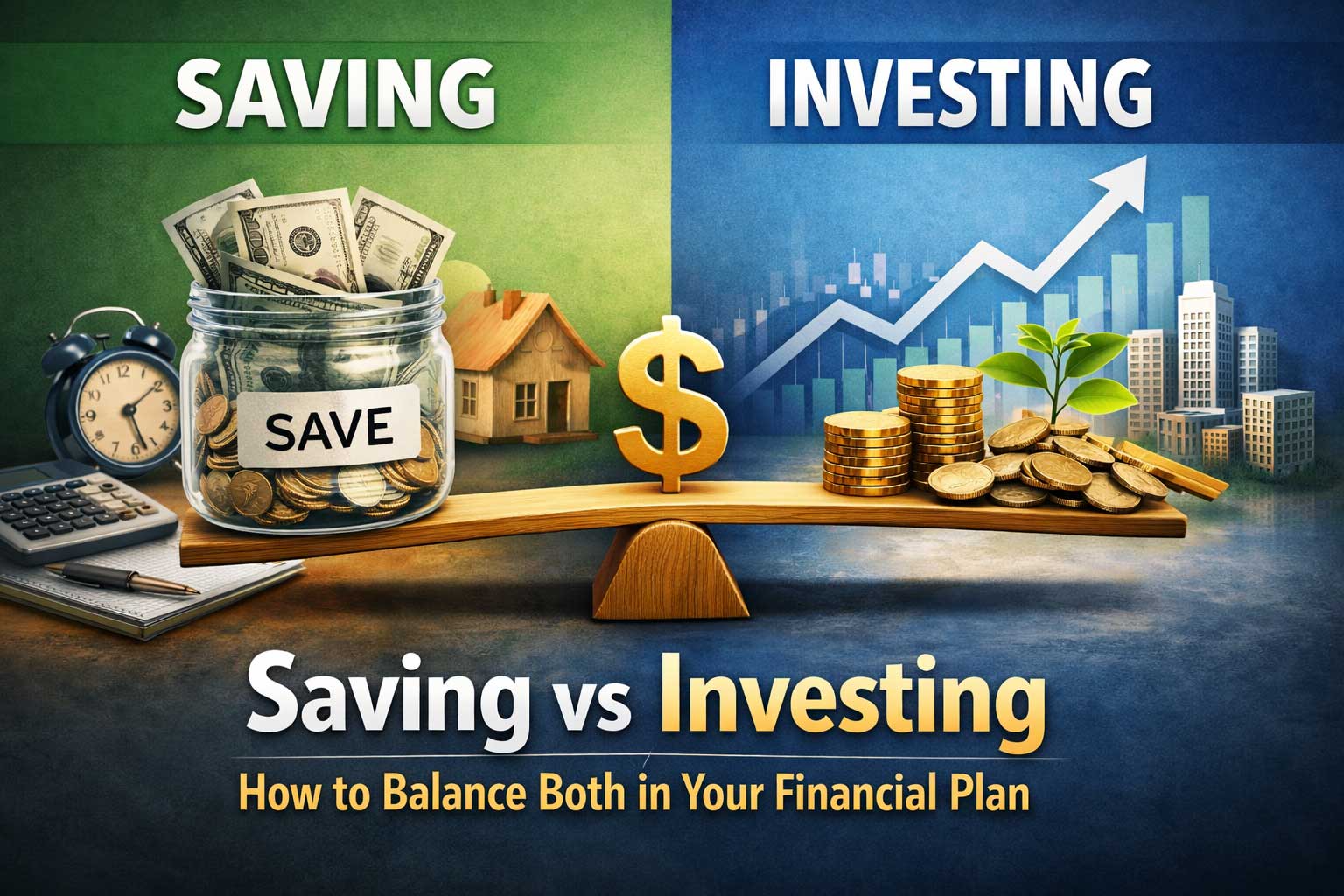
The truth is: saving and investing are not competing goals. They are two tools in the same toolbox—each designed for a different job. A strong financial plan doesn’t pick one and ignore the other. It balances both, intentionally, based on your goals, timeline, and risk level.
This guide will walk you through the difference between saving and investing, why you need both, and exactly how to build a plan that makes them work together—without confusion, guilt, or overthinking.
The Core Difference: Saving Is for Certainty, Investing Is for Growth
Let’s simplify this in a way you can actually use.
What saving is (and what it’s for)
Saving means putting money somewhere stable and accessible, where the value doesn’t swing up and down. The goal is certainty, not high returns.
Saving is typically used for:
- Emergency fund
- Bills and short-term expenses
- Sinking funds (planned future costs like annual insurance, car repairs, holidays)
- Near-term goals (like a down payment within a couple of years)
- Peace of mind and flexibility
Saving is about financial shock absorption. It prevents small problems from becoming big disasters.
What investing is (and what it’s for)
Investing means putting money into assets that can grow over time, but may rise and fall in the short term. The goal is long-term wealth building.
Investing is typically used for:
- Retirement
- Long-term goals (5+ years is a common rule of thumb)
- Building financial independence
- Outpacing inflation over decades
Investing is about financial acceleration. It’s how your money can work harder than your own labor over the long run.
The most useful one-sentence comparison
- Saving = stability and liquidity
- Investing = growth and compounding
In a good financial plan, saving gives you the ability to sleep at night, and investing gives you the ability to build wealth without working forever.
Why You Need Both: The Two-Engine Financial System
A plan that focuses only on saving often leads to frustration:
- You feel responsible and safe
- But your money grows slowly
- And long-term goals feel far away
A plan that focuses only on investing often leads to stress:
- You’re building wealth
- But you’re vulnerable to emergencies
- And you might be forced to sell investments at a bad time
Saving protects your life today. Investing protects your life tomorrow.
If you want a plan that holds up in real life, you need both engines running.
Here’s the hidden reason balancing matters so much:
The biggest financial risk isn’t market volatility—it’s forced decisions
People don’t lose money because markets go down. Markets go down all the time.
People lose money because they:
- Invest money they’ll need soon
- Get hit with an emergency
- Panic and sell at the worst moment
- Or take on debt because they didn’t keep cash
A strong savings base prevents forced selling and high-interest debt. That base makes investing easier, calmer, and more consistent—which is exactly what investing needs to work.
The Real Enemy of Savings: Inflation (and Why It Changes the Game)
Saving feels safe because the number in your account usually doesn’t drop. But there’s another type of loss people ignore: purchasing power loss.
If prices rise over time, the same amount of money buys less. That means:
- Your cash can quietly lose real value over years
- Even if the account balance stays the same
This doesn’t mean you should avoid saving. It means you should avoid using saving for goals that require long-term growth.
A helpful mindset is:
- Use saving to store money for short-term needs
- Use investing to grow money for long-term needs
When you match the tool to the goal, you stop fighting the system.
Step One: Define Your Goals by Timeline (The Key to Balancing Both)
If you only do one thing from this entire article, do this:
Categorize your goals into three time horizons
- Short-term goals: 0–2 years
- Medium-term goals: 2–5 years
- Long-term goals: 5+ years
Now match the strategy:
- Short-term: mostly saving (protect principal)
- Medium-term: a blend (some saving, some investing depending on flexibility)
- Long-term: mostly investing (maximize growth potential)
This solves a huge amount of confusion instantly. Most people struggle because they invest short-term money or save long-term money.
A simple rule that prevents 80% of mistakes
If you cannot accept your money being down when you need it, it’s savings money.
If you can wait and you don’t need the money for years, it’s investment money.
Step Two: Build the “Financial Safety Floor” Before You Invest Aggressively
You don’t need to be “fully prepared” before investing, but you do need a basic safety floor.
Think of your savings foundation as layers:
Layer 1: Bills buffer (mini cash cushion)
Start with a small buffer that prevents day-to-day stress:
- Often 2–4 weeks of expenses
- Enough to cover timing gaps and minor surprises
This reduces overdrafts, late payments, and panic.
Layer 2: Emergency fund (your financial shock absorber)
Emergency funds are for:
- Job loss
- Medical expenses
- Urgent travel
- Essential repairs
- Anything unexpected and necessary
A common target is 3–6 months of essential expenses.
If your income is variable (freelance, business, commissions), many people aim for 6–12 months.
Important detail: calculate emergency funds using essential spending, not your “full lifestyle.” Include:
- Housing
- Utilities
- Groceries
- Transportation
- Minimum debt payments
- Insurance
- Basic household needs
Layer 3: Sinking funds (planned expenses that feel like emergencies if you ignore them)
Sinking funds are savings for predictable expenses, such as:
- Car maintenance
- Annual insurance premiums
- Home repairs
- Gifts and holidays
- School tuition or fees
- Taxes for freelancers/business owners
This category matters because many “emergencies” aren’t emergencies—they’re predictable costs arriving on schedule.
When you have sinking funds, your emergency fund stays intact, and your investing stays consistent.
Step Three: Eliminate “Wealth Killers” That Block Both Saving and Investing
Before you try to optimize returns, remove the biggest leaks.
High-interest debt usually wins against investing
If you have debt with very high interest, it can be extremely hard for investments to beat it reliably—especially in the short term. Many people find the best “return” comes from paying off expensive debt first.
This doesn’t mean you must be debt-free to invest. It means you should have a strategy:
- Pay minimums on all debts
- Attack the highest interest debt aggressively
- Still invest a small amount (to build habit) if possible
Lifestyle inflation is the silent budget killer
When income rises, spending often rises too. If you don’t intentionally direct increases toward goals, you can earn more and still feel stuck.
A powerful tactic:
- Decide a percentage of every raise that automatically goes to saving/investing before you adjust lifestyle.
Example:
- 50% of any raise goes to goals
- 50% can support lifestyle upgrades
This creates progress without feeling deprived.
Step Four: Use a “Bucket System” to Balance Saving and Investing Automatically
A bucket system turns complex decisions into a simple structure you can maintain for years.
Bucket A: Safety (cash-based)
Purpose: stability and quick access
Includes:
- Bills buffer
- Emergency fund
- Sinking funds
- Short-term goals (0–2 years)
Bucket B: Stability + progress (conservative mix)
Purpose: medium-term goals (2–5 years)
This bucket is flexible. Your blend depends on:
- How flexible the goal is
- How painful it would be if the balance dropped temporarily
- Whether you can delay the goal if markets are down
Bucket C: Growth (long-term investing)
Purpose: 5+ year goals and retirement
Includes:
- Retirement investing
- Long-term wealth-building
- Financial independence goals
This bucket is where compounding does the heavy lifting.
The bucket method works because it stops you from asking the wrong question (“save or invest?”) and replaces it with the right question:
“Which bucket is this goal in?”
How Much Should You Save vs Invest Each Month?
There isn’t a single perfect percentage for everyone. But there are reliable ways to choose a number that fits your situation.
Start with a practical baseline (then customize)
A common starting framework is:
- Save/invest 10% of income: building basic stability
- 15%: strong progress for most households
- 20%+: accelerated goals and faster wealth building
But the real answer depends on:
- Your fixed costs
- Your debt situation
- Your income stability
- Your timeline for major goals
- Your retirement needs
- Your risk tolerance
Use the “minimum effective plan” approach
If you’re overwhelmed, don’t aim for perfection. Aim for consistency.
A minimum effective plan might be:
- A small automatic savings transfer every payday
- A small automatic investment contribution every payday
- Gradually increase both as your budget improves
Consistency beats intensity. Many people fail by trying to do too much too fast and then quitting.
The “Priority Order” That Balances Saving and Investing Without Stress
If you want a clear sequence that works in real life, use this step-by-step order. It helps you decide what to do first, second, and third.
1) Cover essentials and stop financial bleeding
- Pay essential bills on time
- Build a small buffer (so you don’t overdraft)
- Avoid late fees and high-cost borrowing
2) Get any “free money” or high-value benefits
If your job offers any form of matching contribution or benefit tied to investing, it often ranks very high because it’s immediate value.
(If you don’t have this, no problem—move to the next step.)
3) Build a starter emergency fund
Even a starter fund can prevent debt:
- Enough for minor emergencies
- Enough to keep you calm while you improve your plan
4) Pay down high-cost debt aggressively
This frees cash flow, reduces stress, and improves long-term investing capacity.
5) Build a full emergency fund + sinking funds
This is where your plan becomes resilient.
6) Increase long-term investing
Once your safety floor is stable, you can invest more confidently and ride out volatility.
7) Save/invest for specific goals using the bucket method
Down payment, education, travel, home renovation, business capital—put each goal into the correct bucket and fund it intentionally.
This order works because it reduces the chance of being forced to stop investing or sell investments at a bad time.
When Saving Should Take Priority Over Investing
There are times when saving is clearly the better move.
Save first if:
- You have no emergency fund and one surprise could push you into debt
- Your income is unstable and you’re in a high-risk period
- You’ll need the money in the next 0–2 years
- You’re about to make a major purchase and you can’t delay it
- You’re dealing with immediate obligations (medical bills, urgent repairs)
- You’re underinsured or missing key protections (which can create massive financial risk)
Saving doesn’t mean you’re “behind.” It means you’re building stability so investing can actually work long term.
When Investing Should Take Priority Over Saving
Investing becomes more urgent when time and compounding matter most.
Invest more if:
- Your emergency fund and sinking funds are solid
- Your high-interest debt is under control
- Your goals are long-term (5+ years)
- Your income is stable and your budget is predictable
- You want to build retirement wealth and reduce future work pressure
- You’re trying to outpace inflation over decades
A helpful idea:
- Saving prevents financial pain
- Investing builds financial power
Once pain-prevention is handled, power-building deserves more attention.
The Medium-Term Zone: Where Most People Get Stuck
The hardest timeline is 2–5 years.
Why? Because:
- Saving may not grow fast enough
- Investing may be too volatile if the market drops right before you need the money
This is where you need a decision framework.
Ask these three questions
- How flexible is the goal date?
If you can delay the goal by 6–18 months if markets are down, you can consider more investing. - How essential is the goal?
If it’s a “must happen” goal (tuition deadline, necessary vehicle replacement), lean toward saving. - Can you partially fund it with savings and partially with investing?
Many people do a hybrid approach:- Keep a base amount in savings (to guarantee minimum progress)
- Invest the extra portion (to potentially boost growth)
A practical split method for medium-term goals
You can create tiers:
- Required amount: save (the minimum you must have)
- Optional upgrade amount: invest (nice-to-have, flexible portion)
Example:
- You need a reliable car in 3 years.
- You save enough to buy a basic reliable car.
- You invest extra if you want a higher model, but you can adjust based on market conditions.
This method reduces risk while still giving growth potential.
Understanding Risk the Right Way: Risk Capacity vs Risk Tolerance
People think risk is about emotions. It’s not only that.
Risk tolerance (feelings)
This is how comfortable you are with volatility:
- Can you handle seeing your account drop temporarily?
- Will it cause anxiety or panic?
Risk capacity (reality)
This is what your life situation can handle:
- How stable is your income?
- How soon will you need the money?
- Do you have dependents?
- Are your fixed expenses high?
- Do you have other safety nets?
A person can have high risk tolerance but low risk capacity (they feel brave, but their timeline is short). Or low tolerance but high capacity (they can afford volatility but emotionally hate it).
A balanced plan respects both.
A Simple “Decision Matrix” You Can Use Anytime
When you’re deciding whether money should go to savings or investments, run it through this matrix:
1) What is the timeline?
- 0–2 years: mostly save
- 2–5 years: hybrid (case-by-case)
- 5+ years: mostly invest
2) What happens if the balance is down when you need it?
- If it would cause major harm: save
- If you can wait: invest
3) Is the goal essential or optional?
- Essential: lean safer
- Optional: can take more risk
4) Do you have a safety floor?
- If not: build savings first
- If yes: invest more confidently
This turns an emotional decision into a structured one.
How to Combine Both in One Monthly Plan (Without Complicated Math)
A balanced plan can be surprisingly simple.
The “3-transfer system”
Every payday (or every month), automate three transfers:
- Bills and essentials (checking account)
- Savings buckets (emergency + sinking funds + short-term goals)
- Investing bucket (long-term goals)
If you do this consistently, your finances run on rails. Your job becomes:
- Review once a month
- Adjust when goals change
- Increase contributions when income rises
The “percentage split” method
If you prefer clear percentages, you can use a structure like:
- 5–10% savings (stability)
- 10–15% investing (growth)
Or if you’re still building your safety floor:
- 10–15% savings
- 5–10% investing
Or if you’re in a high-growth phase with a strong emergency fund:
- 5% savings (maintenance)
- 15–25% investing (aggressive growth)
The point isn’t the perfect split. The point is choosing a split you can sustain.
Real-Life Examples: How Balance Looks in Different Situations
Example 1: A young adult starting from zero
Situation: Early career, low savings, stable job, small debt
Focus: Build habits + starter emergency fund + begin investing
Possible approach:
- Build a small buffer (1 month essentials)
- Start investing a small amount monthly (habit-building)
- Pay down high-cost debt
- Grow emergency fund to 3–6 months
- Increase investing as debt drops and savings stabilize
Why it works: investing starts early, but saving prevents emergencies from destroying progress.
Example 2: A family with higher fixed costs
Situation: Kids, mortgage/rent, childcare, unpredictable expenses
Focus: Strong emergency fund + sinking funds + steady investing
Possible approach:
- Emergency fund toward the higher end (often 6+ months essential)
- Sinking funds for predictable big expenses (school, medical, repairs)
- Automatic retirement investing monthly
- A separate short-term goal fund for vacations and projects
Why it works: families face more “life surprises,” so savings stability protects investing consistency.
Example 3: A freelancer or business owner
Situation: Income fluctuates, taxes and slow months happen
Focus: Bigger cash reserves + structured investing
Possible approach:
- Larger emergency fund (often 6–12 months essentials)
- Separate tax savings bucket
- A “business buffer” bucket for irregular costs
- Investing contributions based on a baseline income, with extra investing in high months
Why it works: volatility in income requires more cash stability so you don’t interrupt long-term investing.
Example 4: Someone within 10 years of retirement
Situation: Time horizon shorter, protecting progress matters
Focus: Reduce risk gradually + maintain liquidity
Possible approach:
- Maintain emergency cash and near-term reserves
- Continue investing for growth but with a focus on managing volatility
- Plan 1–3 years of spending needs in safer vehicles
- Keep long-term portion invested for inflation protection
Why it works: near retirement, you want growth and a plan that prevents forced withdrawals during down markets.
Common Mistakes That Break the Balance
Mistake 1: Keeping too much cash for too long
Cash feels safe, but if long-term money sits in cash indefinitely, you risk falling behind your goals.
Fix:
- Keep cash for short-term needs
- Invest long-term money intentionally
Mistake 2: Investing money you’ll need soon
This creates anxiety and increases the chance you’ll sell at the wrong time.
Fix:
- Match money to timeline using the bucket method
Mistake 3: Overbuilding the emergency fund while ignoring goals
Some people keep adding to emergency savings far beyond what they realistically need because it feels comforting.
Fix:
- Pick a target (3–6 months essentials, or higher if variable income)
- Once the target is reached, redirect extra to investing or goals
Mistake 4: Not separating sinking funds from emergency funds
If every predictable expense comes from the emergency fund, it’s always being drained, which creates stress and instability.
Fix:
- Create sinking funds for predictable big costs
Mistake 5: Letting emotions control investing
Panic-selling, chasing trends, and constant tinkering destroy returns.
Fix:
- Automate investing
- Review periodically, not daily
- Focus on long-term strategy, not short-term noise
Mistake 6: Ignoring taxes and fees
Even small differences in costs can matter over decades.
Fix:
- Understand what you’re paying
- Keep your plan simple and consistent
How to Stay Consistent During Market Drops (Without Losing Your Mind)
Market downturns are normal. The question isn’t whether they happen—it’s whether your plan can survive them.
The “two-account calm” strategy
When you have:
- A solid emergency fund
- Sinking funds for planned expenses
…you’re less likely to panic, because you don’t need to sell investments for cash.
Reframe what a downturn means
If you’re regularly investing for long-term goals, downturns can be viewed as:
- Temporary declines in value
- Potentially better long-term buying opportunities
- A normal part of the cycle
The plan that works is the plan you can stick with. Your savings base helps you stick with it.
A Step-by-Step Blueprint You Can Follow This Week
If you want a practical plan you can implement quickly, here’s a blueprint.
Step 1: List your goals and timelines
Write down:
- Goal
- Amount needed
- Date needed
- Priority (essential vs optional)
Sort them into:
- 0–2 years
- 2–5 years
- 5+ years
Step 2: Calculate your essential monthly expenses
This is your emergency fund baseline.
Step 3: Set your savings targets
- Bills buffer target (small cushion)
- Emergency fund target (3–6 months essentials, or more if needed)
- Sinking funds list (with monthly contributions)
- Short-term goal fund contributions
Step 4: Set your investing target
Pick a monthly amount you can sustain:
- Even if it’s small at first
- Make it automatic
Step 5: Automate the plan
Automation removes daily willpower from the equation.
Set:
- Automatic transfers to savings buckets
- Automatic investment contributions
- Bill payments if possible
Step 6: Review monthly, adjust quarterly
Monthly: check cash flow and category balances
Quarterly: adjust contributions, rebalance goals, plan for upcoming expenses
Your plan should evolve as life changes.
How to Handle Competing Goals (Down Payment vs Retirement, for Example)
This is one of the most common real-world conflicts. You want to invest for retirement, but you also want a big goal soon.
A practical way to solve it is to fund goals in order of urgency and importance:
- Maintain emergency fund and sinking funds
- Contribute to long-term investing consistently (even if modest)
- Prioritize short-term goal funding with the remaining surplus
Why this works:
- Your safety floor remains intact
- Your investing habit stays alive (so you don’t “pause” for years)
- Your short-term goal still gets focused funding
You don’t have to choose one forever. You can choose a season:
- “This year I’m in down payment season, but I’m still investing a baseline amount.”
That’s balance.
Frequently Asked Questions
Is saving or investing better?
Neither is “better.” They solve different problems. Saving provides stability and short-term certainty. Investing provides long-term growth and wealth building. Most people need both.
Should I invest if I don’t have an emergency fund?
In many cases, it’s wise to build at least a starter emergency fund first. But you can also invest a small amount to build the habit—especially if you’re working on debt and building savings simultaneously. The key is avoiding a situation where you’d be forced to sell investments for emergencies.
How much should I keep in savings before investing more?
A common approach is:
- A small buffer first (to stop day-to-day stress)
- Then build toward 3–6 months of essential expenses (or more if variable income)
Once you hit your target, you can redirect more monthly money to investing.
What if I’m afraid of investing?
Start small. Use a long-term mindset and automate contributions. Fear often comes from investing money that should be savings. When your savings foundation is solid, investing feels less threatening.
Can I do both at the same time?
Yes—and many people should. You can build savings and invest simultaneously by splitting contributions and using the bucket method. The exact split depends on your stability and timelines.
What’s the biggest mistake people make?
Mixing timelines—investing short-term money or saving long-term money. The second biggest is failing to build a safety floor, which causes panic decisions later.
The Balanced Plan Checklist
If you want a simple “yes/no” check that your balance is healthy, use this:
Savings foundation
- I have a buffer to avoid overdrafts and timing stress
- I have an emergency fund target and I’m building or maintaining it
- I have sinking funds for predictable big expenses
- Money needed within 0–2 years is mostly protected in savings
Investing foundation
- I invest monthly (even if small)
- My long-term goals (5+ years) are funded through investing
- I’m not relying on invested money for short-term needs
- I can stay consistent even during market drops because my savings base protects me
If most of these are true, your plan is balanced.
Final Thoughts: Balance Isn’t a Number—It’s a System
People often ask, “What’s the perfect percentage to save versus invest?”
But balance isn’t a single number. Balance is a system that:
- Protects you from emergencies
- Funds your near-term goals with confidence
- Builds long-term wealth through consistent investing
- Reduces stress because your plan matches real life
Saving gives you stability. Investing gives you growth.
When you build a plan that respects timelines, protects your cash needs, and automates long-term investing, you stop choosing between them—and start using both to build a stronger financial future.