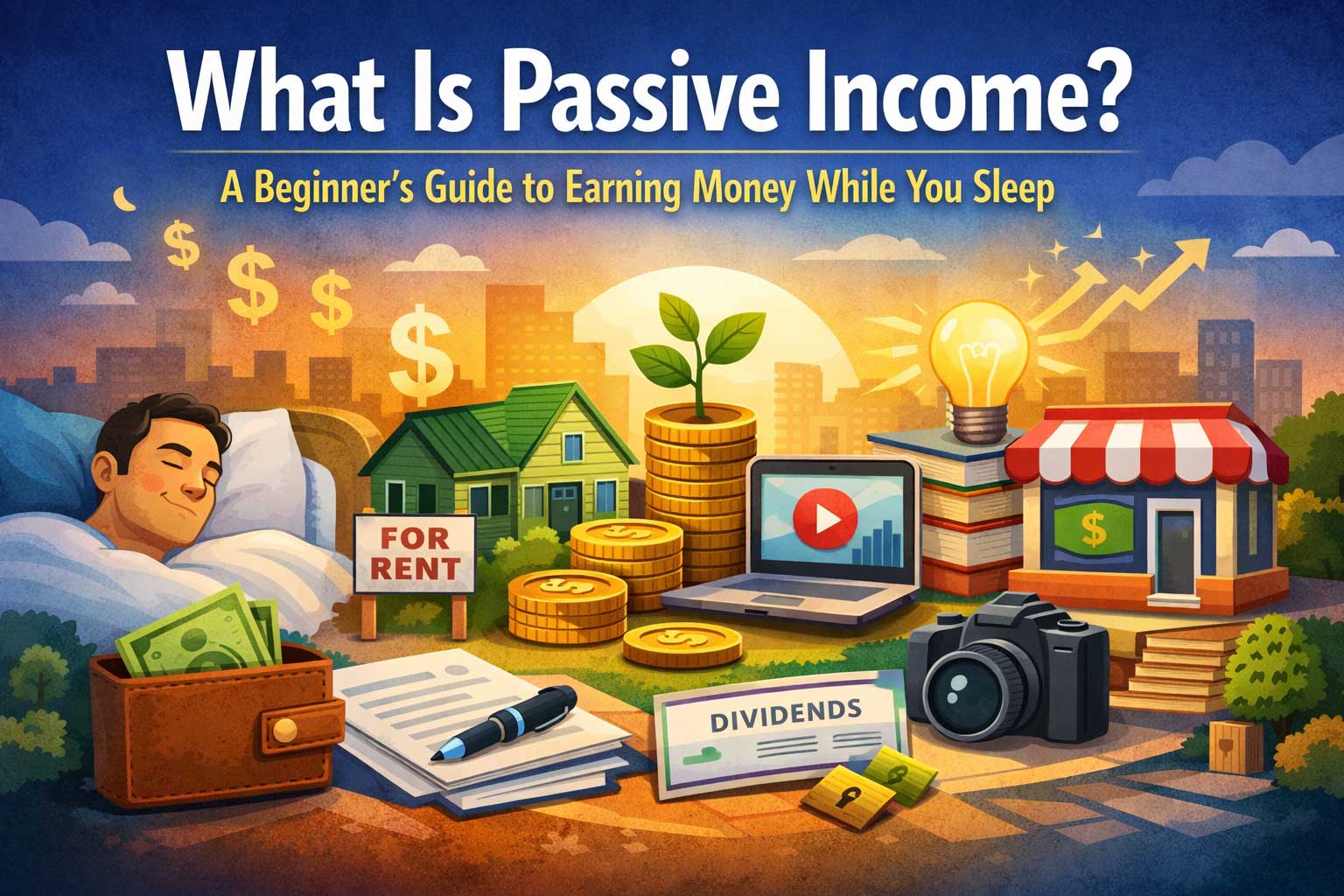
Passive income is one of the most misunderstood ideas in personal finance. It’s often marketed like a magic trick: set something up once, then money flows forever while you relax. In real life, passive income is less like a lottery ticket and more like building a small machine. You design it, assemble it, test it, maintain it, and improve it. After that, it can produce income with far less day-to-day effort than a typical job—but it still needs attention.
This guide will teach you what passive income actually is, how it differs from active income, which passive income ideas are truly beginner-friendly, and how to build your first “sleeping income” plan without falling for scams or unrealistic promises.
Quick note (important): This is educational content, not personalized financial, tax, or legal advice. Use it as a framework and adapt it to your situation.
Table of Contents
- What passive income really means (and what it doesn’t)
- Passive income vs active income: the key difference
- Why passive income matters: freedom, stability, and options
- The “Passive Income Triangle”: time, money, and skills
- Before you start: the financial foundation most people skip
- The passive income spectrum (from easiest to hardest)
- 20 passive income ideas explained for beginners (with steps, costs, and risks)
- How to choose the right passive income path for you
- How much passive income you can realistically expect
- A step-by-step plan to build passive income in 12 months
- Risk management: how to protect your money and time
- Taxes and record-keeping basics (simple and beginner-friendly)
- Frequently asked questions
- A practical checklist to start today
1) What Passive Income Really Means (and What It Doesn’t)
Passive income is money you continue to earn with minimal ongoing effort after you’ve done the upfront work or invested capital.
That’s the definition—but the real understanding comes from the “upfront work” part. Passive income almost always requires one (or both) of the following:
- Capital (money you invest upfront)
- Effort (work you put in upfront, like building a product, content, or a system)
What passive income is NOT
Let’s clear up common myths:
- Myth: Passive income means “no work.”
Reality: It means “less ongoing work,” not “no work.” Even dividend investing needs monitoring, and a rental property needs repairs and tenant management. - Myth: Passive income is fast.
Reality: Most reliable passive income is slow to build. It’s closer to planting trees than flipping coins. - Myth: Passive income is guaranteed.
Reality: Every income stream has risks—market risk, business risk, tenant risk, platform risk, or policy changes. - Myth: Passive income is only for the wealthy.
Reality: Some forms are easier with money, but many start with skills and consistent effort, and grow over time.
The simplest way to think about it
Passive income is delayed reward. You do something now—save, invest, build, automate—so that later it pays you repeatedly.
2) Passive Income vs Active Income: The Key Difference
Active income is tied directly to your time.
If you stop working, your income stops (or drops quickly). Examples: salary, hourly jobs, freelancing, gig work.
Passive income is tied to an asset or system.
If you stop actively working today, the asset still generates income tomorrow (at least for a while). Examples: interest, dividends, rent, royalties, digital product sales.
A helpful comparison
- Active income is like carrying water in buckets.
- Passive income is like building a pipe.
Buckets can get you water today. Pipes can keep delivering water long after the hard digging is done.
The smartest strategy for most beginners is:
Use active income to build assets → assets create passive income → passive income reduces pressure on active income.
3) Why Passive Income Matters: Freedom, Stability, and Options
People chase passive income for different reasons. The reason matters because it changes what you should build.
The four core benefits
1) Financial stability
Passive income adds another leg to your financial stool. If your job income drops, you still have cash flow coming in.
2) Freedom of choice
Passive income can buy options:
- Working fewer hours
- Taking a better job (instead of the first job)
- Starting a business without panic
- Saying “no” to bad clients
- Taking time off for health or family
3) Faster wealth-building
When you reinvest passive income—dividends, interest, business profits—you create compounding. Compounding is not a trick. It’s a mathematical advantage that grows stronger with time.
4) Inflation defense
Prices tend to rise over time. Assets like productive businesses, diversified stock investments, and real estate often have a better chance of keeping up with inflation than leaving money idle.
4) The “Passive Income Triangle”: Time, Money, and Skills
To build passive income, you typically need at least two of these three:
- Time (hours outside work, consistently)
- Money (capital to invest)
- Skills / Audience (ability to create value people pay for)
Examples
- More money + less time: index funds, bonds, REITs, high-yield savings
- More time + strong skills: content + digital products, courses, software, templates
- Skills + money: buy or invest in a small business, build a product and advertise it
- More time + some money: rental property “house hacking,” small niche products, micro-assets
If you’re a beginner with limited money, your best path is often:
- Build skills + systems first
- Invest small amounts consistently
- Increase capital over time as income grows
5) Before You Start: The Financial Foundation Most People Skip
Passive income is easiest when your financial base is stable. If you skip this, passive income projects often fail—not because the idea is bad, but because stress forces bad decisions.
Step 1: Stabilize your monthly cash flow
If you don’t know where your money goes, you can’t reliably invest or build assets. Start with:
- A simple budget (not perfect, just honest)
- A baseline spending number (what life costs you monthly)
Step 2: Build an emergency fund
A basic rule: 1–3 months of essential expenses is a strong start.
Why it matters: without a buffer, you may pull investments out at the worst time or quit your side project too early.
Step 3: Handle high-interest debt
Debt with very high interest is like “negative passive income.” It drains money every month.
Step 4: Protect the basics
Consider fundamentals like:
- avoiding underinsurance
- avoiding risky “all-in” investing
- keeping essential bills stable
Step 5: Set a clear passive income goal
Goals work best when they’re specific:
- “I want $200/month in passive income in 12 months.”
- “I want passive income to cover my rent within 5–7 years.”
A goal gives you a target and helps you choose the right strategy.
6) The Passive Income Spectrum (From Easiest to Hardest)
Not all passive income is equal. Some are easy to start but pay less. Some can pay a lot but require serious work, risk, or time.
Spectrum A: “Low effort, lower upside” (mostly investing)
- Interest from savings tools
- Bonds and bond funds
- Dividend income
- Broad index funds (indirect income via growth and withdrawals)
Pros: simple, scalable, beginner-friendly
Cons: requires capital; takes time to grow meaningful income
Spectrum B: “Medium effort, medium upside” (semi-passive assets)
- REITs
- Real estate crowdfunding (with caution)
- Renting out a room (house hacking)
- Licensing content
Pros: can produce cash flow sooner
Cons: more complexity and risk than basic investing
Spectrum C: “Higher effort, higher upside” (business/digital assets)
- Digital products (templates, ebooks, music)
- Courses
- Content monetization (ads, memberships)
- Micro-software tools
- Buying a small business
Pros: potentially high returns; not limited by your salary
Cons: requires skills, consistency, market testing, and ongoing maintenance
Beginner strategy that works: Start with Spectrum A (investing basics) while building Spectrum C (skills and assets) slowly and intelligently.
7) 20 Passive Income Ideas Explained for Beginners
Below are beginner-friendly passive income ideas with what they are, how they work, what it takes, common mistakes, and realistic expectations.
1) High-yield savings (interest income)
What it is: You earn interest on cash you keep in a savings-like account.
Upfront cost: money you deposit
Ongoing effort: very low
Risk: low (but inflation can reduce purchasing power)
How to start:
- Decide how much cash you need for emergencies and near-term plans.
- Keep that cash somewhere that earns interest.
- Automate monthly contributions.
Common mistakes:
- Treating it as a wealth-building engine (it’s mainly stability + modest interest).
- Keeping too much cash long-term with no investing plan.
Best for: emergency fund, short-term goals, beginners building confidence.
2) Certificates of deposit or time deposits
What it is: You lock money for a set period in exchange for a fixed return.
Upfront cost: money you deposit
Ongoing effort: low
Risk: low (but your money is less flexible)
How to use it well:
- Create a “ladder”: split money across different maturity dates so you’re not locked in all at once.
Common mistakes:
- Locking away emergency funds that you might need quickly.
- Ignoring inflation risk.
3) Government bills or high-quality short-term bonds (interest income)
What it is: You earn interest by lending money to governments or strong institutions.
Upfront cost: capital
Ongoing effort: low
Risk: low to medium (depends on the bond and currency risks)
Why beginners like it:
- Often more stable than stocks
- Useful for conservative portions of a portfolio
Common mistakes:
- Chasing higher yields without understanding credit risk.
- Investing money you’ll need soon in longer-term bonds (price can swing when rates change).
4) Bond funds (simple diversified bond exposure)
What it is: A fund that holds many bonds.
Upfront cost: capital
Ongoing effort: low
Risk: low to medium
Reality check: Bond funds can go down in value, especially when interest rates rise. They’re still useful for diversification, but they aren’t “guaranteed.”
5) Dividend investing (dividend income)
What it is: Some companies pay shareholders a portion of profits.
Upfront cost: capital
Ongoing effort: low to medium (research + monitoring)
Risk: medium (market risk; dividends can be cut)
Beginner-friendly approach:
- Focus on diversification rather than trying to pick “perfect dividend stocks.”
- Make sure you understand that dividend yield isn’t the whole story—business quality matters.
Common mistakes:
- Chasing the highest dividend yield (often risky).
- Ignoring total return (dividends + price changes).
6) Broad index funds (wealth-building that can become passive income)
What it is: You invest in a wide basket of companies.
Upfront cost: capital (even small monthly amounts)
Ongoing effort: very low
Risk: medium (market fluctuations)
Why it’s powerful for beginners:
- Simple
- Diversified
- Scales with your income
- Historically has been a strong long-term wealth approach (though not guaranteed)
How it becomes “income”:
- You can reinvest returns early, then later withdraw a portion for income needs.
- The “income” may not look like monthly dividends; it may be planned withdrawals.
Common mistakes:
- Panic selling during downturns
- Investing money you’ll need in the short-term
- Constantly changing strategy
7) REITs (real estate investment trusts)
What it is: Companies that own or finance real estate and often pay dividends.
Upfront cost: capital
Ongoing effort: low
Risk: medium
Why REITs are popular:
- Real estate exposure without owning physical property
- Often pays income
Common mistakes:
- Treating REIT payouts as “safe” regardless of market conditions.
- Failing to diversify (too much in one type like offices or malls).
8) Rental property (classic passive income, but not truly hands-off)
What it is: You buy property and earn rent after expenses.
Upfront cost: high (down payment, repairs, reserves)
Ongoing effort: medium (or pay a manager)
Risk: medium to high (tenants, repairs, vacancies, regulations)
Reality check: Rental property is often “semi-passive.” It can become more passive with:
- strong tenant screening
- reserves for repairs
- a property manager
- realistic expectations
Beginner steps:
- Learn the math: rent minus mortgage, insurance, taxes, repairs, vacancy reserve.
- Build a cash buffer for repairs.
- Start conservatively (one property, simple location, stable demand).
Common mistakes:
- Underestimating maintenance and vacancy costs
- Buying because it “feels safe” without doing the numbers
- Overleveraging (too much debt)
9) Renting out a spare room (house hacking)
What it is: You rent part of your home to reduce your housing cost and create cash flow.
Upfront cost: low to medium
Ongoing effort: medium
Risk: medium (privacy, tenant issues)
Why it’s beginner-friendly:
- Doesn’t require buying a separate property
- Can improve finances quickly
- Helps you build experience with rental income
Common mistakes:
- Ignoring boundaries and house rules
- Not planning for the emotional cost (sharing space)
10) Parking space or storage rental
What it is: You rent a parking spot, garage, or storage space.
Upfront cost: depends on what you own
Ongoing effort: low to medium
Risk: low to medium
Best use case: You already have unused space in a good area.
11) Digital products (templates, spreadsheets, guides)
What it is: Create a useful digital asset once and sell it repeatedly.
Upfront cost: low
Ongoing effort: medium upfront; low ongoing (customer support + updates)
Risk: medium (market fit)
Examples (beginner-friendly):
- budgeting spreadsheets
- meal planning templates
- resume templates
- business checklists
- design assets
- educational mini-guides
How to start:
- Choose a narrow problem you can solve well.
- Create a simple version that’s genuinely useful.
- Improve based on buyer feedback.
- Build a small library rather than relying on one product.
Common mistakes:
- Making something you like instead of something people need
- Overbuilding before validating demand
- Ignoring product descriptions and user experience
12) Online course (structured teaching as an asset)
What it is: Turn your skill into a structured learning experience.
Upfront cost: low to medium (tools, time)
Ongoing effort: medium (support, updates, marketing)
Risk: medium to high (competition)
Beginner approach that works:
- Start with a small course solving one specific problem.
- Focus on outcomes, not length.
Common mistakes:
- Creating a huge course before testing interest
- Teaching too broadly (“everything about investing”) instead of one clear result (“how to build a monthly budget system”)
13) Ebooks or self-published books (royalties)
What it is: Write once, earn royalties from sales.
Upfront cost: low (mostly time)
Ongoing effort: low to medium
Risk: medium
Best tip for beginners:
Write the book people search for and need, not just what you want to write.
14) Stock photos, music, or creative licensing (royalties)
What it is: Create assets once, license repeatedly.
Upfront cost: low to medium (equipment/time)
Ongoing effort: low to medium
Risk: medium
Works best if you already create content consistently.
15) Affiliate income (commissions)
What it is: Earn a commission for recommending products/services.
Upfront cost: low
Ongoing effort: medium to high upfront (content + trust)
Risk: high (policy changes, platform dependency)
Beginner warning: Affiliate income can be real, but it’s rarely “easy.” It requires:
- trust
- consistent content
- audience building
- ethical recommendations
Common mistakes:
- Promoting anything for money (kills trust)
- Expecting fast results without an audience
16) Content monetization (ads, sponsorships, memberships)
What it is: Create content (blog, video, audio) that earns money through ad revenue, sponsorships, or memberships.
Upfront cost: low to medium
Ongoing effort: high upfront; medium ongoing
Risk: high (platform volatility)
Reality check: This is not passive at the beginning. It becomes more passive when:
- you build a library of evergreen content
- old content continues generating traffic/views
Common mistakes:
- Chasing trends only (short-lived) instead of building evergreen value
- Quitting before the content library is large enough
17) Print-on-demand products (semi-passive e-commerce)
What it is: Sell custom designs on products that are printed and shipped by a third party.
Upfront cost: low
Ongoing effort: medium (design + listings + customer support)
Risk: medium to high (competition, ads costs)
Beginner tip: Niche down hard. The more specific the audience, the easier it is to stand out.
18) Vending machines or small physical assets (semi-passive)
What it is: You buy a machine, place it, restock it.
Upfront cost: medium
Ongoing effort: medium
Risk: medium (location risk, maintenance)
This can work, but it’s more “systems income” than passive income. It’s a business.
19) Peer-to-peer lending (interest income with meaningful risk)
What it is: You lend money through platforms and earn interest.
Upfront cost: capital
Ongoing effort: low
Risk: high (defaults, platform risk)
Beginner warning: Don’t treat this like a savings account. Losses can happen.
20) Crypto staking or DeFi yield (high risk)
What it is: Earning yield by staking tokens or providing liquidity.
Upfront cost: capital
Ongoing effort: low to medium
Risk: very high (price volatility, hacks, smart contract risk, liquidity risk)
Beginner guidance: If you don’t deeply understand how the yield is generated, treat it as speculation—not “passive income you can rely on.”
8) How to Choose the Right Passive Income Path for You
The best passive income stream is the one you can actually stick with long enough to become real.
Use this decision filter
A) How much time do you realistically have weekly?
- 0–2 hours: focus on automated investing + cash management
- 3–7 hours: build a small digital asset + invest
- 8–15 hours: you can build a serious side asset (course, content engine, small business)
- 15+ hours: you can test multiple strategies and iterate quickly
B) How much capital can you invest without stress?
Be honest. If investing money makes you anxious, start smaller and build consistency first.
C) What type of risk can you handle emotionally?
Some people can watch investments drop and stay calm. Others lose sleep. The “right” strategy is the one your nervous system can tolerate.
D) Do you prefer “numbers” or “people” or “creative” work?
- Numbers: investing, real estate analysis, finance tools
- People: teaching, community memberships, services that become products
- Creative: templates, design assets, writing, photography, content
A simple beginner-friendly pairing
Many beginners succeed with this combination:
- Automated investing every month (slow, reliable foundation)
- One skill-based digital asset (higher upside over time)
This balances stability and growth.
9) How Much Passive Income Can You Realistically Expect?
This is where most “earn money while you sleep” marketing goes wrong. Passive income is real, but numbers matter.
The basic formula
Monthly passive income = (Total invested capital × annual return rate) ÷ 12
Here’s a simple illustration of how much invested capital might be needed for different monthly income targets (purely mathematical examples, not guaranteed returns):
| Monthly Passive Income Goal | 3% annual | 4% annual | 6% annual | 8% annual |
|---|---|---|---|---|
| $250/month | $100,000 | $75,000 | $50,000 | $37,500 |
| $500/month | $200,000 | $150,000 | $100,000 | $75,000 |
| $1,000/month | $400,000 | $300,000 | $200,000 | $150,000 |
| $3,000/month | $1,200,000 | $900,000 | $600,000 | $450,000 |
What this teaches you:
If your passive income plan relies only on investing returns, you typically need time and consistent contributions to build enough capital.
How long does it take to build capital?
Time + consistency is the secret most people underestimate.
For example, contributing $500 per month and earning an average 7% annual growth (not guaranteed) could grow to approximately:
- ~ $35,796 in 5 years
- ~ $86,542 in 10 years
- ~ $158,481 in 15 years
- ~ $260,463 in 20 years
Then, if you later aimed to generate income at around 4% annually, $260,463 could mathematically support roughly $868 per month (before taxes and fluctuations). Again: numbers vary, returns aren’t guaranteed, and markets move—but the pattern is powerful.
10) A Step-by-Step Plan to Build Passive Income in 12 Months
If you’re new, your goal in the first year is not “become rich.” Your goal is to build a system that you can scale.
Month 1: Set your base
- Track spending for 2–4 weeks
- Build or top up an emergency fund
- Pick one passive income path (don’t pick five)
- Set a simple target: “$50/month by month 12” or “first $1,000 earned”
Month 2–3: Start the foundation engine
- Automate a monthly investment contribution (even small)
- Learn the basics of diversification and risk
- If you choose digital assets: create your first simple product or first 10–20 pieces of evergreen content
Month 4–6: Build your first real asset
- Improve the product or content based on feedback
- Create a second product or expand the library
- Start basic tracking: revenue, conversion, audience growth, expenses
Month 7–9: Optimize and systematize
- Improve the highest-performing asset
- Automate parts of the workflow
- Add protections: backups, documentation, clearer processes
Month 10–12: Scale carefully
- Add a second channel or second asset type
- Keep investing automated
- Reinvest profits into growth (tools, better quality, testing new offers)
The goal by the end of year 1:
You should have at least one asset that can earn without you doing daily work—plus a stable habit of investing that compounds over time.
11) Risk Management: How to Protect Your Money and Time
Passive income is exciting, but beginners often lose money by ignoring basic safety rules.
Rule 1: Diversify (don’t rely on one stream)
One income stream can break:
- markets crash
- tenants leave
- platforms change policies
- competitors copy your idea
- demand drops
Build multiple streams over time.
Rule 2: Avoid “guaranteed high returns”
If someone promises high returns with no risk, assume the risk is hidden.
Rule 3: Keep a reserve fund for semi-passive assets
If you do real estate or any physical asset:
- Repairs happen
- Vacancies happen
- Emergencies happen
Plan for them.
Rule 4: Protect your time as well as your money
A “passive income idea” that eats your weekends can become a second job.
Ask:
- Will this be easier or harder in 6 months?
- Does it become more automated over time?
- Can I delegate parts later?
12) Taxes and Record-Keeping Basics (Simple and Beginner-Friendly)
Taxes vary by country and situation, but you can stay organized with a few habits.
Common passive income categories
- Interest income (savings, bonds)
- Dividend income (stocks, REITs)
- Capital gains (selling investments for profit)
- Rental income (property)
- Business income (digital products, courses, content)
Beginner record-keeping system
- Keep a separate account (or at least a separate tracking category) for side income
- Track:
- income received
- expenses
- dates and notes
- Save receipts and invoices
- Review monthly so nothing piles up
If your passive income grows meaningfully, consider talking to a qualified local professional to avoid costly mistakes.
13) Frequently Asked Questions
Is passive income really possible without money?
Yes, but it usually requires time and skill. Creating digital products, content libraries, or licensing creative work often starts with more effort than money.
How much passive income should beginners aim for first?
Start small and realistic: $10/month, then $50/month, then $200/month. The early wins build confidence and systems.
What’s the safest passive income?
“Safest” depends on your country and options, but generally: conservative interest-based tools and diversified investing are often lower risk than speculative strategies. No option is risk-free.
Can passive income replace a full-time job?
It can, but it usually takes years for most people—unless you already have capital, a strong audience, or a high-profit business asset.
Is real estate passive income?
It can be semi-passive, especially with a manager, but it still involves decisions, maintenance, and risk.
Are dividends better than index funds?
Dividends can be part of a strategy, but many people prefer broad diversification. Dividends alone don’t guarantee better results.
Should I build passive income or pay off debt first?
If the debt is high-interest, paying it down often provides a better “risk-free return.” You can still learn and build skills at the same time.
How do I avoid passive income scams?
Be suspicious of:
- guaranteed returns
- pressure to act fast
- unclear explanations
- no transparency about risks
- complicated systems you don’t understand
What’s the best passive income for busy people?
Often:
- automated investing
- simple interest tools for short-term cash
- a small digital asset built gradually (one product, one niche)
How long before I see results?
Some strategies show results quickly (renting a room, small digital product sales), while investing-based passive income usually grows slowly but steadily.
14) A Practical Checklist to Start Today
If you want to take action immediately, use this:
Foundation (today)
- Write down your monthly essential expenses
- Set an emergency fund target (start with 1 month)
- Choose one passive income focus for the next 90 days
Investing engine (this week)
- Set an automatic monthly contribution (any amount)
- Keep it consistent for 6 months before making big changes
Asset-building engine (next 30 days)
Pick one:
- Create a simple digital product solving one specific problem
- Build a small library of evergreen content
- Learn the basics of a semi-passive asset (REITs or real estate math) before buying anything
Safety (ongoing)
- Don’t invest money you need soon
- Don’t chase high yields you don’t understand
- Build multiple small streams over time
Final Thoughts: Passive Income Is Built, Not Found
Passive income isn’t a shortcut. It’s a strategy. It’s what happens when you consistently turn your money, skills, and time into assets that can produce value repeatedly. The “sleeping” part is real—but only after you do the work of building the machine.
If you’re a beginner, the best approach is simple:
- Stabilize your finances
- Automate investing
- Build one asset that can sell or earn repeatedly
- Reinvest and compound
- Scale patiently