
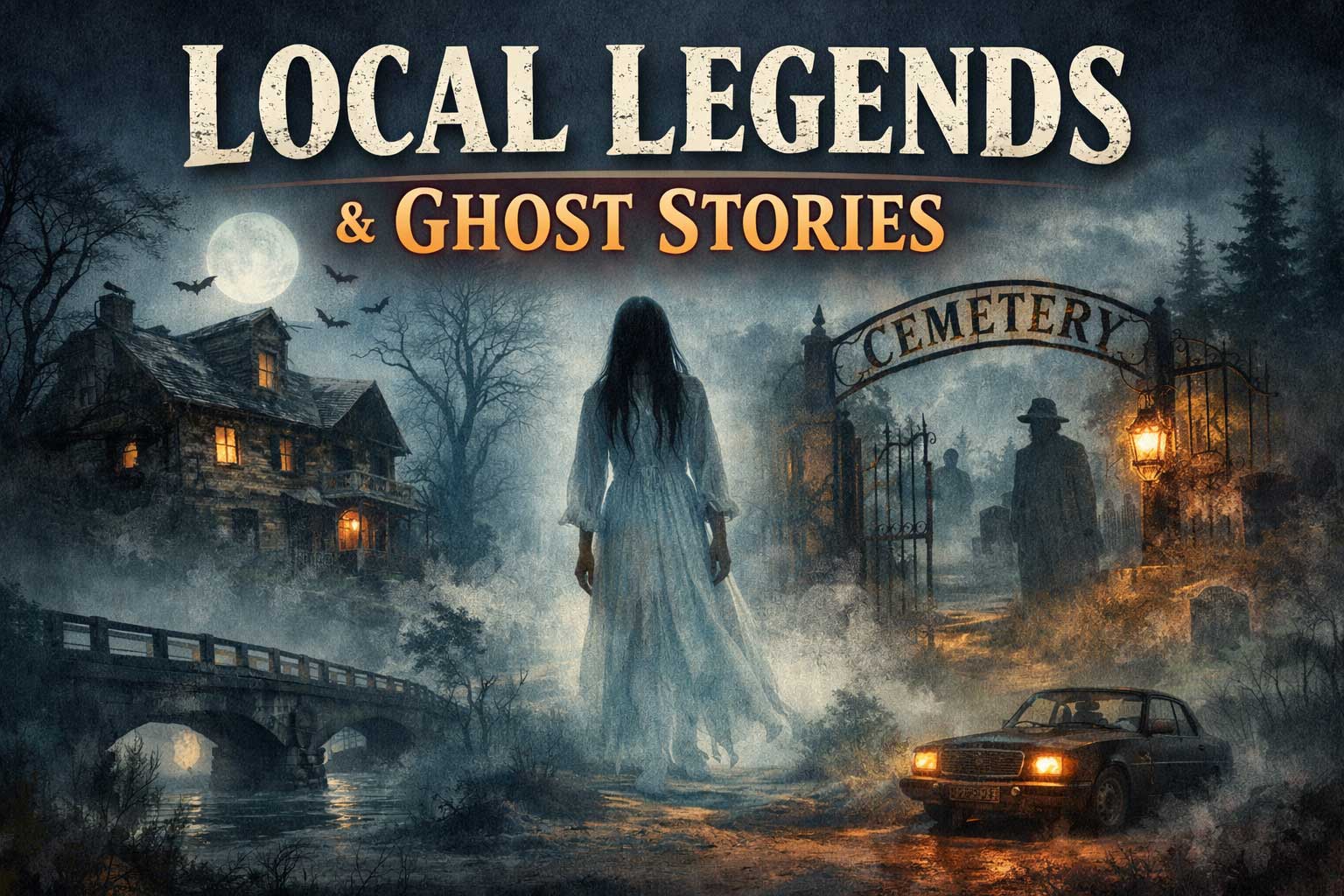
Local Legends & Ghost Stories: Origins, Meaning, and How They Spread
Local legends and ghost stories are some of the most powerful forms of storytelling humans have ever created. They can be funny, unsettling, mysterious, or oddly comforting—but they almost always feel close. They belong to a specific road, a specific pond, a specific house, a specific school hallway, a specific temple courtyard, a specific cemetery gate, a specific bend in the river where the fog gathers at dawn. Even when the story travels, it keeps the shape of a place.
People often talk about legends and ghost stories as “just entertainment,” but that explanation is too small. These tales have real jobs. They warn. They teach. They protect social rules. They help communities process grief and tragedy. They give names to fears that don’t have clear explanations. They turn ordinary landmarks into memory machines. And sometimes—especially when you hear the story from someone who swears it happened to their cousin’s friend’s brother—it feels like the world has more rooms than we can see.
This article dives deep into local legends and ghost stories: what they are, how they form, why they persist, how they change, and how to collect and tell them responsibly. Whether you’re a writer, a traveler, a curious reader, or someone who grew up hearing whispered stories during a blackout, you’ll find the hidden architecture behind these tales—and why they continue to thrive even in the age of smartphones.
What Counts as a “Local Legend” or a “Ghost Story”?
Before you can truly understand these stories, it helps to separate a few terms that people often mix together.
Local legends
A local legend is a story attached to a particular place or community, usually told as if it might be true—or at least as if the teller wants you to treat it seriously. Legends often involve:
- A specific location (bridge, tree, shrine, hill, abandoned building)
- A memorable character (a stranger, a spirit, a wronged lover, a hidden guardian)
- A repeated warning or lesson (“Don’t go there at night,” “Don’t disrespect the land,” “Don’t take what isn’t yours”)
- A sense of “I heard this from someone who knows”
Local legends do not require ghosts. Some are about lost treasure, secret tunnels, strange animals, curses, mysterious disappearances, or “the thing that lives in the water.” But even without the supernatural, they often carry that same chilling feeling: a boundary is being described, and crossing it has consequences.
Ghost stories
A ghost story is a tale about the presence of the dead—spirits, hauntings, apparitions, voices, footsteps, signs, or unexplained encounters that suggest someone is still there. Ghost stories come in many tones:
- Sad and reflective (a spirit that lingers out of love)
- Warning-based (a spirit tied to wrongdoing or injustice)
- Mischievous (a prankster presence)
- Protective (an ancestor spirit guarding family or land)
- Terrifying (a presence that feels threatening)
Not every ghost story is local, but the most memorable ones often are. When a ghost story anchors itself in a real building or road you can actually visit, it gains power. The location becomes a stage you can step onto.
Folklore, myth, and urban legends
- Folklore is the big umbrella: the traditions, tales, beliefs, proverbs, rituals, and superstitions of a community.
- Myths often involve gods or cosmic origins and explain “why the world is the way it is.”
- Urban legends are modern legends—often set in contemporary life—circulating through schools, cities, workplaces, and the internet. They tend to spread quickly and can adapt to new technologies (a haunted chat message, a cursed video, a warning about a “dangerous app,” and so on).
Local legends and ghost stories can overlap with all of these. A local ghost story can be folklore. A local legend can become an urban legend when it spreads beyond its home.
Why These Stories Feel So Real
Even people who insist they don’t believe in ghosts will still lower their voice when telling a good haunting story. That’s not an accident. Ghost stories and local legends use psychological tools that make the brain treat them as important.
1) Place-based credibility
A location gives a story weight. “There’s a haunted bridge” feels more believable than “somewhere there’s a haunted place.” Specificity tells your brain: This has coordinates. It could be checked.
2) “Friend of a friend” logic
Many legends use a chain of testimony: “It happened to my friend’s cousin.” This creates distance (so the teller can’t be easily challenged) while still implying a credible connection.
3) Emotional truth
Even if the facts are uncertain, the feelings are real. A story about a spirit waiting for someone who never came home hits something human: longing, grief, guilt, fear of loss. Emotional truth can make a story feel more convincing than evidence.
4) Pattern-seeking brains
Humans are built to detect patterns—especially threats. A strange sound at night becomes more meaningful if you already “know” a story about that hallway. Once the legend exists, ordinary coincidences can seem like confirmation.
5) Social reinforcement
Legends survive because they’re shared. A story told by a group around a fire, during a sleepover, or on a late-night drive becomes part of belonging. Believing (even temporarily) is a way of joining the circle.
The Hidden Purposes of Local Legends
Local legends often act like invisible signs posted on the landscape. They don’t just entertain—they guide behavior.
Legends as safety warnings
Some stories exist to keep people away from dangerous locations:
- Fast rivers, cliffs, unstable ruins, deep wells, thin ice
- Areas where people get lost easily
- Roads where accidents are common
A community may wrap a safety message in supernatural clothing because it sticks in memory. “Don’t go near the river at night” becomes more effective when it’s tied to a presence that “pulls people in.”
Legends as moral lessons
Many legends teach social rules:
- Respect elders and ancestors
- Don’t steal or disrespect sacred places
- Be careful with promises and loyalty
- Avoid cruelty and arrogance
The supernatural often acts as a dramatic judge, turning abstract morality into a vivid consequence.
Legends as history’s echo
Sometimes a community experienced a tragic event—war, famine, epidemic, a disaster, a betrayal—and the “official story” faded. A legend can preserve a shadow of truth even when details are blurred. The ghost becomes a symbol of unresolved memory.
Legends as identity
A town with a well-known legend has a shared narrative. Even if people joke about it, they still repeat it. It becomes part of “who we are,” like a local accent or a traditional dish.
How Ghost Stories Are Born
A ghost story rarely appears fully formed. More often, it grows from a seed—an event, a rumor, a feeling, a misinterpretation—and becomes a story through repetition.
Step 1: A spark
Common sparks include:
- A death, especially sudden or unjust
- An abandoned building with a mysterious past
- A location that triggers unease (poor lighting, echoes, isolation)
- An unexplained experience (sounds, lights, cold drafts, sleep paralysis)
Step 2: A narrative frame
Humans don’t like mystery without shape. So the community creates a frame:
- Who is the presence?
- Why are they here?
- What do they want?
- What happens if you go there?
Step 3: A signature detail
Great ghost stories have a repeated “signature”:
- A certain time (midnight, 3 a.m., dawn)
- A sound (footsteps, a bell, soft crying)
- A smell (flowers, smoke)
- A visual cue (a figure in white, a shadow near the stairs)
- A rule (“Don’t answer if you hear your name”)
The signature detail makes the story easier to retell—and easier to “confirm.”
Step 4: Community editing
Each retelling sharpens the story:
- boring parts get cut
- scary parts get clearer
- the lesson becomes stronger
- the location becomes more specific
Over time, the story becomes “the version everyone knows,” even though it’s been shaped by many mouths.
Classic Types of Local Legends and Hauntings
Across cultures, ghost stories and legends often fall into recognizable patterns. These aren’t strict categories—many stories blend them—but they help you see the underlying structure.
The Wronged Spirit
A person dies with unresolved injustice—betrayal, broken promises, stolen life plans. The haunting becomes a reminder that some wrongs do not vanish just because time passes.
Common themes:
- a search for truth
- a warning to others
- a demand for acknowledgment
These stories often feel sad more than scary, because they center on human unfairness.
The Guardian Presence
Not every spirit is portrayed as dangerous. Some tales describe an ancestral or protective presence:
- guarding a family home
- protecting a sacred tree or shrine
- warning people away from harm
These stories often include a rule of respect: if you behave properly, nothing bad happens.
The “Hitchhiker” or Traveler Ghost
One of the most widespread patterns: someone offers help or a ride to a stranger who later vanishes—or is discovered to have been dead.
Why it persists:
- it plays on guilt and kindness
- it involves a liminal space (roads, travel, night)
- it’s easy to adapt to any region
The Cursed Object or Place
A necklace, mirror, ring, doll, or book is said to carry misfortune. Or a place is “cursed” due to a past event. These stories often include rules:
- Don’t take anything from the site
- Don’t bring the object home
- Don’t mock the story
The rule is the engine. Once rules exist, people can test them—and “tests” create more stories.
The Ritual Legend
Some legends revolve around a dare:
- say a name repeatedly into a mirror
- knock on a door at a certain hour
- stand on a bridge and look down
- call out to the darkness and listen
The ritual creates a feeling of control. It turns fear into a game—especially among teens—while still allowing the story to “prove itself.”
The “Something in the Water”
Lakes, wells, ponds, and rivers are legendary magnets. Water is reflective, deep, and often dangerous. Many cultures tell of:
- spirits that lure people
- voices heard near the surface
- guardians of wells or springs
These stories often protect valuable water sources and keep people cautious.
The Shape-Shifter or Trickster
Not all legends are about the dead. Some describe beings that imitate human voices, appear as animals, or confuse travelers. These stories frequently teach:
- be cautious at night
- don’t wander alone
- trust your instincts
They also explain the eerie feeling of being watched in a dark forest or empty street.
The Role of Fear: Why We Choose to Be Scared
It’s worth asking: why do people enjoy stories that raise their heartbeat?
Fear as rehearsal
Ghost stories let people practice danger in a safe environment. You experience adrenaline while knowing you’re still in control. It’s like a fire drill for the imagination.
Fear as bonding
Sharing a scary story creates instant connection:
- People lean closer.
- Voices drop.
- Everyone reacts together.
A group that’s scared together often feels closer afterward.
Fear as meaning-making
Some fears are vague: death, loneliness, the unknown, injustice. Ghost stories give these fears a shape. A shapeless fear becomes a figure at the end of the hallway. Once it has a shape, it can be spoken about.
How Local Legends Spread and Change
A story survives when it can travel. And it travels best when it can adapt.
The “portable core”
Most legends have a core idea that stays the same:
- a spirit appears at a location at night
- a wronged person haunts those who repeat the wrongdoing
- a place punishes disrespect
Around that core, details can change freely:
- the name
- the outfit
- the exact building
- the year it happened
This flexibility is a survival trait.
The “localization effect”
When a legend enters a new community, it gets rewritten to fit local landmarks. A “haunted road” becomes your haunted road. A “spirit in white” becomes the figure seen near your school gate.
The “new media engine”
In earlier times, legends moved by word of mouth. Today, they move through:
- group chats
- short videos
- community forums
- comment sections
But the psychological rules are the same: specific details, social proof, and emotional punch.
Why Certain Places Become “Haunted” More Often
Not every building becomes the home of a legend. Certain features attract stories.
Abandoned or transitional spaces
Places that feel between categories—no longer used, not yet renewed—invite imagination:
- abandoned houses
- empty factories
- old theaters
- closed schools
- unused hospital wings
The silence feels like a question.
Echo-rich architecture
Long corridors, stairwells, high ceilings, and old wood floors create natural sounds: creaks, taps, thumps, echoes. These are perfect raw materials for legend-making.
Confusing layouts
Places where people get lost or disoriented—winding roads, dense forests, old alleys—create anxiety. Anxiety makes ordinary stimuli feel meaningful.
Places with heavy history
Locations tied to conflict, tragedy, or intense emotion are more likely to attract stories, because people already associate them with seriousness.
The “Rules” That Make Ghost Stories Work
One of the most interesting things about legends is that they often include rules—almost like a folk-law system.
Examples of legend rules:
- Don’t whistle at night.
- Don’t call someone’s name in an empty place.
- Don’t point at a grave.
- Don’t take stones from a shrine.
- Don’t mock the story while standing at the location.
Rules serve three purposes:
- They create tension.
- They invite testing.
- They generate new “evidence” when someone breaks them and later experiences a coincidence.
The legend becomes self-sustaining.
Psychological Experiences That Fuel Ghost Stories
Many ghost stories begin with real experiences. Not supernatural proof—just human perception under certain conditions.
Sleep paralysis
Some people wake up unable to move, sometimes sensing a presence nearby. It can feel terrifying and vivid. Cultures often interpret this experience through local folklore, which then reinforces the folklore.
Pareidolia (seeing patterns)
Faces in shadows, figures in curtains, shapes in fog—brains are wired to recognize familiar forms. At night, with low visibility, the brain fills in gaps.
Infrasound and environmental effects
Certain low-frequency sounds (from wind, machines, or building vibrations) can cause discomfort, unease, or a sense of dread in some people. Poor air quality, mold, or flickering lights can also affect mood and perception.
Social suggestion
If you enter a place already told it’s haunted, you become more sensitive to anomalies. That doesn’t mean you’re “making it up.” It means your attention is tuned differently.
Local Legends as Cultural Mirrors
The most telling part of a legend isn’t always the ghost—it’s what the story reveals about the community’s values and fears.
What the community protects
If a legend warns against entering a forest, it may reflect:
- real danger (wild animals, cliffs, getting lost)
- sacred meaning (ritual grounds, ancestral respect)
- boundaries (private land, taboo zones)
What the community fears
If a legend fixates on a stranger, a traveler, or a disguised figure, it may reflect:
- historical insecurity
- past conflict
- anxiety about outsiders
What the community regrets
Wronged-spirit stories often highlight:
- injustice ignored
- tragedies not properly mourned
- guilt passed down quietly
Legends let communities talk about what’s hard to say directly.
Famous Folklore Patterns Found Worldwide
Without turning this into a list of “top ten haunted places,” it’s still useful to know that many motifs appear across different regions because they tap into shared human concerns.
The Weeping Figure
A figure associated with mourning—often seen near water, roads, or bridges. The story may connect to loss, separation, or unresolved grief.
The Headless Wanderer
A symbol of incomplete identity, violent endings, or punishment. Often tied to roads at night. (Most versions avoid details and focus on the eerie image.)
The Vanishing Room
A hotel room, classroom, or building section that “doesn’t exist” on the map. People swear they entered it, but later cannot find it again. This motif thrives because it feels like a crack in reality.
The Haunted Call or Message
Modern legends often feature a voice note, missed call, or message from someone who shouldn’t be able to send it. These stories blend technology with the old fear: the dead crossing a boundary.
How to Collect Local Legends Responsibly
If you want to gather stories—whether for writing, research, podcasts, or community projects—how you collect them matters. Legends are part of people’s identity and sometimes tied to painful history.
Approach with respect
- Ask permission before recording or retelling a specific person’s account.
- Avoid mocking, especially in communities where spiritual beliefs are deeply held.
- Remember: even if the story isn’t factually proven, it can still be emotionally real to the teller.
Separate “story” from “claim”
You can preserve a legend without presenting it as confirmed fact. A respectful approach is:
- “People in the area tell a story that…”
- “Locals describe a belief that…”
- “The legend says…”
This honors tradition without pretending to verify the supernatural.
Watch for harm
Some legends target real people or groups unfairly. Be cautious about spreading stories that:
- blame outsiders without evidence
- accuse specific families
- encourage harassment or trespassing
A good storyteller can keep the mystery while avoiding damage.
Preserve context
A legend isn’t only its plot. It’s also:
- where it’s told
- when it’s told
- who tells it
- what emotions surround it
- what lesson it carries
If you remove the context, you remove half the meaning.
How to Tell a Great Ghost Story Without Overdoing It
The strongest ghost stories are often subtle. They don’t rely on extreme details. They rely on atmosphere, timing, and the feeling that something is slightly off.
Use sensory realism
Instead of describing something wildly impossible, describe something small and believable:
- a door that is always found slightly open
- footsteps that stop when you stop
- a smell that appears only in one corner
- a cold patch in a warm room
- a reflection that doesn’t match the angle
Small details create trust.
Build with escalation
Start normal. Add one odd detail. Then add a second. The listener’s mind does the work.
Keep the unknown intact
A story becomes less scary when it explains everything. Mystery is the oxygen of fear.
Make the place a character
In local legends, the location isn’t just scenery. It’s a living presence:
- “The alley narrows like it’s trying to close behind you.”
- “The river sounds louder there, as if it’s speaking in a different tone.”
When the place feels alive, the story feels inevitable.
End with a hook, not a lecture
A good ending doesn’t always conclude. Sometimes it leaves a door ajar:
- a final detail that doesn’t fit
- a repeated pattern
- a rule that someone broke—and nothing happened… yet
Why Skeptics Still Love Ghost Stories
You don’t have to believe in the supernatural to value these stories. Ghost stories can be enjoyed as:
- Cultural artifacts (what a community fears, values, remembers)
- Psychological puzzles (how perception and expectation interact)
- Narrative art (tension, pacing, and atmosphere)
- Social rituals (bonding, courage tests, late-night storytelling traditions)
In many ways, ghost stories are less about proving ghosts exist and more about proving humans are storytellers.
The Ethics of Haunted Tourism and “Legend Locations”
Some communities turn legends into attractions. This can be positive—supporting local businesses and preserving history—but it can also become harmful if it encourages disrespect.
Respect first, curiosity second
If a place is:
- a cemetery
- a memorial site
- a sacred location
- private property
Then respect is not optional. Legends don’t give permission to trespass or disturb.
Avoid turning tragedy into entertainment
If a legend is tied to real suffering, treat it like history, not a thrill ride. The goal should be remembrance and understanding, not cruelty.
Support the living community
If legends bring visitors, the benefits should not ignore the locals who keep the culture alive. Ethical storytelling considers who profits and who pays the cost.
How Local Legends Stay Alive in the Future
Modern life hasn’t killed folklore—it has upgraded it.
New settings, same fears
Old legends evolve into new forms:
- haunted elevators instead of haunted staircases
- ghostly messages instead of ghostly letters
- cursed digital files instead of cursed books
The technology changes, but the emotional engine stays the same: the unknown, the boundary, the warning.
Legends as community glue in a fast world
As cities grow and people move frequently, local identity can feel thin. Legends re-thicken the sense of place. They say: This is not just a street. This is a story.
The endless appetite for mystery
No matter how much science explains, humans still crave wonder and uncertainty. Ghost stories offer a controlled doorway into that uncertainty—one you can step through and then step back from.
Bringing It All Together: What These Stories Really Are
Local legends and ghost stories are not just tales about spirits or strange events. They are community-built narratives that shape how people understand place, memory, fear, morality, and belonging. They can carry warnings, preserve history, offer comfort, and turn ordinary landmarks into something that feels alive.
The reason these stories endure is simple: they speak a language older than modern life. They speak in footsteps in the dark, in wind through old trees, in roads that seem too quiet after midnight, in places where people feel watched even when no one is there. They remind us that the world is more than what we measure—and that human beings will always fill silence with meaning.
Whether you treat them as literal truth, metaphor, tradition, or entertainment, local legends and ghost stories remain one of the most vivid ways a community tells itself who it is—and where its invisible boundaries lie.