


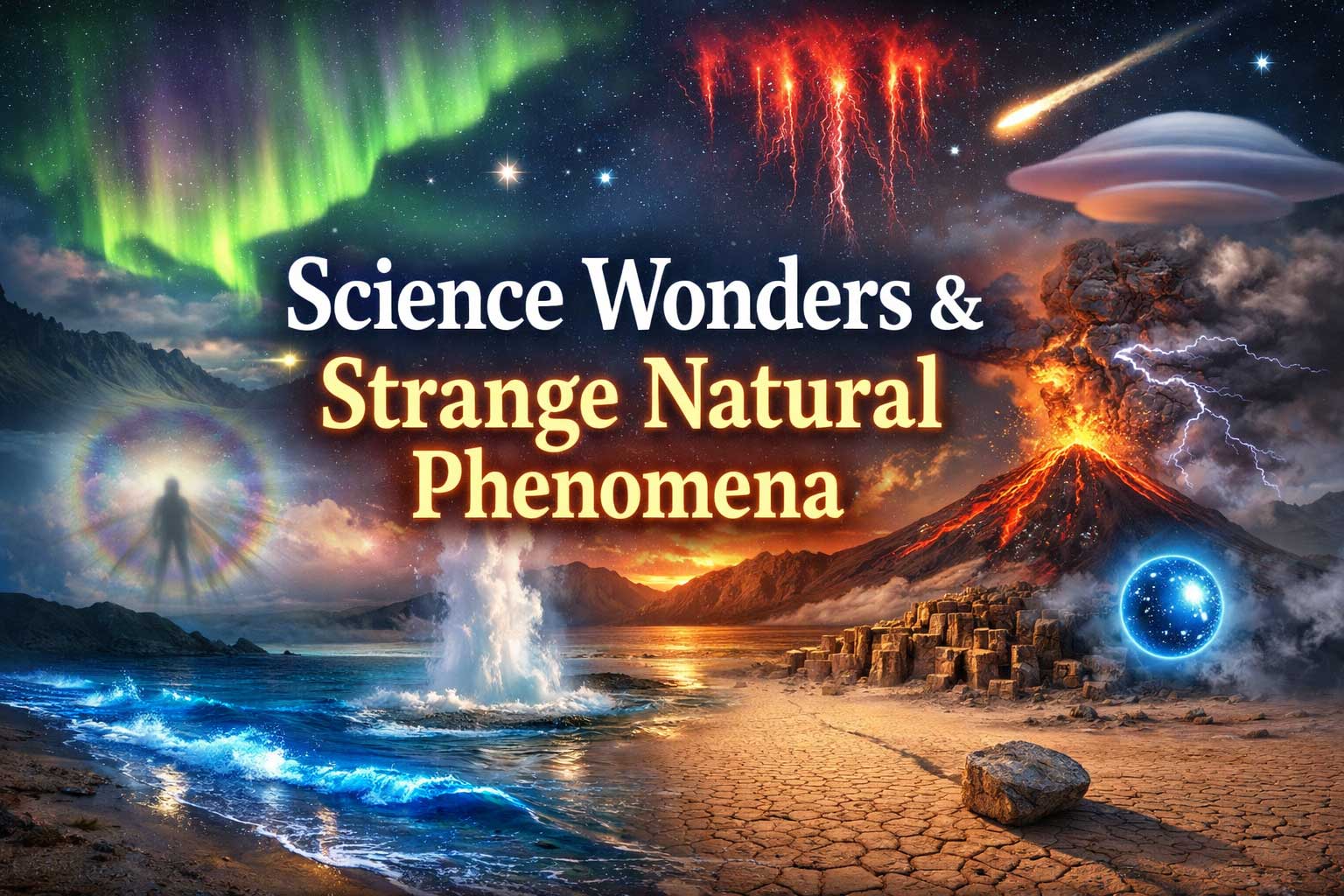
Science Wonders & Strange Natural Phenomena: A Deep Guide
Nature can look impossibly magical—sky curtains that glow green, waves that sparkle like stars, stones that “walk” across desert floors, and clouds shaped like UFOs. But the real wonder is this: the world doesn’t need fantasy to feel unbelievable. Ordinary physics, chemistry, geology, biology, and atmospheric science—operating at unusual scales or under rare conditions—can create spectacles that seem supernatural until you know the rules behind them.
This article explores science wonders and strange natural phenomena in depth. You’ll see how they form, why they’re rare, what scientists have learned from them, and what they reveal about our planet’s hidden processes. Along the way, you’ll discover a key theme: many “mysteries” are not unsolved because they’re impossible, but because they’re hard to measure—brief, remote, unpredictable, or occurring where instruments rarely sit at the right moment.
Why Nature Can Seem So Strange
Before diving into specific phenomena, it helps to understand why our brains label certain natural events as “weird.”
Rare conditions create familiar physics in unfamiliar ways
Many unusual events are simply common processes happening under extreme or finely tuned conditions—like temperature right at the freezing point, air layers stacked just so, or chemical concentrations within narrow ranges. The physics is normal; the circumstances are not.
Scale changes everything
At tiny scales, surface tension can dominate gravity. At huge scales, small differences in density can steer entire ocean layers. Scale shifts which forces matter most, and that can lead to surprising outcomes—like thin ice forming elaborate “flowers,” or internal ocean waves taller than skyscrapers.
We see patterns and assume intention
Humans are excellent at recognizing shapes—faces in clouds, rings in deserts, glowing patches in the sky. That’s a strength, but it can make natural patterns look designed. Many “mysterious” formations are the result of self-organization: simple rules repeated over time create complex designs.
The environment hides the cause
Some phenomena are the visible “final step” of a process that happens out of sight. A glowing aurora is powered by events on the Sun. A moving rock is pushed by thin ice you might never notice. A sudden fog bank is built by invisible moisture and temperature gradients.
Sky Spectacles: Strange Phenomena in the Atmosphere
The atmosphere is a laboratory made of flowing gas, sunlight, electricity, ice crystals, and aerosols. It constantly creates optical tricks and electrical events that look otherworldly.
Auroras: Curtains of light powered by the Sun
Auroras (often called the Northern and Southern Lights) occur when charged particles from the Sun—carried by the solar wind—interact with Earth’s magnetic field. The field funnels many particles toward high latitudes, where they collide with gases in the upper atmosphere.
- Oxygen emissions commonly produce green and red light.
- Nitrogen emissions can produce blue and purplish tones.
- The shimmering “curtain” look comes from charged particles spiraling along magnetic field lines and energizing atoms at different altitudes.
Auroras teach scientists about space weather, which matters because strong solar storms can disrupt satellites, radio communications, and power grids. In other words, this stunning phenomenon is also a warning sign that Earth’s magnetic shield is actively interacting with the Sun.
Sprites, jets, and elves: Lightning above the storms
Most people think lightning goes cloud-to-ground or cloud-to-cloud. But there are “upper-atmosphere lightning” events that occur far above thunderstorms:
- Sprites appear as red, jellyfish-like flashes high above storm clouds.
- Blue jets shoot upward like narrow cones from storm tops.
- Elves are expanding rings of light even higher up, often lasting only a fraction of a second.
These events are linked to powerful electrical changes in thunderstorms. Because they’re brief and occur high above clouds, they were difficult to confirm until modern low-light cameras and specialized sensors became widespread. Studying them improves our understanding of atmospheric electricity and how thunderstorms influence the upper atmosphere.
St. Elmo’s fire: A ghostly glow on sharp objects
St. Elmo’s fire is not fire at all. It’s a corona discharge—a faint glow caused when strong electric fields ionize air around pointed objects like ship masts, aircraft wings, or mountain peaks.
In intense weather, the electric field in the air rises. Sharp points concentrate electric fields, making it easier for air molecules to ionize and emit light. This glow can look eerie, but it’s a known electrical process—one that also hints that conditions may be favorable for lightning.
Ball lightning: Rare, debated, and difficult to study
Ball lightning is reported as a glowing sphere—sometimes drifting, sometimes moving oddly, occasionally appearing indoors during storms. It’s a classic “strange natural phenomenon” because it’s hard to capture reliably with instruments.
There isn’t a single universally accepted explanation, but several plausible mechanisms are studied:
- Vaporized material models: A lightning strike vaporizes soil or metal, producing a glowing plasma-like cloud.
- Electromagnetic trapping models: Energy becomes temporarily confined in a structure that maintains a luminous ball.
- Chemical models: Burning aerosols and reactive molecules might create sustained glow.
Ball lightning is a reminder that science sometimes struggles not because ideas are weak, but because data is scarce. Rare events require either luck or huge monitoring networks to capture.
Volcanic lightning: Storms made of ash
Eruptions can produce lightning inside ash plumes. Ash particles collide and rub against each other, building electric charge. If the charge separation becomes strong enough, the plume discharges like a thunderstorm.
This phenomenon helps scientists infer conditions inside eruption columns and can be used—along with other measurements—to monitor volcanic activity and hazards.
Lenticular clouds: “UFO clouds” shaped by airflow
Lenticular clouds look like smooth, stacked lenses—often mistaken for spacecraft. They form when stable, moist air flows over mountains and creates standing waves. At the crests of these waves, air cools and condenses into cloud. Because the wave structure is steady, the cloud can appear stationary even as air moves through it.
Lenticular clouds reveal how terrain shapes airflow and can indicate turbulence, which is important for aviation.
Noctilucent clouds: Electric-blue clouds at the edge of space
Noctilucent clouds form extremely high in the atmosphere—so high they can glow after sunset because they’re still lit by the Sun while lower air layers are dark.
They are made of tiny ice crystals and occur under rare conditions where it’s cold enough at those altitudes for ice to exist. Their study connects to atmospheric circulation, water vapor at high altitudes, and even the influence of tiny dust particles that help ice crystals form.
The green flash: A brief emerald spark at sunset
The green flash is a short-lived green spot or band sometimes seen at the top edge of the Sun as it sets or rises. It happens due to atmospheric refraction and dispersion: the atmosphere bends light, and different colors bend slightly differently. Under the right conditions—clear horizons and specific temperature gradients—the green component can momentarily stand out.
It’s a small phenomenon, but it’s a beautiful demonstration that the sky is constantly acting like a lens.
Optical Illusions in Nature: When Light Tricks the Eye
Some “strange” events aren’t objects or substances at all—they’re the result of how light moves through air and water.
Mirages and the Fata Morgana: Floating cities and upside-down ships
A mirage happens when light bends as it travels through air layers of different temperatures. Hot air is less dense than cool air, and that density gradient changes how light refracts.
- Inferior mirages often create “water on the road” illusions on hot days.
- Superior mirages can make distant objects appear higher than they are.
- Fata Morgana is a complex mirage that can stack and distort images, creating the appearance of floating cliffs, towers, or ships hovering above the horizon.
These illusions are strongest when strong temperature inversions create layered refractive structures. They’re not hallucinations—they’re real optical distortions that can be photographed.
Halos, sun dogs, and light pillars: Ice crystals as sky prisms
When sunlight passes through ice crystals in the air (often in thin cirrus clouds), it can create:
- Halos: rings around the Sun or Moon.
- Sun dogs: bright spots on either side of the Sun.
- Light pillars: vertical columns of light, often near sunrise/sunset or over bright streetlights in cold conditions.
Crystal shape and orientation matter. Plate-like crystals drifting flat can reflect light upward to form pillars. Random orientations can create halos. These phenomena are like giant atmospheric optics experiments—no glass required.
The Brocken spectre and glory: Your shadow becomes a giant
When you stand above a cloud layer with the Sun behind you, your shadow can appear projected onto the clouds, sometimes surrounded by colored rings. The shadow can look enormous due to perspective and the way cloud droplets scatter light.
- Brocken spectre refers to the magnified shadow effect.
- Glory refers to the colored rings caused by backscattering and wave interference in tiny droplets.
These phenomena demonstrate that light is both particle-like and wave-like in ways that show up in real life, not just textbooks.
Ocean Oddities: Strange Phenomena at the Water’s Edge
The ocean is a dynamic system where physics and biology constantly interact. Many of its strangest phenomena appear at night or far from shore, making them feel mysterious.
Bioluminescent waves: The sea that sparkles
Some marine organisms produce light through a chemical reaction involving a light-emitting molecule (often called luciferin) and an enzyme (often called luciferase). When disturbed by waves or movement, they flash—creating sparkling surf.
This isn’t just pretty; it’s ecological communication. Bioluminescence can:
- Startle predators
- Attract larger predators to attack a grazer
- Help organisms find mates or signal presence
- Provide camouflage through counter-illumination in deep water
Bioluminescence also inspires technology: researchers study it for medical imaging and biological sensors because light production can be tied to specific biological processes.
Milky seas: A rare glow across the horizon
Even stranger than sparkling waves are “milky seas”—vast areas of ocean that glow steadily at night, sometimes for hours or days. Rather than quick flashes from tiny plankton disturbed by waves, milky seas appear like a continuous luminous layer.
Evidence suggests certain luminous bacteria, sometimes associated with algae or organic matter, may create the effect when conditions allow high concentrations and collective light emission. Because these events occur far offshore and unpredictably, they’re difficult to investigate directly—yet satellite observations and ship reports have helped build scientific understanding.
Rogue waves: The ocean’s sudden walls of water
Rogue waves are unusually large waves that can appear unexpectedly. They’re not just tall; they can be disproportionately steep and powerful compared to surrounding seas.
Mechanisms that can contribute include:
- Constructive interference: multiple waves align to form a bigger wave.
- Current-wave interactions: opposing currents can compress wave energy, increasing height.
- Nonlinear focusing: wave energy can self-amplify under certain conditions.
Rogue waves matter for ship safety and offshore engineering. They’re a real example of how complex systems can produce rare extremes.
Brinicles: Underwater “ice fingers”
In polar regions, a phenomenon called a brinicle can form when sea ice creates very salty, super-cold brine that drains downward into the ocean. This sinking brine freezes surrounding seawater, forming a hollow tube of ice that grows downward like an icicle under water.
Brinicles demonstrate how salt, freezing, density, and fluid flow combine into a striking structure. It’s a reminder that ice isn’t just frozen water; it’s part of a larger chemical and physical system.
Internal waves: Giant waves you don’t see from above
Not all waves happen at the surface. The ocean has layers of different densities (from temperature and salinity differences). Where these layers meet, gravity can generate internal waves—sometimes enormous—rolling through the ocean’s interior.
Internal waves can affect:
- Nutrient mixing
- Marine life distribution
- Submarine navigation
- Climate-related ocean circulation patterns
They’re “strange” because they’re hidden, but they shape ocean behavior on massive scales.
Earth and Rock Mysteries: Strange Geological Phenomena
Geology often appears slow—mountains rising over millions of years. But Earth can also produce fast, weird, and highly patterned events.
Sailing stones: Rocks that move without hands
Some desert flats have rocks that leave long tracks as if they slid across the ground. For years, people debated wind, magnetism, and other ideas. The key turned out to involve rare conditions:
- Thin water covers the flat.
- Nights freeze the surface into floating ice sheets.
- Gentle winds push ice, which nudges rocks.
- The wet mud surface allows rocks to glide, leaving tracks.
The rocks move slowly, often when no one is watching. The phenomenon is a perfect example of a “mystery” solved by combining patient observation with understanding of ice physics and wind forces.
Singing sand dunes: Dunes that hum or boom
Some sand dunes can produce a deep humming or booming sound when sand avalanches down the slope. The sound can be loud and sustained.
The leading explanation involves grains sliding together in a synchronized way. Grain size, dryness, shape, and the dune’s structure can create conditions where the moving layer of sand resonates, turning many tiny collisions into a coherent sound wave.
This phenomenon connects geology to acoustics and materials science: granular materials can behave in unexpectedly organized ways.
Columnar basalt: Nature’s polygon stone architecture
Columnar basalt forms when thick lava flows cool and contract. Cooling causes the rock to shrink, creating stress fractures. The fractures often organize into polygon patterns (commonly hexagons) because hexagons efficiently distribute stress in a uniform field.
This is natural pattern formation: the rock is not “trying” to make hexagons, but the physics of cracking favors repeating shapes. Similar polygon patterns show up in dried mud, paint, and even some biological tissues.
Mud volcanoes and “breathing” Earth
Mud volcanoes are not magma volcanoes. They occur when underground gases and fluids push mud upward through vents. The result can be bubbling pools, cones, and sudden eruptions of cold or warm mud.
They can be linked to:
- Tectonic compression
- Hydrocarbon-bearing sediments
- Underground pressure changes
They matter because they can release gases and indicate subsurface conditions—sometimes even warning of changes in underground pressure.
Earthquake lights: Strange glows near seismic activity
Earthquake lights are reported as unusual glows or flashes in the sky associated with earthquakes. They’re controversial because reports are sporadic and conditions vary. However, research suggests possible mechanisms:
- Stress in rocks can generate electric charges.
- Certain minerals may produce electrical effects under pressure (piezoelectric-like behavior in specific contexts).
- Charges could ionize air near the ground, producing light.
Even if not fully understood, the phenomenon pushes scientists to study how mechanical stress, rock chemistry, and electricity interact during tectonic events.
Ice circles and spinning river disks
In slow-moving rivers and lakes, large circular ice disks can form and rotate. They can happen when:
- A chunk of ice breaks off.
- It gets caught in a gentle rotating current (an eddy).
- The rotation smooths the edges into a circle as the disk bumps against surrounding ice or water.
It looks surreal—like a spinning platter of ice—yet it’s a straightforward result of fluid dynamics and friction.
Blood-colored water and strange mineral springs
Sometimes water turns vivid red, orange, or milky blue due to minerals, microorganisms, or chemical reactions.
- Iron-rich water can oxidize, creating red or orange staining.
- Certain microbial communities can produce pigments.
- Fine mineral particles can scatter light, producing unusual colors.
These places help scientists study geochemistry and extremophile life, showing how biology can thrive in conditions that seem hostile.
Living Light and Weird Biology: When Life Looks Unbelievable
Biology produces some of the most astonishing “science wonders,” because living systems can evolve solutions that look like science fiction.
Bioluminescence: Nature’s chemical lantern
Bioluminescence appears in insects, fungi, fish, jelly-like animals, and many ocean microorganisms. The light is typically “cold light,” meaning it produces little heat—highly efficient compared to incandescent bulbs.
Bioluminescent systems vary:
- Some organisms make light internally.
- Some rely on symbiotic bacteria housed in special organs.
- Some can control flashes, patterns, and intensity.
In the deep sea, bioluminescence is incredibly common because sunlight doesn’t reach those depths. Light becomes a language: lure prey, communicate, confuse predators, and camouflage.
Deep-sea gigantism and extreme adaptations
Deep-sea environments can produce animals that look exaggerated: giant versions of relatives found in shallow waters, or creatures with enormous mouths, long feelers, or flexible bodies.
Why? Several factors can contribute:
- Cold temperatures can slow metabolism and favor long lifespans.
- Scarce food can reward opportunistic feeding strategies.
- High pressure and darkness shape sensory systems.
Some animals use smell and vibration rather than sight. Others create their own light. Many have slow, energy-saving lifestyles—an adaptation to scarcity.
Magnetoreception: Animals that sense Earth’s magnetic field
Some birds, sea turtles, fish, and possibly other animals can detect Earth’s magnetic field to navigate. The mechanisms likely involve:
- Magnetite particles in tissues (acting like tiny compass needles), and/or
- Quantum-level effects in light-sensitive proteins that respond differently depending on magnetic orientation
This is one of the most mind-bending natural abilities because it suggests biology can use physics in ways humans don’t directly perceive.
Extremophiles: Life thriving in “impossible” places
Extremophiles are organisms that live in conditions once thought uninhabitable: high heat, intense acidity, extreme salinity, or high radiation.
They matter because they expand our understanding of what life can tolerate and how it can persist. They also guide astrobiology: if life can thrive in Earth’s harsh niches, it may be possible elsewhere under the right conditions.
Slime molds and decentralized intelligence
Slime molds can solve maze-like problems, find efficient paths to food, and reorganize themselves in ways that look purposeful—despite having no brain. They’re an example of how complex behavior can emerge from simple rules.
Scientists study slime molds to understand:
- Collective behavior
- Decision-making without a central controller
- Efficient network design and resource distribution
It’s a biological reminder that “intelligence” is not one single blueprint. Nature evolves many ways to sense and respond.
Synchronized fireflies: A living light show
In some regions, fireflies can synchronize their flashes, producing waves of light across a forest. This can happen when individuals adjust their timing based on neighbors—like biological metronomes slowly aligning.
The phenomenon connects to a broader science topic: synchronization in complex systems. Similar math appears in:
- Heart pacemaker cells
- Neuron rhythms
- Power grid stability
- Crowd movement dynamics
Nature’s beauty often mirrors deep principles that show up across many fields.
Chemistry and Physics You Can See: Strange Material Behaviors
Some of the most fascinating natural phenomena happen when materials behave in ways that violate our everyday expectations.
Supercooled water: Liquid below freezing
Water can sometimes stay liquid below 0°C if it lacks impurities or disturbances that normally trigger freezing. Once disturbed, it can freeze rapidly, forming intricate ice structures.
Supercooling helps explain:
- Certain types of ice storms
- Some rapid ice formation events in nature
- How ice crystals begin forming in clouds (important for weather)
It also shows that phase changes aren’t just about temperature—they’re about nucleation, structure, and triggers.
Frost flowers: Delicate ice blooms on new sea ice
In polar regions, delicate crystalline “flowers” can grow on the surface of new sea ice when:
- Air is very cold.
- Ice is thin.
- Moisture rises and freezes into complex shapes.
These structures can concentrate salts and interact with atmospheric chemistry. They’re both beautiful and scientifically important because they affect how chemicals move between ocean and air.
The Leidenfrost effect: Water skittering on heat
When a liquid touches a very hot surface, the bottom layer can vaporize instantly, creating a cushion of gas that lets the droplet glide. You can see this when droplets dance on a hot pan.
In nature and industry, similar principles can influence how liquids behave on hot surfaces, how cooling occurs, and how heat transfer changes under extreme conditions.
Non-Newtonian behavior: When “fluid” doesn’t act like a fluid
Some mixtures behave like a liquid when handled gently but act like a solid when stressed suddenly. This behavior depends on particle interactions and how force changes the internal structure.
While many classic examples are man-made mixtures, nature also contains complex slurries—mudflows, volcanic ash-water mixtures, and sediment-laden currents—whose flow behavior can be surprisingly complex and hazardous. Understanding these behaviors improves models for landslides and debris flows.
Triboluminescence: Light from breaking or rubbing materials
Some crystals and materials emit light when fractured or rubbed, due to electrical charge separation and rapid discharge. In natural settings, similar processes can occur when rocks fracture under stress—one reason triboelectric and fracture-related electrical effects are considered in studies of unusual lights associated with geological activity.
Even when the light is faint, the underlying lesson matters: mechanical energy can become electrical energy, which can become visible light under the right conditions.
Oscillating chemical reactions: When colors pulse on their own
Certain chemical systems can change color rhythmically as reaction pathways cycle. These “chemical oscillators” show that reactions can be dynamic rather than simply moving one-way to completion.
In nature, analogous oscillations appear in biological rhythms, ecological cycles, and geochemical processes—systems where feedback loops create repeating patterns.
Strange Sounds, Vibrations, and Invisible Forces
Not all wonders are visual. Some are heard—or felt.
Infrasound: The low-frequency world
Infrasound is sound below the range of human hearing. Volcanoes, storms, ocean waves, and even large animal calls can generate infrasound. While you might not “hear” it, you may feel unease, pressure, or vibration.
Scientists use infrasound sensors to detect:
- Volcanic eruptions
- Meteors exploding in the atmosphere
- Severe storms and tornadoes
- Large waves and distant ocean activity
This turns the planet into an instrument: Earth’s processes generate vibrations that can be measured and interpreted.
The “hum”: When people report mysterious low tones
Some communities report persistent low-frequency hums with unclear sources. Sometimes the cause is found—industrial equipment, traffic patterns, resonance in structures, or environmental conditions that carry sound efficiently. Sometimes it remains uncertain, especially when multiple small sources combine.
What’s fascinating scientifically is that sound can travel in complex ways depending on temperature layers, wind, humidity, and terrain—making certain tones seem to “appear” or “disappear” based on conditions.
Resonance in nature: When timing amplifies force
Resonance happens when repeated forces match a system’s natural frequency, building larger oscillations. Nature contains resonant systems everywhere:
- Wind interacting with structures
- Waves pushing into bays
- Air vibrating in cavities
- Seismic energy amplifying in certain ground types
Resonance explains why modest forces can sometimes produce dramatic effects. It’s not always about being stronger; it’s about being timed perfectly.
Space Wonders Seen from Earth
Space phenomena can be subtle or spectacular, and they connect Earth to the broader cosmos.
Meteors, fireballs, and airbursts
Meteors are small particles burning up in the atmosphere. Occasionally, larger objects create bright fireballs. If a body breaks apart explosively in the atmosphere, it can produce an airburst—releasing energy as a shockwave.
Scientists track meteors to learn about:
- The composition of small solar system bodies
- The frequency of atmospheric entries
- Potential impact risks
Zodiacal light and gegenschein: Dusty sunlight
After sunset or before sunrise, under very dark skies, you may see a faint triangular glow along the ecliptic. This is zodiacal light—sunlight scattered by dust in the inner solar system.
Gegenschein is a related faint glow opposite the Sun in the night sky. These are subtle phenomena, but they reveal that the solar system is not empty. It contains fine dust that shapes how light travels.
Lunar and planetary illusions near the horizon
The Moon can look huge near the horizon compared to when it’s high in the sky. This “Moon illusion” is largely psychological: our brains interpret the horizon as far away and the sky dome as closer, changing perceived size even though the Moon’s angular size remains roughly constant.
It’s a reminder that perception is part of the natural experience—and sometimes the “strange phenomenon” is partly inside our own interpretation system.
How Scientists Solve Mysteries in Nature
Strange natural phenomena aren’t solved by guessing; they’re solved by gathering evidence. The challenge is that rare events may not happen when researchers are ready.
Instruments turn fleeting moments into data
High-speed cameras, low-light sensors, satellites, radar, spectrometers, magnetometers, seismic arrays, ocean buoys, and chemical sensors let scientists “freeze” events that our eyes miss.
- High-speed footage can reveal how sprites evolve in milliseconds.
- Spectroscopy can identify which atoms are producing auroral colors.
- Satellite imaging can spot large-scale ocean glow events.
- Seismic networks can detect subtle ground changes leading to landslides or eruptions.
Models test whether explanations can work
A good explanation must do more than sound plausible—it must match numbers:
- Can the wind force actually move a rock across mud?
- Does the energy in a storm support the observed upper-atmosphere lightning?
- Can known wave dynamics generate a rogue wave of that height?
Models help eliminate ideas that can’t meet physical constraints and refine those that can.
Citizen observations matter—when combined with verification
Because many strange events happen unexpectedly, public photos and reports can be valuable. But science requires careful verification:
- Time and location confirmation
- Weather data cross-checks
- Multiple viewpoints
- Instrument consistency
When those align, citizen documentation can become a powerful part of discovery, especially for phenomena that are too rare for permanent on-site monitoring.
What These Wonders Teach Us About the Planet
Beyond being impressive, strange natural phenomena provide real scientific value.
They reveal hidden layers of Earth’s systems
- Auroras reveal magnetic and solar interactions.
- Internal waves reveal ocean layering and energy transfer.
- Mirages reveal atmospheric stratification.
- Ice phenomena reveal salinity, temperature gradients, and phase-change physics.
They help predict hazards and protect infrastructure
Understanding volcanic lightning can improve eruption monitoring. Rogue wave research improves ship design. Infrasound monitoring can support early warnings. Knowledge of debris-flow physics can guide safer land planning.
They inspire technology and new science
Bioluminescence inspires medical imaging and biosensors. Self-organized patterns in geology influence materials research. Magnetoreception studies push biology into deeper physics questions.
They remind us that “ordinary” rules create extraordinary beauty
The biggest lesson might be philosophical but grounded in science: the world is not weird because it breaks laws; it’s weird because its laws—applied across countless conditions—produce endless outcomes.
Conclusion: The Real Mystery Is How Much There Is to Learn
Science wonders and strange natural phenomena are not just curiosities. They are windows into Earth’s deep machinery—how air bends light, how oceans move energy, how rocks crack into patterns, how life generates light and senses invisible fields, and how space constantly influences our planet.
Some phenomena are now well explained, while others remain partly uncertain due to rarity and limited data. But the direction is clear: as observation tools improve and more data accumulates, nature’s “mysteries” often become even more impressive—because the scientific story behind them is richer than any myth.
And that’s the best kind of wonder: the kind that grows, not shrinks, when you understand it.