

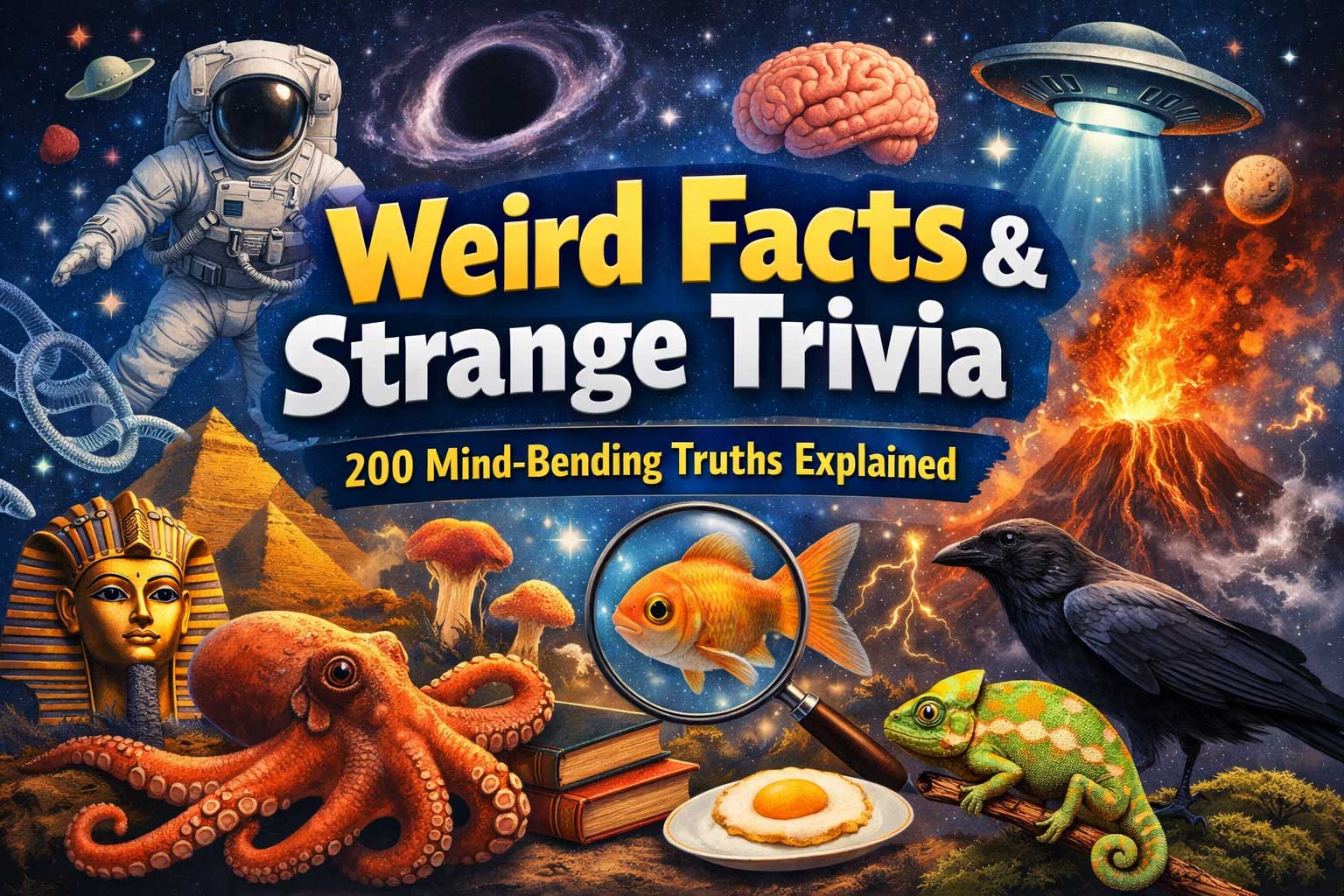
Weird Facts & Strange Trivia: 200 Mind-Bending Truths Explained
Weird facts and strange trivia are fun because they hit your brain in two places at once: surprise and certainty. A good weird fact makes you pause—“No way”—and then it sticks because it’s easy to repeat and feels like secret knowledge. But the best kind of trivia does more than shock you. It comes with context: how we know it’s true, what people often misunderstand, and why it matters.
This article is built exactly for that. You’ll get a giant collection of weird facts and strange trivia, grouped by theme, but each one comes with a clear explanation. Some are truly wild. Some are “technically true” with important details. And some common internet “facts” are included specifically so we can debunk or correct them.
Table of Contents
- The Psychology Behind Weird Facts
- Space & Time Oddities
- Earth, Oceans, and Weather Weirdness
- The Human Body’s Strangest Truths
- Animals With Real Superpowers
- Plants, Fungi, and Microscopic Weirdness
- Food, Materials, and Everyday Object Trivia
- History’s Strangest Verified Moments
- Language, Numbers, and Logic Curiosities
- Technology and Modern Life Quirks
- Myth vs Fact: “Weird Facts” That Need Context
- How to Remember Trivia Like a Pro
- FAQ
The Psychology Behind Weird Facts
Weird facts feel “sticky” for a reason
A random fact becomes memorable when it triggers one or more of these:
- Violation of expectation: It contradicts what your brain predicts.
- Vivid imagery: Your mind can picture it quickly.
- Simple packaging: Short, repeatable structure.
- Social value: You can tell it at a party and get a reaction.
Strange trivia is often “compressed science”
Many weird facts are actually the short version of a bigger story. For example, saying “octopuses have three hearts” is true, but the interesting part is what those hearts do and why evolution built them that way. The “why” turns trivia into understanding.
Why humans love “odd but true”
Your brain is constantly learning what’s safe, what’s useful, and what patterns exist. A weird fact is like a puzzle piece that doesn’t fit until you rotate it. That “click” of re-framing is satisfying. It’s the same reason plot twists are enjoyable—except trivia happens in real life.
Space & Time Oddities
Space is the best source of strange trivia because it refuses to behave like everyday life.
1) Space is not truly empty
Even in deep space, there are particles, radiation, and fields. “Vacuum” mainly means “extremely low density,” not “nothing.”
2) You can’t hear sound in space
Sound needs a medium like air or water. Space has too few particles for sound waves to travel the way they do on Earth.
3) The International Space Station experiences “sunrise” many times per day
Because it orbits Earth roughly every 90 minutes, it passes into daylight and darkness repeatedly.
4) Astronauts can grow slightly taller in orbit
In microgravity, the spine decompresses a bit because it isn’t constantly compressed by body weight.
5) A day is not the same length on every planet
- Mercury and Venus have strange rotation behaviors.
- Some planets spin so fast their day is only hours long.
- Others rotate slowly enough that “a day” can be longer than “a year.”
6) On Venus, a day is longer than a year
Venus rotates very slowly. Its rotation period is longer than its orbit around the Sun.
7) Time is not universal in the way it feels
Einstein’s relativity means time can pass at different rates depending on gravity and speed. Your everyday life doesn’t notice it, but high-precision clocks do.
8) Black holes aren’t “cosmic vacuum cleaners”
They don’t magically suck everything. You’d have to get extremely close—closer than a safe orbit distance—to be pulled in.
9) A teaspoon of neutron star material would be unimaginably heavy
Neutron stars pack enormous mass into a tiny volume. The densities are beyond normal intuition.
10) The Sun is so big you could fit over a million Earths inside it (by volume)
This kind of scale fact is classic weird trivia because it rewires how “big” you think the solar system is.
11) There are places in the universe where “ice” is hot
In extreme environments, “ice” can refer to solid forms of substances that aren’t water, like ammonia or methane. Temperatures can still be far below what humans can tolerate, but chemistry changes what “ice” means.
12) You are always moving—even when you stand still
Earth spins, Earth orbits the Sun, the Sun orbits the galaxy, and the galaxy moves relative to others. “Stillness” is local.
13) The night sky is a time machine
Light takes time to travel. When you look at distant stars, you see them as they were long ago.
14) A planet can rain rocks (in theory, and maybe in reality)
In certain atmospheres, unusual chemistry and pressure could allow solid particles to “rain” in ways that feel impossible compared to Earth.
15) Some “stars” you see may already be gone
Because of light travel time, you can see light from objects that changed or ended long before the light reached you.
Earth, Oceans, and Weather Weirdness
Earth is a weird planet. It just feels normal because you grew up here.
16) Earth is not a perfect sphere
It bulges slightly at the equator due to rotation. It’s closer to an “oblate spheroid.”
17) The ocean is still largely unexplored
We map coastlines and shallow seas fairly well, but huge sections of the deep ocean remain mysterious.
18) There are underwater rivers and lakes
In some places, salty water and chemical conditions create dense layers that flow like rivers beneath normal seawater.
19) Most of Earth’s habitable space is actually underground (for microbes)
Microbial life can thrive deep in rocks, within ice, and in extreme environments that would be deadly for humans.
20) Lightning can strike the same place repeatedly
Tall structures and certain landscapes are frequent targets.
21) “Petrichor” is the smell of rain—and it has a scientific cause
The scent comes from oils, plant compounds, and soil bacteria interacting with moisture, releasing aerosols into the air.
22) Some deserts get snow
“Desert” describes low precipitation, not temperature. Cold deserts exist.
23) The hottest and coldest places on Earth can both be extremely dry
Dryness and temperature aren’t the same thing.
24) You can see Earth’s curvature from high altitude
You don’t need to go to space—just high enough and with the right conditions.
25) Water can boil and freeze at the same time (under special pressure conditions)
Phase diagrams are the secret behind many “that can’t be real” facts.
26) Ice can be slippery because it partially melts under pressure and friction
Slipperiness is a mix of pressure effects, frictional heating, and a thin film of water.
27) The strongest winds aren’t always in storms you expect
Mountain passes, pressure gradients, and local geography can create intense winds.
28) There are “singing” sands
Some dunes produce a low hum or booming sound when sand slides in a particular way.
29) A river can flow backward temporarily
Tides, storms, or unusual pressure patterns can push water upstream.
30) Earth’s magnetic poles wander
They drift over time. A compass points toward magnetic north, which isn’t fixed and isn’t the same as geographic north.
31) There are places where rocks “move” on their own
In certain dry lake beds, thin ice, wind, and slick mud can cause rocks to slide, leaving trails behind them.
32) Volcanoes can create lightning
Ash clouds can build up static charge, leading to volcanic lightning—one of nature’s most dramatic combinations.
The Human Body’s Strangest Truths
Your body is full of weird facts, but biology makes them logical.
33) You are more bacteria than you think (and that’s not automatically bad)
Your body hosts a huge community of microbes. Many are helpful, and the relationship can be complex.
34) Your stomach replaces its lining frequently
This helps protect it from the acid and enzymes it uses to digest food.
35) Your bones are living tissue
They constantly remodel, responding to stress and repair needs.
36) Your brain can “fill in” missing information
Vision isn’t a perfect camera. Your brain reconstructs reality using prediction and context.
37) You have a blind spot in each eye
Where the optic nerve connects, there are no photoreceptors. Your brain fills the gap so you don’t notice.
38) Your body glows—very faintly
Humans emit a tiny amount of light due to biochemical reactions, but it’s far too weak for the eye to see.
39) Goosebumps are a leftover feature from hairier ancestors
They helped trap air for warmth or make an animal look larger when threatened.
40) Your fingerprints begin forming before you’re born
Their patterns are influenced by genetics and tiny differences in development conditions.
41) Taste is strongly linked to smell
A lot of what you call “taste” is actually aroma traveling to your nose.
42) Your tongue doesn’t have “separate zones” for sweet, salty, sour, bitter
That old map is misleading. Taste receptors are more distributed than that myth suggests.
43) Your body can trick you into feeling hungry when you’re thirsty
Signals can overlap, especially when you’re tired or dehydrated.
44) You can get “brain freeze” from cold food
Cold triggers nerves and blood vessels in the mouth, creating a referred pain response that feels like it’s in the head.
45) Your heart can keep beating outside the body for a short time (under the right conditions)
Heart muscle has its own electrical properties, though it still needs oxygen and proper conditions.
46) You produce saliva constantly
It’s essential for digestion, oral health, and comfort.
47) You shed skin continuously
The dust in many homes includes a mix of fibers, soil, and shed skin cells.
48) Your body temperature isn’t always exactly the same
It varies throughout the day, and “normal” has a range.
49) You can dream in short bursts without remembering
Sleep cycles and memory formation decide what you keep.
50) The “sound” of your voice in recordings feels wrong because of bone conduction
When you speak, you hear your voice through air and vibrations in your skull. Recordings remove the skull component.
Animals With Real Superpowers
Nature is a superhero factory. Many “superpowers” are just evolution solving problems with weird tools.
51) Octopuses have three hearts
Two pump blood to the gills, and one pumps it to the rest of the body. Their blood chemistry is also unusual compared to ours.
52) Octopus blood is not red like ours
It uses a different oxygen-carrying molecule than human hemoglobin, contributing to different properties.
53) Some lizards can detach their tails
It’s a survival strategy called autotomy. The tail may wiggle to distract predators while the lizard escapes.
54) Starfish can regenerate
Some can regrow parts of their bodies. Regeneration varies by species.
55) Tardigrades are famously tough
They can survive extreme environments by entering a “tun” state, drastically reducing metabolism.
56) Sharks have existed longer than trees
This kind of timeline fact is excellent trivia because it sounds impossible until you remember how old life on Earth is.
57) Bees can communicate direction and distance
They use movement patterns to signal where food is, effectively sharing navigation information.
58) Dolphins use echolocation
They produce sounds and interpret echoes to “see” their environment through sound.
59) Owls have remarkably silent flight
Feather structures reduce noise, helping them hunt stealthily.
60) A shrimp can create a shockwave with a snap
Some snapping shrimp produce a cavitation bubble that collapses with force, creating a sharp sound and a burst of energy.
61) Certain frogs can freeze partially and survive
Some species produce protective chemicals that limit damage. It’s a deeply weird adaptation.
62) Some fish change sex
In certain species, social structure or environmental conditions can trigger sex change, which can be advantageous for reproduction.
63) Pigeons can navigate using multiple cues
Sun position, landmarks, odors, and possibly magnetic sensing contribute to their navigation skills.
64) Cats have an extra “compass” in their bodies (sort of)
Their whiskers and sensory systems detect subtle changes in air currents and space, making their movement feel almost supernatural.
65) Crows and ravens can solve puzzles
They can use tools, plan steps, and demonstrate problem-solving that surprises many humans.
66) Ant colonies behave like a “super-organism”
No single ant understands the whole plan, yet the colony organizes complex behavior through local rules.
67) Some animals see ultraviolet
Many birds and insects detect UV patterns invisible to humans, changing how flowers and feathers “look” to them.
68) Mantis shrimp vision is famously complex
Their eyes detect a wide range of light information, and their punch is extremely fast.
Plants, Fungi, and Microscopic Weirdness
If you think plants are boring, trivia will fix that.
69) Bananas are berries (botanically)
Botany uses definitions that don’t match grocery-store categories.
70) Strawberries are not berries (botanically)
The seeds on the outside play a role in the classification.
71) Mushrooms are closer to animals than plants (in major biological grouping terms)
Fungi have different cell structures and energy storage methods.
72) Fungi can form huge underground networks
Mycelium spreads through soil and can connect large areas, moving nutrients and signals.
73) Some plants “move” quickly
Venus flytraps snap shut. Mimosa plants fold leaves when touched. Movement can be surprisingly fast.
74) Plants can “talk” chemically
They release chemicals that attract predators of pests or warn nearby plants, depending on conditions.
75) Trees can share resources through fungal networks
In some ecosystems, fungi connect roots, and resources can shift through the network.
76) Bamboo can grow extremely fast
Under the right conditions, it can grow astonishingly quickly compared to typical plants.
77) Some flowers mimic insects
Orchids and other plants can lure pollinators by resembling shapes or scents that trigger insect behavior.
78) “Zombie” fungus exists in nature
Some fungi can influence insect behavior to spread spores. It’s real, and it’s as creepy as it sounds.
79) Lichens are a partnership
They’re a combination of fungus and algae (or cyanobacteria) living together.
80) The majority of life by number is microscopic
Bacteria, archaea, and microscopic eukaryotes dominate the planet in ways humans rarely visualize.
Food, Materials, and Everyday Object Trivia
Everyday life is full of weird facts hiding in plain sight.
81) Honey can last a very long time without spoiling
Its low water content and acidity create conditions that slow microbial growth. It can crystallize, but that isn’t the same as “going bad.”
82) Salt was once so valuable it helped shape economies
In many societies, salt was essential for preservation and nutrition, making it strategically important.
83) A microwave heats food differently than an oven
Microwaves excite water molecules and heat unevenly, while ovens use surrounding hot air and surface browning.
84) Glass is an amorphous solid
It behaves like a solid but lacks the crystal structure many solids have.
85) Paper cuts hurt more than you’d expect
They create a thin, sharp wound and can irritate dense nerve endings in skin.
86) Some metals can “remember” shapes
Shape-memory alloys can return to a predefined shape after heating.
87) Rubber bands can melt from stretching too much
Stretching changes molecular behavior, producing heat. It’s not magic—it’s physics and polymer chemistry.
88) Popcorn “pops” because of steam pressure
A tough shell traps moisture; heating turns water into steam, pressure builds, and the kernel bursts into a foam-like structure.
89) Peanuts aren’t nuts (botanically)
They’re legumes, more closely related to beans and peas.
90) Chocolate is a complex mixture, not just “a flavor”
Its texture and melt behavior depend on fat crystals and careful processing.
91) Spicy heat isn’t a taste—it’s a sensation
Capsaicin activates receptors related to heat and pain, which your brain interprets as “hot.”
92) “Cool” mint is also a sensation trick
Menthol triggers receptors that signal coolness even without temperature change.
93) Some foods can change your perception of taste
Certain compounds can temporarily alter how your taste buds and smell interpret flavor.
History’s Strangest Verified Moments
Real history produces trivia that sounds like fiction, because reality doesn’t care if a story seems plausible.
94) There were wars that started from bizarre misunderstandings
History contains conflicts sparked by small incidents that escalated through politics and pride.
95) Some rulers had extremely specific fears and rituals
Court life often involved superstition, security paranoia, and symbolic behavior that looks strange now.
96) Ancient people built with surprising precision
Many historical structures show careful geometry and engineering—without modern tools.
97) Some “ancient” inventions were reinvented multiple times
Technology isn’t a straight line. Ideas can appear, be lost, and reappear later.
98) The first “computer” concepts are older than most people assume
Humans have built calculation tools for thousands of years, from mechanical devices to early programmable concepts.
99) The past had strange fashion trends that were genuinely risky
Certain styles involved heavy materials, poor ventilation, or restrictive designs—though risk levels varied by time and place.
100) People have always loved pranks and satire
Old writings show humor and sarcasm are not modern inventions.
101) Some famous “facts” about history are actually later inventions
Myths get repeated because they make a better story than the truth. The truth is still fascinating—just messier.
Language, Numbers, and Logic Curiosities
Words and numbers create their own kind of weirdness: abstract but real.
102) You don’t “read every letter”
Your brain often recognizes word shapes and patterns, which is why typos can be hard to notice.
103) Many languages don’t use “left” and “right” as primary directions
Some languages rely more on compass-like directions, shaping how speakers think about space.
104) Some words exist in one language but not another
Languages package reality differently, which can create “untranslatable” concepts.
105) The number zero wasn’t always common
Zero as a number and placeholder was a major conceptual leap in math history.
106) Infinity is not “a number” in the normal sense
It behaves differently in mathematics. That’s why some infinity statements feel paradoxical.
107) There are more possible chess games than atoms in many large physical comparisons
Combinatorics can explode rapidly, making game possibilities huge.
108) The shortest complete sentence in English can be one letter
“I.” It works because English allows a single-word subject with implied context.
109) Palindromes show up naturally
Not only in words, but in patterns, numbers, and even some biological sequences.
110) Your brain treats “almost right” as wrong in language
A tiny error can break understanding because grammar depends on precise structure.
Technology and Modern Life Quirks
Modern life creates trivia because complex systems produce surprising results.
111) GPS needs relativity corrections
Satellites move fast and experience different gravity than Earth’s surface. Without corrections, GPS accuracy would drift.
112) Touchscreens can struggle with certain gloves
Capacitive screens detect electrical properties; some materials don’t interact the right way unless designed for it.
113) The “cloud” is physical
It’s made of real servers, cables, cooling systems, and data centers. The “cloud” is a metaphor for how it’s accessed, not what it is.
114) Most online “speed” depends on latency more than raw bandwidth
Bandwidth is how much can move; latency is how fast it starts. Many experiences feel “slow” because of delay, not capacity.
115) A single typo can break huge software systems
Computers follow exact instructions; small mistakes can have outsized impact.
116) Computers can generate “randomness,” but true randomness is hard
Many random generators are “pseudo-random,” meaning they follow formulas. For many uses, that’s fine—but it’s not the same as fundamental randomness.
117) Compression can create weird artifacts
Images, audio, and video can look or sound strange because compression removes information your brain usually expects.
118) Autocorrect fails in predictable ways
It optimizes for common patterns, not your specific intent, which is why it sometimes invents weird results.
Myth vs Fact: “Weird Facts” That Need Context
The internet loves repeating trivia that’s either exaggerated or missing a key detail. Here are common ones—fixed.
Myth: “Humans use only 10% of their brains”
Reality: You use far more than that. Brain activity changes by task, but large parts of the brain are active across a normal day.
Myth: “Goldfish have a three-second memory”
Reality: Goldfish can learn and remember patterns longer than that.
Myth: “Bulls hate the color red”
Reality: Bulls react to movement; they don’t specifically “hate” red the way people claim.
Myth: “Sugar makes kids hyper”
Reality: Hyper behavior can be influenced by context, excitement, and expectations. Sugar isn’t a guaranteed switch.
Myth: “Cracking your knuckles causes arthritis”
Reality: The sound is related to joint gas bubbles; arthritis claims are often overstated. Pain and injury risk are different topics.
Myth: “You swallow eight spiders a year in your sleep”
Reality: It’s a widely repeated claim without solid evidence. It spreads because it’s disgusting and memorable.
Myth: “The Great Wall is visible from space with the naked eye”
Reality: Visibility depends on conditions, altitude, lighting, and contrast. The simplified claim is often misleading.
Myth: “Humans have five senses”
Reality: We have many more sensory systems—balance, proprioception (body position), temperature sensing, pain, and more.
This is one of the best takeaways from weird facts: the truth is often stranger than the myth, and usually more interesting once you understand it.
How to Remember Trivia Like a Pro
If you want weird facts to stick (for school, conversation, content creation, or just fun), use these methods:
1) Build tiny stories
Your brain remembers narratives better than isolated data. Turn “fact” into a two-sentence story: what happened and why.
2) Use contrast
Pair a fact with a comparison:
- “This is bigger than…”
- “This is older than…”
- “This takes longer than…”
3) Group by themes
That’s why this article is organized by categories. The brain loves shelves.
4) Repeat with variation
Say it out loud once, write it once, then explain it once. Three formats = stronger memory.
5) Learn the “why,” not just the “wow”
The explanation creates hooks in your brain. Hooks make recall easy.
FAQ
What makes a fact “weird” instead of normal?
A weird fact usually violates an everyday expectation—something you assumed without thinking. It doesn’t have to be rare; it just has to be surprising.
Are weird facts always true?
Not always. Many popular trivia lines are true but incomplete, and some are simply myths. The safest approach is to look for context and avoid absolute statements when a topic is complex.
Why do people love strange trivia so much?
Because it’s emotionally rewarding (surprise), socially useful (shareable), and mentally satisfying (it reshapes a belief in a small way).
How can I use weird facts for content or SEO writing?
Use themed clusters (space, body, animals), add explanations, include myth-busting, and write in a structure that’s easy to skim: strong headings, short paragraphs, and lists.
Weird facts and strange trivia aren’t just entertainment—they’re tiny doors into how reality actually works. The more you collect, the more you realize the universe isn’t “normal” at all. It’s simply familiar.