



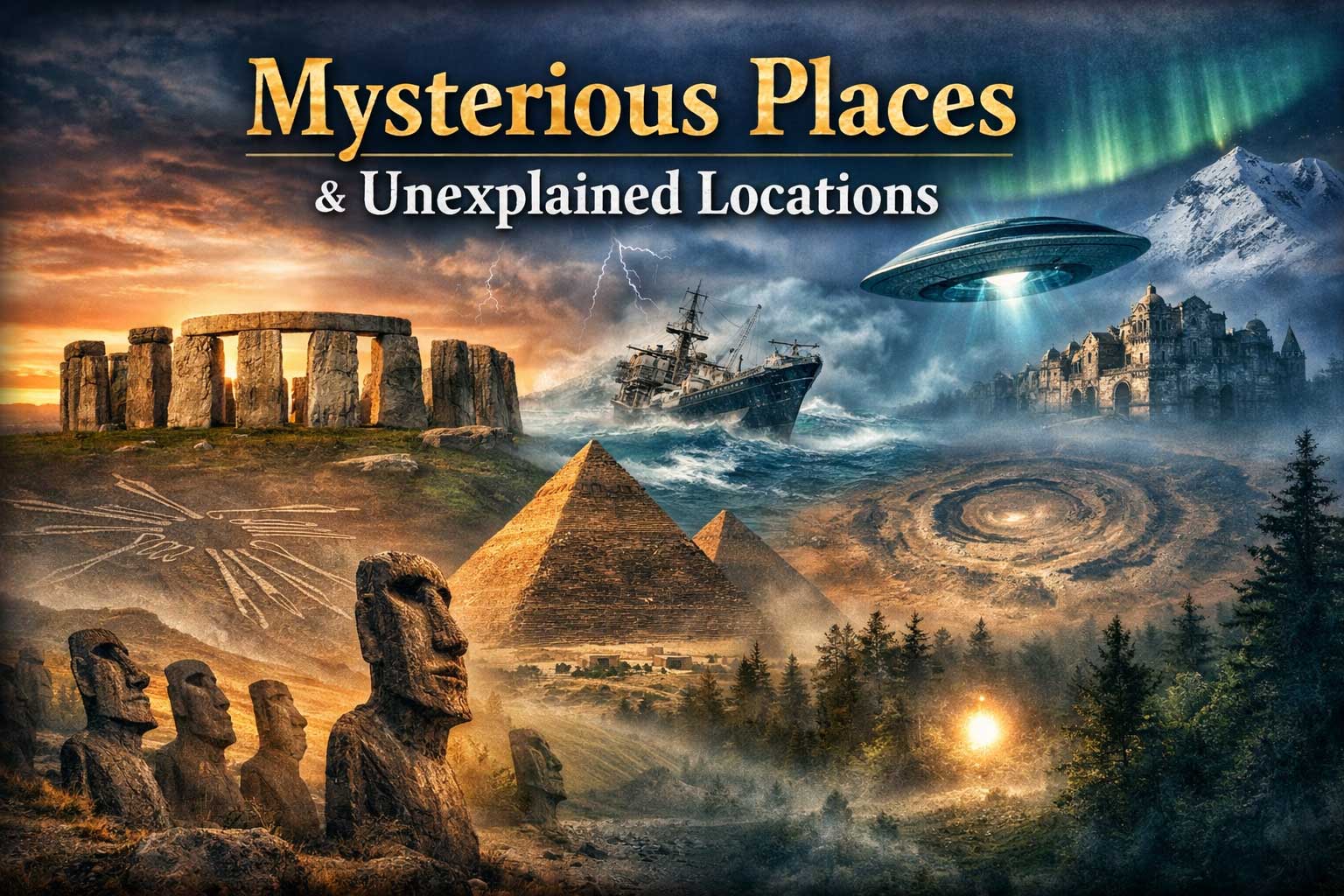
Mysterious Places & Unexplained Locations: The World’s Strangest Sites, Theories, and What We Know
Why Some Places Feel “Unexplained”
Across every culture and era, people have pointed to certain landscapes, ruins, and remote corners of the Earth and said, “Something doesn’t add up here.” Sometimes that reaction is pure emotion—an atmosphere created by weather, isolation, or local stories. Other times it’s rooted in genuine gaps in our knowledge: an ancient structure whose builders left no clear records, a natural phenomenon that behaves in ways that seem to break “common sense,” or a pattern so large it can only be fully appreciated from above.
“Mysterious” doesn’t always mean “paranormal.” In many cases, mystery simply means that the best explanation is still incomplete, the evidence is fragmentary, or several plausible theories compete. A place can be scientifically understood in one sense and still feel unexplained in another. We might understand the geology that shaped a valley, for example, but not fully know why a civilization chose that valley for a sacred center. We might know the age of a monument but not the step-by-step process used to build it with the tools available at the time.
This article explores mysterious places and unexplained locations from a practical, evidence-based angle while still honoring what makes them captivating. You’ll find natural anomalies, archaeological puzzles, engineered wonders that raise questions about methods and purpose, and sites wrapped in folklore. For each, we’ll look at what is known, what is debated, and why the mystery persists.
A Useful Way to Categorize the World’s Mysteries
Before diving into specific places, it helps to group “unexplained” locations into a few types. This makes it easier to understand why some mysteries are solved quickly, while others remain open for decades.
1) Archaeological Mysteries
These include ruins, monuments, or artifacts where questions remain about:
- How something was built or transported
- Why it was created (function, symbolism, intention)
- Who built it (identity, timeline, cultural continuity)
- When it was built (dating disputes or multiple construction phases)
2) Geological and Environmental Oddities
Nature creates features that look unreal—perfect hexagons, blood-red streams, lakes that can appear deadly, deserts that “sing,” rocks that roll uphill (at least visually). Often the core mechanisms are known, but the details can still be debated.
3) Atmospheric and Optical Illusions
Some “mysteries” are perception traps: mirages, strange lights, sound channels, temperature inversions, and gravity hill illusions. These are fascinating because they reveal how easily human senses can be tricked, especially under extreme conditions.
4) Electromagnetic and “Anomalous Zone” Legends
Certain areas are rumored to disrupt compasses, radios, or electronics. Sometimes the explanation is mundane (local mineral deposits, solar activity, terrain) and sometimes the claims are exaggerated through storytelling.
5) Folklore Layers on Real Places
Many locations are ordinary in physical terms but extraordinary in cultural terms. Over centuries, a story becomes part of the landscape. Visitors then interpret every creak of wood or twist of fog through that lens, reinforcing the legend.
With those categories in mind, let’s explore the world’s most compelling mysterious places.
Unexplained Locations in the Ocean and Along Coastlines
The Bermuda Triangle: Myth, Statistics, and the Power of Story
The “Bermuda Triangle” is one of the most famous mysterious regions on Earth—roughly associated with an area between Florida, Bermuda, and Puerto Rico. Popular culture often describes it as a zone where ships and aircraft vanish without explanation.
What we know:
- The Atlantic is heavily traveled, and storms can develop rapidly.
- Human error, mechanical failure, navigational mistakes, and extreme weather are common causes of accidents at sea and in the air.
- Some dramatic stories grew in retellings, with details added or distorted over time.
Why it still feels mysterious:
- The ocean is vast; wreckage can sink quickly and disperse.
- Many disappearances happened before modern tracking, communication, and search technologies.
- The “Triangle” narrative bundles unrelated events into one dramatic theme, making coincidences feel like a pattern.
Leading explanations:
- Severe weather, including hurricanes and sudden squalls
- Ocean currents that rapidly carry debris away
- Navigation errors and equipment failures
- Communication limitations in earlier eras
The Bermuda Triangle shows how mystery can emerge from the combination of real danger, incomplete information, and a compelling story template.
The Baltic Sea Anomaly: Shapes Underwater and the Limits of Interpretation
Underwater exploration sometimes produces sonar images that look like science fiction. The so-called “Baltic Sea Anomaly” became famous because sonar data suggested a large, unusual formation on the seafloor.
What we know:
- Sonar can produce ambiguous images depending on angle, distance, and seabed composition.
- Glacial activity and rock formations can create shapes that appear artificial.
- Underwater environments are difficult to document clearly without extensive diving and imaging.
Why it remains debated:
- Images can be interpreted in multiple ways without high-resolution, direct observation.
- Public imagination tends to leap toward dramatic conclusions when shapes look geometric.
Most scientists lean toward natural geological explanations, but the site remains a good example of how limited data can fuel long-lasting speculation.
The “Singing Sands” and Mysterious Beach Sounds
Some dunes and beaches produce sounds like humming, booming, or squeaking when sand moves. The phenomenon has been observed in several places around the world.
What we know:
- The effect depends on grain size, dryness, composition, and the way grains slide over each other.
- Under the right conditions, sand can synchronize vibrations and create audible tones.
Why it feels unexplained:
- The sound can be surprisingly loud and “musical.”
- Small changes in humidity can stop the effect entirely, making it seem inconsistent and mysterious.
This is a mystery where science offers strong explanations, but the experience still feels uncanny.
Desert Mysteries and Remote “Zones”
The Zone of Silence: Radio Myths in the Desert
In parts of northern Mexico, a region gained a reputation for strange radio behavior and unusual events. Legends describe disrupted communications, odd lights, and “unusual” objects found on the ground.
What we know:
- Remote deserts create conditions where navigation and communication problems are more likely due to distance, terrain, and limited infrastructure.
- Meteorites do fall worldwide, and deserts can preserve them well, making them easier to find.
- Stories grow when travelers share dramatic experiences in harsh environments.
Why the legend persists:
- Isolation amplifies uncertainty and fear.
- A few unusual incidents can become a local identity, attracting more stories.
The Nazca Lines: Giant Geoglyphs and the Question of Purpose
In the Peruvian desert, enormous line drawings depict animals, plants, and geometric shapes. They are best appreciated from above, which raises an obvious question: why create art that can’t be easily seen from the ground?
What we know:
- The lines were made by removing darker surface stones to reveal lighter ground beneath.
- The desert’s dry, stable climate helped preserve them.
- The designs likely had cultural or ritual significance.
What remains debated:
- The exact purpose: astronomical markers, ceremonial pathways, water-related rituals, social signaling, or a mix of functions.
- Whether certain lines align intentionally with celestial events or whether alignments are coincidental.
The Nazca Lines are not “unexplained” in the sense of “impossible.” The mystery is about meaning—what the builders intended and how these designs fit into their worldview.
The Richat Structure: The “Eye” of the Sahara
The Richat Structure in Mauritania is a massive circular feature visible from space. At first glance, it looks like an impact crater.
What we know:
- Geological evidence indicates it’s more likely a deeply eroded dome rather than a meteor impact crater.
- Layers of rock and differential erosion created the ring-like appearance.
Why it captivates:
- Its scale and symmetry feel too perfect to be natural.
- It became linked in popular imagination to lost-city myths.
This is a great reminder: nature often produces patterns that look designed.
Mountains, Valleys, and Landscapes That Seem “Impossible”
The “Gravity Hill” Illusions
Many places around the world have roads where cars appear to roll uphill. People often describe these as magnetic or gravitational anomalies.
What we know:
- These are typically optical illusions caused by surrounding landscape slope, lack of a clear horizon, and visual cues that confuse the brain’s sense of level.
- Measurements with tools usually show the “uphill” is actually downhill.
Why people believe it:
- Human perception relies heavily on context.
- Once someone expects “mystery,” the brain interprets ambiguous signals in that direction.
The Devil’s Kettle: A River That “Disappears”
A waterfall in Minnesota became famous because part of the river seems to vanish into a hole, leading to speculation that it flows into a hidden underground system.
What we know (in general terms):
- Water can enter cracks, channels, and turbulent zones where it’s difficult to trace visually.
- Dye tests and careful measurements can sometimes track where water reemerges, but results can vary based on flow conditions and methods.
Why it remains a popular mystery:
- The visual effect is dramatic, and turbulence hides the water’s route.
- People love the idea of a “lost river.”
Even when the physics is ordinary, the sensation of disappearance triggers deep curiosity.
The “Fairy Circles” of Desert Landscapes
In certain deserts, circular patches appear where vegetation grows differently, creating a pattern of rings or spots across wide areas.
What we know:
- Several explanations can be plausible depending on region: termite activity, plant competition for water, soil chemistry, or a combination.
- Patterns can emerge naturally when organisms compete for scarce resources, producing spacing that looks designed.
Why it feels mysterious:
- The circles can be remarkably consistent in shape and distribution.
- Competing explanations can each fit parts of the evidence.
Ancient Monuments That Raise Big Questions
Stonehenge: Engineering, Time, and Cultural Purpose
Stonehenge is iconic—massive stones arranged in a circle, aligned in ways that appear connected to the sun’s seasonal movements.
What we know:
- It was built in phases over a long period.
- Some stones came from far away, implying significant transport effort.
- The site likely had ceremonial, social, and possibly funerary functions.
What remains debated:
- The full range of uses: calendar, ritual center, healing site, political gathering, ancestral monument.
- The precise social organization that enabled long-term construction.
Stonehenge is a mystery of human complexity: not whether it can be built, but why people committed to it for generations.
Göbekli Tepe: A Shock to Simple Timelines
This ancient site in modern-day Turkey features monumental stone pillars with carvings—built far earlier than many expected for large ceremonial structures.
What we know:
- The site suggests organized labor and sophisticated symbolic culture.
- It challenges simplistic stories that assume monuments only appear after agriculture and cities.
What remains debated:
- The relationship between ritual centers and the rise of settled life.
- Whether large gatherings for ceremony could have helped drive social structures that later supported farming.
Göbekli Tepe feels “unexplained” because it forces us to rewrite comfortable assumptions about how civilization develops.
The Great Pyramids: Precision and Logistics
The pyramids of Egypt are famous not only for size but for accuracy—alignments, angles, and the scale of material movement.
What we know:
- Extensive archaeological evidence supports human construction with organized labor.
- Workers likely used ramps, sleds, lubrication techniques, and coordinated teams.
- Construction took place within strong administrative systems.
Why questions persist:
- Multiple plausible ramp designs exist; no single model answers every detail perfectly.
- The logistics of quarrying, transporting, and placing stones at scale remain an engineering puzzle in the practical sense.
The pyramids are less a supernatural mystery and more a demonstration of what coordinated human society can achieve.
Easter Island Moai: Moving Giants Across a Landscape
The moai statues of Rapa Nui are enormous stone figures—some weighing many tons. How did people move them across the island?
What we know:
- There is evidence of quarrying areas and transport routes.
- Experiments suggest statues could be moved using rope teams in a “walking” motion or on sled-like systems, depending on design and conditions.
What remains debated:
- Which methods were most common and how strategies changed over time.
- How environmental shifts, resources, and social changes affected the process.
This mystery shows how experimental archaeology can turn “impossible” into “difficult but doable.”
The Baalbek Trilithon: Stones That Seem Too Heavy to Move
In Lebanon, massive stone blocks used in ancient construction are among the largest ever quarried and positioned.
What we know:
- Ancient societies had advanced techniques for leverage, rollers, sleds, and coordinated labor.
- Monumental building often reflects political power and religious identity.
What remains debated:
- The exact step-by-step method used for the heaviest blocks.
- The timeline of construction phases and how later cultures repurposed earlier foundations.
The “mystery” is largely about missing documentation and the extreme scale of ancient engineering.
Hidden Cities, Subterranean Worlds, and Underground Puzzles
Derinkuyu and Underground Settlements
In parts of Cappadocia, multi-level underground cities exist, with ventilation, storage, and living spaces carved into rock.
What we know:
- Soft volcanic rock can be carved more easily than many imagine.
- Underground spaces can provide protection from extreme temperatures and conflict.
What remains debated:
- The full chronology: exactly when various levels were expanded and by whom.
- How long people lived underground at a time—temporary refuge versus longer habitation.
The mystery is not whether it’s possible, but how societies organized life below ground with limited light and airflow technology.
Catacombs and “Cities of the Dead”
Large underground burial networks appear in multiple regions. They can become legendary, with stories of hidden chambers and lost pathways.
Why they feel mysterious:
- The underground distorts sound and orientation.
- Many sections are sealed, undocumented, or unsafe, leaving gaps in mapping.
- Human psychology reacts strongly to darkness and confinement.
Often, what remains “unexplained” is more about incomplete records and restricted exploration than about paranormal forces.
Lakes, Rivers, and Water That Looks Wrong
Blood Falls: Red Water in a White World
In Antarctica, a flow of red-stained water emerges from ice, creating a striking, almost unreal scene.
What we know:
- The red color can result from iron-rich, salty water interacting with oxygen, producing rust-like compounds.
- Extreme environments can trap ancient water pockets beneath ice.
Why it feels uncanny:
- The color resembles something living, even though the explanation is chemical and geological.
- The contrast against ice makes the phenomenon look impossible.
Lake Natron: A Harsh Chemistry That Creates Strange Scenes
In Tanzania, Lake Natron’s water chemistry can be extreme under certain conditions, shaping how organisms survive there.
What we know:
- High alkalinity and evaporation can create challenging conditions for many animals.
- Some life forms are adapted to extremes, especially certain microorganisms and hardy species.
Why it becomes “mysterious” online:
- Photos and stories can be shared without context, leading to exaggerated claims.
- Unusual natural preservation effects can be misrepresented as supernatural.
The real story is already extraordinary: life adapting to conditions that seem unlivable.
The Boiling River Legends
In some regions, stories describe rivers so hot they can scald. While “boiling rivers” are often exaggerated, there are places where geothermal heat raises water temperatures significantly.
What we know:
- Geothermal activity can warm groundwater and surface water.
- Local geology determines where heat emerges and how concentrated it is.
Why the mystery persists:
- Temperatures can change rapidly with rainfall and seasonal shifts.
- Legends simplify complex geology into memorable narratives.
Forests, Islands, and Places That Look Like Another Planet
Socotra: The Island That Seems Invented
Socotra is famous for its unusual plant life, including distinctive tree shapes and high levels of endemic species.
What we know:
- Long geographic isolation allows species to evolve uniquely.
- Harsh climates and limited competition can produce strange adaptations.
Why it feels unreal:
- The silhouettes of plants can look like props from science fiction.
- Visitors experience a strong “this shouldn’t exist” reaction when familiar plant rules don’t apply.
The mystery here isn’t a lack of explanation—it’s the sheer creativity of evolution when given time and isolation.
The Crooked Forest: Trees That Bend for Unknown Reasons
A forest in Poland contains trees with unusual curved trunks near the base, creating a strange, almost engineered look.
What we know:
- Several plausible explanations exist: human shaping, unusual snow pressure during growth, or environmental stresses.
- The exact cause is not fully documented, and definitive records are scarce.
Why it remains a mystery:
- The uniformity of the bend suggests intentional shaping, but the “why” is unclear.
- Many human explanations depend on historical events that may not be recorded.
The Sailing Stones of Death Valley
In a dry lakebed environment, rocks appear to “move” across the ground, leaving long trails.
What we know:
- Under rare conditions, thin ice sheets, wind, and water create a low-friction surface that allows rocks to slide.
- The phenomenon can be observed and measured, but it requires a perfect mix of temperature and moisture.
Why people called it unexplained for so long:
- Movement events are infrequent and hard to witness directly.
- Trails remain long after the action, making it easy to imagine something supernatural.
This is a classic case where patient observation revealed a surprising but natural mechanism.
“Forbidden” Forts, Haunted Ruins, and the Psychology of Fear
Some sites are labeled haunted, cursed, or forbidden. Whether or not you believe in anything supernatural, these places offer a powerful lesson in how environment and expectation shape experience.
Bhangarh Fort: A “Haunted” Reputation with Real-World Roots
Bhangarh Fort in India is often described with legends of curses and hauntings.
What we know:
- Many ruins become associated with ghost stories, especially when abandoned, structurally unstable, or surrounded by restricted access.
- Warnings and rules can intensify fear, creating a self-fulfilling atmosphere.
Why such places feel different:
- Ruins are full of ambiguous sounds: wind through openings, animals moving in darkness, echoes.
- Low light conditions make the brain over-detect “patterns,” including faces and movement.
- Stories prime visitors to interpret normal events as eerie.
Even without paranormal claims, these sites can be psychologically intense because they trigger deeply human instincts.
“Cursed” Tombs and the Spread of Legends
Tombs and burial sites often accumulate curses in popular imagination.
What we know:
- Early archaeological expeditions sometimes lacked modern hygiene and safety protocols.
- Illness can follow exposure to molds, bacteria, or contaminated air in sealed spaces.
- Coincidence gets interpreted as causality when people already expect danger.
The lesson: legends often form where risk is real, but misunderstood.
Mysterious Lights, Sounds, and “Unexplained” Atmospheric Events
Ghost Lights and Distant Glows
Many regions report strange lights in remote areas—floating or moving glows seen at night.
Plausible explanations:
- Vehicle lights refracted by temperature inversions
- Atmospheric refraction that bends light over long distances
- Bioluminescence in some contexts
- Electrical phenomena under certain weather conditions
- Misinterpretation of stars or planets near the horizon
Why they remain debated:
- Conditions are hard to replicate.
- Eyewitness reports vary widely and can be influenced by fear, fatigue, or expectation.
Infrasound: The “Unseen” Sound That Feels Like a Presence
Infrasound is sound below the range of human hearing. It can be produced by wind, storms, machinery, and even natural resonances.
What it can do:
- Create feelings of unease or anxiety
- Cause vibrations that people interpret as footsteps or distant movement
- Produce subtle physical sensations
This doesn’t “explain” every haunting claim, but it does show how a location can feel unsettling for purely physical reasons.
Places That Challenge Our Timeline of Human Creativity
Ancient Art, Symbolism, and the Mystery of Meaning
Cave paintings, carved pillars, and ancient symbols often raise questions not about capability, but about interpretation.
What we know:
- Humans have produced symbolic art for tens of thousands of years.
- Art can serve many roles: storytelling, ritual, identity, teaching, social bonding.
What remains difficult:
- Decoding meaning without written records.
- Avoiding modern bias—assuming ancient people thought like we do.
Many “mysteries” persist because meaning isn’t a single answer. A site might have changed roles across centuries: ritual center becomes burial ground becomes political symbol.
Megalithic Sites Around the World
Large stone structures appear across continents. Some are clearly tombs, some are ceremonial, and some remain ambiguous.
Why megaliths invite speculation:
- They feel beyond what a small community could do—until you consider generational projects.
- They often align with celestial events, suggesting careful observation over time.
- Their builders sometimes left few durable records compared to the stones themselves.
The mystery is a mix of engineering questions and cultural questions: not only how, but why.
Why “Unexplained” Often Stays Unexplained
Some mysteries persist because the evidence is genuinely limited. Others remain because the problem is harder than it looks.
1) The Evidence Is Fragile or Missing
Wood decays. Textiles rot. Oral histories change over time. If a culture built with perishable materials alongside stone, we may only see the stone, which distorts the story.
2) Dating Can Be Complex
A site might be used for thousands of years. Different layers can confuse interpretation. Later people might rebuild, reuse, or reshape earlier structures.
3) Multiple Explanations Can Fit
In many cases, several theories explain much of the evidence. Without a “smoking gun” artifact or text, debate continues.
4) Human Minds Love Patterns
We’re wired to connect dots—sometimes correctly, sometimes not. When a place is famous, every unusual detail becomes part of the legend.
5) Media Simplifies
A complex scientific explanation can be less memorable than a single dramatic claim. Over time, the dramatic claim spreads faster.
How to Think Clearly About Mysterious Places
You don’t have to choose between “everything is magical” and “everything is boring.” A balanced approach keeps wonder alive while staying grounded.
Ask These Questions
- What is the strongest evidence available?
- Is the mystery about mechanics (how it works) or meaning (why it exists)?
- Are claims based on repeatable observations or one-time stories?
- Do we have measurements or only impressions?
- Is there an incentive for exaggeration, like tourism or online attention?
Watch for Common Traps
- Argument from ignorance: “We don’t know X, therefore it must be Y.”
- Cherry-picking: Only counting facts that match one theory.
- False precision: Using exact numbers and confident tone without real data.
- Modern bias: Assuming ancient people lacked intelligence or skill.
The most exciting reality is usually this: humans and nature are both capable of things that feel impossible until you understand the process.
Visiting Mysterious Places Responsibly
Many mysterious places are fragile, sacred, or dangerous—not because of curses, but because of physics, erosion, and human impact.
Practical Respect and Safety
- Treat sacred sites as living cultural spaces, not props.
- Follow local rules and access restrictions.
- Avoid touching ancient surfaces; oils from skin can damage stone and paint.
- Stay on established paths to reduce erosion.
- Don’t remove stones, shells, or artifacts—small actions compound over time.
- Consider weather, altitude, wildlife, and terrain. Many “mystery” locations are remote and unforgiving.
Responsible travel preserves the mystery for future visitors while honoring the people and ecosystems connected to the place.
A World Full of Mystery, Even When Explained
“Mysterious places and unexplained locations” aren’t just a list of spooky coordinates. They are reminders that the world is larger than our everyday routines. Some mysteries remain because we lack evidence, some because the truth is layered and complex, and some because nature produces beauty that feels designed even when it isn’t.
The best approach is to hold two ideas at once:
- Curiosity: A willingness to be amazed, to imagine, to explore.
- Discipline: A commitment to evidence, context, and careful thinking.
When you combine both, the world becomes more fascinating—not less. The mystery doesn’t disappear. It deepens.