



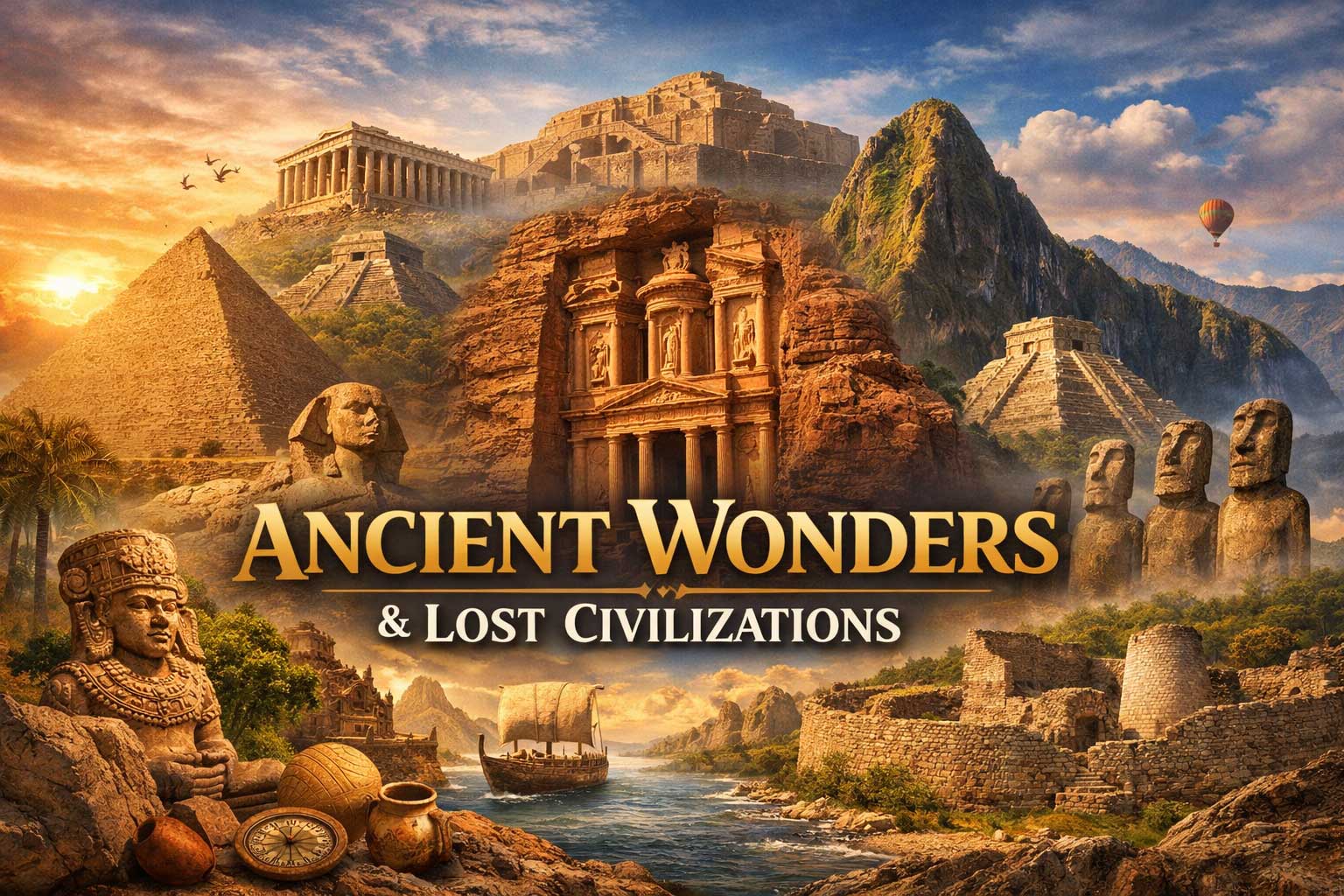
Ancient Wonders & Lost Civilizations: The Greatest Mysteries, Monuments, and Forgotten Empires
Ancient wonders capture the imagination for a simple reason: they prove that human beings have always been capable of extraordinary creativity, organization, and ambition. Long before satellites, modern engines, and computers, people planned cities, engineered water systems, raised monuments that still challenge our understanding, and created art and writing that continue to shape the world. Yet the same past that feels dazzling also feels fragile. Entire civilizations—once powerful enough to command trade routes, sustain huge populations, and reshape landscapes—declined, fragmented, or vanished from history’s main stage. Their cities were swallowed by jungle, covered by desert, buried under volcanic ash, or repurposed stone by stone by later societies. What remains is a patchwork of ruins, artifacts, and clues that invite one of humanity’s greatest detective stories: reconstructing lives lived thousands of years ago.
This article explores ancient wonders and lost civilizations as more than a list of famous sites. It looks at how wonders were built, what they meant to the societies that created them, why civilizations sometimes “disappear,” and how modern research methods are transforming what we can know. Along the way, we’ll visit legendary places—some iconic, some less famous but equally astonishing—and connect them through themes that repeat across history: environment, innovation, belief, power, trade, conflict, resilience, and memory.
What Counts as an Ancient Wonder?
The word “wonder” can make the ancient world feel like a museum of miracles—isolated masterpieces that appeared fully formed. In reality, a wonder is usually the visible tip of a much larger social iceberg. A monumental temple, palace, pyramid, fortress, or city wall implies skilled labor, stable food production, supply chains, specialized crafts, political authority, and shared beliefs strong enough to motivate generations. Wonders are not only about size or beauty; they are also about what they reveal:
- Engineering skill: mastery of stone, brick, timber, metal, geometry, and materials.
- Organization: the ability to coordinate labor, transport, and timing on a massive scale.
- Cultural meaning: architecture tied to religion, kingship, identity, and cosmic order.
- Economic reach: access to resources far beyond local landscapes—rare stone, metals, dyes, hardwoods, incense, and luxury goods.
- Longevity: structures built to last, meant to anchor memory and authority across centuries.
Wonders can be sacred (temples, pyramids), political (palaces, capitals), defensive (walls, citadels), economic (ports, road systems), or ceremonial (processional avenues, plazas). Many served multiple roles at once. A temple could be a religious center, a storehouse of grain, a treasury, and a symbol of divine-backed rule.
What Does “Lost Civilization” Really Mean?
A “lost civilization” does not always mean a people vanished completely. Often, it means one or more of the following:
- Writing is undeciphered or absent. Without readable texts, outsiders may not know a society’s name, rulers, or chronology.
- Cities were abandoned or transformed. Political centers shift; old capitals become ruins or are rebuilt under new regimes.
- Cultural continuity exists, but labels changed. Descendants may persist while the earlier political identity fades.
- Memory was disrupted. Conquest, disease, or forced migration can sever historical continuity.
- The archaeological record is hidden. Dense vegetation, deserts, floodplains, or later construction can conceal remains for centuries.
“Lost” often means “lost to mainstream historical narratives,” not lost to humanity entirely. Many communities living today are descendants of ancient cultures and maintain traditions, languages, or place-based knowledge that connects to deep history. The modern rediscovery of ancient sites can be inspiring, but it can also be politically sensitive. Who gets to interpret the past? Who owns artifacts? Who benefits from tourism? These questions matter as much as the stones themselves.
Why Do Civilizations Decline or Disappear?
There is rarely a single cause. Civilizations are complex systems—economies, ecosystems, political structures, and belief systems woven together. Their collapse is often a cascade, where one stressor amplifies another. Common factors include:
Environmental Stress and Climate Shifts
Long droughts, flooding cycles, soil depletion, deforestation, and shifts in river courses can undermine agriculture. When food surpluses shrink, cities struggle to feed populations, fund elites, and maintain public works.
Resource Management and Overreach
Monuments and armies require resources—timber, stone, metals, labor, and food. If a state overextends (militarily or economically), it can become vulnerable to shocks.
Trade Disruption
Many ancient economies depended on long-distance trade for metal, salt, obsidian, horses, luxury goods, and even building materials. If trade routes shift due to conflict, piracy, new competitors, or political fragmentation, urban life can change rapidly.
Disease and Demography
Epidemics can reduce populations, weaken labor pools, and destabilize authority. Migration can bring new ideas and strength—or trigger conflict.
Political Instability and Inequality
When elites extract too much from commoners, or succession crises weaken governance, internal fragmentation can set in. Civil unrest may not leave clear archaeological signatures, but it can reshape settlement patterns.
Warfare and Invasion
Conquest can topple capitals, but even without dramatic invasions, chronic raiding or border conflict can drain resources and encourage people to abandon vulnerable areas.
Cultural Transformation Rather Than “Collapse”
Sometimes people do not vanish; they reorganize. Cities shrink, authority decentralizes, and life continues in smaller communities. From a distance, that looks like collapse. From the ground, it may be adaptation.
The Deep Background: How Ancient Societies Built Wonders
Before exploring specific civilizations, it helps to understand the building blocks of wonder-making.
Food Surpluses and Urban Growth
Monuments begin with agriculture. When farmers can reliably produce more than immediate survival requires, societies can support craft specialists, administrators, priests, and builders. Irrigation, terrace farming, crop rotation, animal traction, and granary systems often underpin monumental eras.
Skilled Craft and Technical Knowledge
Stonecutting, brickmaking, metallurgy, carpentry, plasterwork, and pigment production require experimentation and tradition. Technical knowledge is usually embedded in apprenticeship networks—generations of learning rather than sudden genius.
Logistics: Moving Mountains Without Machines
Transport is the hidden story of most wonders. Ancient builders moved stones using sledges, rollers, ramps, waterways, and sheer coordination. Rivers were ancient highways. Seasonal timing mattered: wet ground could reduce friction for dragging heavy loads; flood seasons could float materials closer to sites.
Surveying, Geometry, and Measurement
Many monumental complexes show remarkable alignment and precision. That does not require modern instruments, but it does require consistent measurement systems, careful surveying, and the ability to coordinate teams to maintain right angles and level foundations over large areas.
Labor Systems
Wonders were not always built by slaves, and not always by free volunteers. Labor models varied: paid workers, seasonal corvée labor (a tax in work), temple labor, bonded labor, and prisoners of war. The moral story differs by place and time, but the practical reality remains: large projects reflect powerful authority and shared cultural goals.
Mesopotamia: The Cities of Sumer and the First Urban Experiments
When people think of “lost civilizations,” they often imagine jungle ruins. But some of the earliest great civilizations flourished on open plains between rivers—the region often called Mesopotamia, between the Tigris and Euphrates. Here, urban life developed early, along with writing, bureaucracy, and monumental religious architecture.
Wonders of Mudbrick and the Rise of the Ziggurat
Mesopotamia lacked abundant building stone, so its wonders were built largely of mudbrick—sun-dried or kiln-fired. That makes surviving ruins more fragile, yet the scale was immense. The ziggurat, a stepped temple platform, rose above cities as a cosmic mountain linking earth and sky. It was not only a religious statement but also a political one: the city’s identity was bound to its patron deity, and rulers legitimized power through temple economies.
Why So Much Was Lost
Mudbrick erodes. Cities were rebuilt again and again atop earlier layers, creating tells—mounded ruins formed by centuries of rebuilding. Over time, shifting rivers and salinization (salt buildup from irrigation) affected agriculture. Political rivalry between city-states and later empires transformed the region repeatedly. Yet “lost” here is not a disappearance; it is a deep stratigraphy of continuous human adaptation.
The Civilizational Legacy
From early writing systems to law codes and administrative accounting, Mesopotamian urban life shaped later civilizations. Even when individual cities declined, the core innovations spread across regions.
The Indus Valley Civilization: A Quiet Giant of the Ancient World
One of the most intriguing ancient civilizations is the Indus Valley Civilization (also called Harappan), which flourished across a vast area with sophisticated cities such as Harappa and Mohenjo-daro. It remains mysterious because its script has not been conclusively deciphered.
Urban Planning as a Wonder
Indus cities display remarkable planning: grid layouts, standardized brick sizes, drainage systems, wells, and public bathing facilities. Instead of emphasizing giant royal tombs or towering temples, the Indus world seems to have invested in civic infrastructure—water management, sanitation, and urban order.
This itself is a kind of wonder: a civilization whose grandeur appears in systems rather than in a single monumental icon.
Trade Networks and Standardization
Weights and measures appear standardized across wide distances, suggesting coordinated economic practices. Goods such as beads, metals, shell ornaments, and possibly textiles moved through trade routes connecting coastlines and inland cities.
Decline Without a Single Catastrophe
Rather than a sudden collapse, evidence suggests gradual changes: shifts in river patterns, climate variability, and the reorganization of settlements. Urban centers declined while smaller communities persisted. That challenges the popular idea that civilizations end in dramatic flames. Sometimes they fade into new forms of life.
Ancient Egypt: Stone Eternity and the Architecture of Afterlife
Egypt is famous precisely because so much survived: dry climate, stone architecture, and long traditions of record-keeping. Yet even within this well-known civilization, there are mysteries—lost tombs, erased rulers, and forgotten cities beneath modern settlements.
The Pyramids as a System of Wonders
The pyramids are not isolated monuments; they are the center of carefully planned landscapes: causeways, mortuary temples, workers’ settlements, quarries, and supply routes. Their precision reflects both technical ability and ideological commitment. They were engines of legitimacy, linking kingship with divine order.
The Hidden Complexity: Workers, Food, and Time
Pyramids imply logistics: feeding large labor forces, organizing quarrying, shaping stone, transporting blocks, and maintaining a stable state for decades. They also imply societal consensus—whether coerced or culturally embraced—that such projects mattered.
When Cities Vanish
While pyramids remain, many Egyptian cities were built of mudbrick and were reshaped over time. Capitals shifted. Temples were expanded and dismantled. Some sacred centers persisted for millennia; others disappeared under silt or modern development. Even Egypt, the “best-preserved,” contains countless lost layers.
The Minoans of Crete: Palaces, Sea Power, and a Civilization Without a Clear Ending
The Minoan civilization on Crete is often associated with elegant palaces such as Knossos, vibrant art, and extensive maritime trade. Its “lost” quality comes from both its cultural distinctiveness and the complexity of its decline.
Palace Complexes as Administrative Wonders
Minoan palaces were not just royal homes; they were economic hubs with storerooms, workshops, ceremonial areas, and bureaucratic systems. Their architecture suggests planned complexity—courtyards, multi-level rooms, and light wells. Frescoes depict nature, ceremonies, and social life, offering a rare window into aesthetics and ideology.
Trade, Influence, and Vulnerability
As a sea-oriented society, the Minoans benefited from trade but were also exposed to disruptions. Natural disasters, including major volcanic events in the region, likely played a role in destabilizing networks, economies, and political systems.
Transformation Rather Than Total Disappearance
Minoan cultural elements influenced later societies in the Aegean. The story is not a simple vanishing, but a shift—new political centers, new scripts, and changing power dynamics.
The Hittites: An Empire That Faded into the Fog
In Anatolia, the Hittite Empire once rivaled Egypt and controlled extensive territories. Its capital, with fortifications and monumental gates, represented centralized authority and imperial ambition.
Imperial Wonders: Fortifications and Archives
Hittite centers were fortified, with massive stonework and gates often decorated with powerful animal symbolism. Their bureaucratic records, preserved on clay tablets, reveal diplomacy, treaties, and the realities of empire—alliances, hostages, and contested borders.
The “Collapse” of the Late Bronze Age
The wider Late Bronze Age saw disruptions across the Eastern Mediterranean—trade breakdowns, migrations, internal revolts, and conflict. The Hittite state fragmented, and its political identity dissolved, even as people remained in the region. Later cultures absorbed and transformed what came before.
Petra and the Nabataeans: The Rose-Cut City and Desert Water Mastery
Petra is often treated as a single wonder: a city carved into stone. But its true marvel may be its water engineering and its strategic position in trade networks.
Rock-Cut Architecture as Identity
Carving monumental facades into cliffs is an architectural statement that merges landscape and culture. It communicates permanence in a harsh environment—beauty and authority emerging from stone.
Water as the Real Miracle
Desert cities survive through mastery of water: channels, cisterns, dams, and careful management of seasonal flows. Petra’s prosperity depended on capturing and storing water, enabling population density and supporting travelers and trade.
Why It Was Abandoned
As trade routes shifted and political contexts changed, Petra’s role diminished. Over time, the city’s importance faded, leaving a spectacular ruin that feels “lost” precisely because it once sat at the crossroads of wealth and movement.
Angkor: The Hydraulic Metropolis of Southeast Asia
Angkor, the heartland of the Khmer Empire, is one of the greatest urban and architectural achievements in human history. Its temples are famous, but the broader system is even more astonishing: a vast landscape of waterworks and urban planning.
Temples as Cosmic Diagrams
Angkor’s major temples were designed as symbolic models of the universe. Towers, moats, and layered enclosures express sacred geography. The architecture reflects a worldview where kingship, divinity, and cosmic order were intertwined.
Water Infrastructure on a Monumental Scale
Reservoirs, canals, and managed waterways helped regulate agriculture and support large populations. This was not only engineering but political economy: controlling water meant controlling food, labor, and stability.
Fragility of Complex Systems
Large hydraulic networks require constant maintenance. Climate variability, political conflict, and ecological strain can turn strengths into vulnerabilities. When systems become too complex to sustain under stress, societies may decentralize or relocate. Angkor’s story illustrates how wonders can both symbolize power and reveal the pressures behind it.
The Maya: Cities in the Forest and the Mathematics of Time
The Maya world produced extraordinary achievements: temple pyramids, sophisticated calendars, astronomy, writing, and art. Their cities rose across forests and varied landscapes, linked by trade and political rivalry.
Wonders Beyond Stone
Maya wonders include not only architecture but intellectual systems: precise calendrical calculations, monumental inscriptions, and artistic programs that encoded political history and myth. Inscriptions reveal dynasties, wars, alliances, and ritual performances—history carved into stone.
Why Many Cities Were Abandoned
The decline of certain Maya city centers was not uniform. Some regions experienced demographic shifts, warfare, drought stress, and political fragmentation. Many people moved, reorganized, and continued cultural traditions in other areas. The concept of a sudden “Maya collapse” is too simple; it was a complex transformation across different regions and timelines.
The Jungle as Preserver and Concealer
Forests can destroy structures through roots and moisture, but they also protect sites from modern development. Today, new mapping technologies are revealing that Maya urban landscapes were far more extensive than once believed, with networks of causeways, terraces, and reservoirs.
Teotihuacan: The Mysterious Giant of Central Mexico
Teotihuacan was once among the largest cities in the world, with monumental avenues and pyramids that still dominate the landscape. Yet its rulers’ names are not as clearly known as those of the Maya, and its political structure remains debated.
Urban Monumentality as a Statement
The city’s layout—broad avenues, aligned pyramids, and carefully planned neighborhoods—suggests strong central planning. The scale implies a state capable of mobilizing vast labor and resources. Its influence spread widely through trade, art, and ideology.
A City of Neighborhoods
Archaeological evidence points to diverse communities living in apartment compounds, possibly including migrants and specialized craftspeople. This diversity may have been a strength, enabling economic and cultural dynamism.
Decline and Transformation
Evidence of burning and upheaval suggests political crisis, but the reasons remain uncertain. As with many “lost” civilizations, decline may have involved internal conflict, resource pressures, and shifting regional power dynamics rather than a single external invader.
Cahokia: North America’s Earthen Wonder City
When people think of ancient wonders, they often overlook North America. Cahokia, near the Mississippi River, was a major urban center with enormous earthen mounds and complex social organization.
Earthworks as Engineering Wonders
Building massive mounds requires moving huge volumes of soil—organized labor, planning, and leadership. The layout suggests ceremonial spaces, political centers, and community identity embedded in landscape design.
Rivers, Trade, and Power
Cahokia’s location near major waterways supported trade and communication. It was connected to a broader world of exchange and cultural interaction across large distances.
Why It Declined
Environmental pressures, social changes, and political dynamics likely contributed. The population may have dispersed into smaller communities. Cahokia’s story reminds us that “monumental” does not require stone; earth can be shaped into architecture of power and meaning.
Great Zimbabwe: Stone Cities and Trade Across the Indian Ocean World
In southern Africa, Great Zimbabwe stands as a powerful example of indigenous urbanism and stone architecture, connected to long-distance trade networks.
Dry-Stone Architecture
Great Zimbabwe’s stone walls were built without mortar, carefully fitted to create massive enclosures. The craftsmanship reflects both skill and social organization. The site’s layout suggests zones of power, ritual, and daily life.
Trade and Wealth
Great Zimbabwe’s prosperity was linked to regional resources and trade connections that reached far beyond its immediate landscape. Its rise challenges older misconceptions that underestimated African complexity and autonomy.
Shifts in Power Centers
Over time, political and economic centers moved. Great Zimbabwe’s decline was not the end of its people but part of broader regional transformations.
Easter Island: Monuments, Ecology, and the Dangers of Simple Stories
Easter Island, or Rapa Nui, is famous for its moai statues. The site is often used as a cautionary tale about environmental collapse, but the reality is more nuanced than popular myths.
Moai as Ancestors and Authority
The statues likely represent ancestral figures tied to lineage, prestige, and spiritual protection. Creating and transporting them required organization, specialized knowledge, and social cooperation.
Ecology and Adaptation
The island’s environment is limited, and human activity changed landscapes over centuries. But simple narratives of sudden self-destruction overlook factors like climate variability, introduced species, and later disruptions from outside contact.
A Lesson in Complexity
Rapa Nui illustrates a central truth: when we reduce collapse stories to moral slogans, we miss the real human experience—adaptation, resilience, and the interplay of multiple pressures.
Technologies That Helped Rediscover Lost Worlds
The modern study of ancient wonders is being transformed by methods that reveal hidden structures and refine timelines.
Remote Sensing and Landscape Archaeology
Airborne and satellite-based methods can detect buried foundations, ancient roads, canals, and terraces by reading subtle variations in vegetation or soil. In forested regions, laser scanning can “see” ground shapes beneath tree canopies, revealing city plans that would take decades to map on foot.
Radiocarbon Dating and Material Science
Improved dating methods help archaeologists reconstruct sequences of building, occupation, and abandonment. Material science can trace where stone, metals, and pigments came from, revealing trade networks and resource strategies.
Ancient DNA and Bioarchaeology
Human remains and ancient DNA can illuminate migration patterns, diet, health, and population changes—helping to test theories about movement and interaction. Isotopic analysis can show whether a person grew up locally or moved from elsewhere.
Decipherment, Epigraphy, and Digital Archives
Where writing exists, decipherment can reshape everything. Even without full decipherment, digital imaging can reveal faint inscriptions and help scholars compare symbol patterns across large datasets.
Myths, Pseudo-History, and Why Evidence Matters
Ancient wonders often attract sensational claims: lost supercivilizations, impossible technologies, or mysterious outsiders. These stories can be entertaining, but they can also erase the real achievements of ancient peoples by implying they needed outside help.
A more respectful approach recognizes that human ingenuity is universal. People learned through trial, error, and cumulative knowledge. Engineering “mysteries” are usually solvable when we consider:
- simple machines and leverage
- seasonal labor cycles
- logistical planning over long timeframes
- the social power of belief and identity
- incremental improvements across generations
Evidence-based history is not less exciting—it’s more profound. It shows how real communities, with real constraints, achieved feats that still inspire awe.
The Human Meaning of Wonders: Why People Built the Impossible
To understand ancient wonders, it helps to ask what they did for society—emotionally, politically, spiritually.
Wonders as Social Glue
Large projects create shared identity. Building together—whether willingly or under obligation—binds communities to a common story.
Wonders as Political Theater
Monuments broadcast legitimacy. They tell subjects and rivals: “This power is stable, blessed, and capable of mobilizing the world.”
Wonders as Sacred Technology
In many cultures, architecture was a tool to connect with gods, ancestors, and cosmic order. Alignments, processions, and ritual spaces turned stone into a living map of belief.
Wonders as Memory Machines
Monuments anchor time. They preserve names, lineages, victories, and myths. Even ruins serve this function—reminding later generations that greatness existed and can return.
Modern Threats: Why Some Wonders May Become “Lost” Again
Ancient sites face threats that can erase knowledge faster than time did.
- Urban expansion: modern construction can bury or destroy layers of history.
- Looting and trafficking: artifacts removed from context lose much of their meaning.
- Climate change: rising seas, extreme weather, and shifting rainfall threaten fragile ruins.
- Mass tourism: foot traffic, pollution, and infrastructure can damage sites without careful management.
- Conflict: war can devastate heritage, both intentionally and accidentally.
Protecting ancient wonders is not only about preserving stones; it is about protecting the ability of future people to understand the human story.
What Ancient Wonders Teach Us About the Future
Ancient wonders and lost civilizations are not just echoes of a distant world. They are a mirror. They show that complexity can rise quickly and fall quietly. They show that societies thrive when they manage resources wisely, adapt to change, and maintain legitimacy through fair systems—not only through monumental display. They show that human creativity is strongest when communities invest in shared infrastructure and meaning.
Most importantly, they remind us that people in the past were not “primitive.” They were engineers, artists, planners, farmers, sailors, astronomers, and storytellers operating with the best tools and knowledge available to them—building worlds that shaped everything that came after.
Ancient wonders endure because they are more than ruins: they are evidence that human ambition can carve stone, reorder landscapes, and imagine eternity—while still being vulnerable to the shifting realities of nature, politics, and time.