



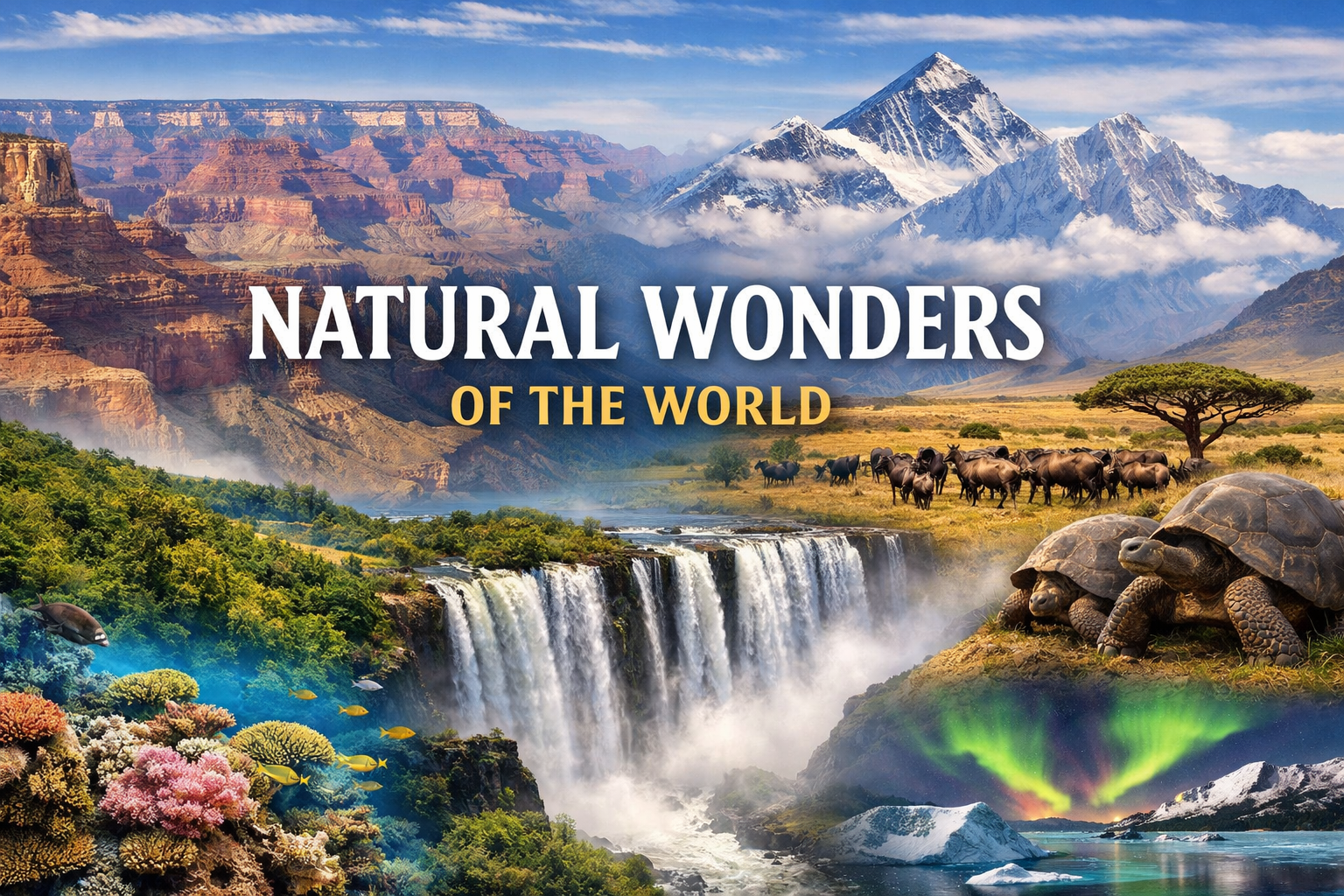
Natural Wonders of the World: The Ultimate Guide to Earth’s Most Spectacular Places
Nature has been building masterpieces for about 4.5 billion years. Long before cities, roads, and borders, the planet was already sculpting cathedrals of stone, rivers that carve continents, forests that breathe for the world, and oceans that hold entire hidden galaxies of life. When we talk about the “Natural Wonders of the World,” we’re really talking about places where Earth’s processes are so dramatic, so beautiful, and so alive that they feel almost impossible.
This article is a deep dive into what makes a natural wonder, how these landscapes form, why they matter to the planet’s health, and which destinations consistently stand out as the most awe-inspiring. Some of these wonders are famous icons you’ve seen in photos a thousand times. Others are less discussed yet equally extraordinary. All of them reveal something essential about Earth: its history, its power, and its delicate balance.
What Counts as a Natural Wonder?
A natural wonder isn’t just “a nice view.” It usually combines several qualities:
Extraordinary Scale or Rarity
Some landscapes are vast beyond normal human perspective—canyons miles wide, deserts stretching to the horizon, mountain ranges that look like the bones of the planet. Others are rare because the conditions needed to create them are unusual.
A Story Written in Stone, Water, or Life
The best natural wonders feel like a readable history book. You can see layers of time in rock strata, the fingerprints of glaciers, the slow grind of tectonic plates, or the astonishing complexity of ecosystems.
A Sense of Living Systems
Not all wonders are purely geological. Many are biological: reefs, rainforests, migration routes, wetlands. Their “wow factor” comes from life itself—density, diversity, and interdependence.
Cultural and Emotional Impact
Natural wonders often become sacred, symbolic, or identity-defining for local communities. They shape myth, art, and memory. And for visitors, they can trigger something rare: a feeling of being small in a good way.
The Forces That Create Natural Wonders
To understand these places deeply, it helps to know the invisible engines behind them:
Plate Tectonics: Earth’s Slow Architecture
The crust is broken into moving plates. Where they collide, mountains rise. Where they separate, rifts open and volcanoes build new land. Over millions of years, this motion designs the largest features on Earth.
Erosion: The Patient Sculptor
Wind, water, ice, and gravity are constantly reshaping landscapes. Rivers cut canyons, waves carve sea cliffs, and rain slowly dissolves rock into caves. Erosion is how raw geological “construction” becomes elegant form.
The Water Cycle: The Planet’s Circulatory System
Water moves energy around the planet. It carries sediments, feeds forests, fills aquifers, and powers waterfalls. Many wonders are essentially water in motion—either visibly, like falls and rivers, or invisibly, like groundwater shaping caves.
Climate: The Mood That Changes Everything
Climate decides what kinds of ecosystems can exist and how fast landscapes change. Glaciers carve valleys, deserts form dunes, and tropical heat builds reefs and rainforests.
Life: Nature’s Engineer
Plants stabilize soil, corals build reefs, beavers reshape waterways, and microorganisms help create soil and rock formations. Biology doesn’t just decorate landscapes—it constructs them.
Natural Wonders of the World You Should Know
Below are some of the most iconic and scientifically fascinating natural wonders on Earth, chosen for their beauty, uniqueness, and the powerful Earth systems they represent.
The Grand Canyon, USA: A Monument to Deep Time
The Grand Canyon is one of the best places on Earth to see time exposed like pages of an open book. Its layered walls reveal hundreds of millions of years of geological history, with rock strata stacked like colored bands. But what makes it truly mind-bending is the scale: a canyon so wide and deep that your brain struggles to “measure” it.
How It Formed
A canyon of this size is the product of uplift and erosion working together. The region rose over time, and the river carved downward through layers of rock. The cutting wasn’t a single dramatic event—it was relentless persistence, aided by floods, gravity, and weathering.
Why It Matters
The canyon is a living laboratory. Geologists study its layers to understand ancient environments—deserts, seas, river plains—and how they shifted over deep time. Ecologically, it also contains multiple climate zones, supporting diverse plant and animal life in a relatively compact region.
What Makes It a Wonder
Standing at the rim is an experience of scale and time at once. You’re not just looking at a landscape—you’re looking into Earth’s memory.
Great Barrier Reef, Australia: The Ocean’s Living City
The Great Barrier Reef is not a single reef but a vast network of reef systems, islands, and coral formations. It’s a living structure built by tiny animals—coral polyps—over thousands of years. Seen from above, it looks like a watercolor masterpiece. Seen underwater, it feels like entering a crowded city of color and movement.
How Reefs Form
Corals build calcium carbonate skeletons. Over time, these skeletons accumulate and create reef frameworks. Reefs thrive in warm, clear, shallow water where sunlight can penetrate—because corals depend on symbiotic algae that photosynthesize and provide energy.
Why It Matters
Reefs support enormous biodiversity. They are nurseries for fish, protect coastlines by absorbing wave energy, and sustain livelihoods through fishing and tourism. Even if you never visit, reefs influence global ocean health.
What Makes It a Wonder
It’s one of the largest living structures on Earth, created not by a single organism but by a community of life cooperating over time.
Victoria Falls, Zambia/Zimbabwe: The Roar of a River
Victoria Falls isn’t the tallest waterfall in the world, but it is often considered one of the most powerful and dramatic. The river spreads wide, then suddenly collapses into a deep chasm, producing a roaring wall of water and a constant plume of mist.
How It Formed
The waterfall exists because of a geological setup where rock layers fracture and erode at different rates. Over time, the river exploited weaknesses in the rock, cutting a series of gorges. The falls gradually retreat upstream as erosion continues.
Why It Matters
Waterfalls are more than scenery—they oxygenate water, shape river ecosystems, and influence local climate through mist and humidity. The surrounding area often supports unique plant communities adapted to constant moisture.
What Makes It a Wonder
It’s a sensory event: thunderous sound, vibrating ground, mist on your skin, rainbows forming in the spray. It doesn’t feel like a view—it feels like standing beside a force.
The Amazon Rainforest, South America: The Breath of Biodiversity
The Amazon is often described as one of the most biodiverse places on Earth. It’s not just a forest; it’s an interconnected climate system, a water engine, and a vast living network. It shapes weather patterns, stores carbon, and contains millions of species—many still unknown.
How Rainforests Stay Alive
The Amazon recycles moisture. Trees release water vapor through transpiration, which contributes to cloud formation and rainfall. This means the forest helps create the conditions it needs to survive—a natural feedback loop.
Why It Matters
Rainforests regulate climate by storing carbon in biomass and soil. They also house genetic diversity that supports medicine, agriculture, and ecosystem resilience. When rainforest systems degrade, the impacts ripple far beyond the region.
What Makes It a Wonder
In a rainforest, the wonder isn’t a single giant object—it’s the density of life. The air feels alive. The forest has layers: canopy, understory, forest floor—each with its own species and survival strategies.
The Himalayas and Mount Everest: The Roof of the World
The Himalayas are a monument to tectonic power. This mountain range exists because two massive plates collided, compressing and lifting rock upward. Even today, the mountains continue to rise and reshape.
How They Formed
The Indian plate moved northward and collided with the Eurasian plate. Instead of one plate neatly sliding under the other, the collision crumpled crust like a slow-motion car crash, thrusting rock upward into the highest peaks on Earth.
Why It Matters
Mountain ranges shape weather and water supplies. The Himalayas influence monsoon patterns and store vast amounts of freshwater in glaciers and snowfields. Many major rivers originate here, supporting hundreds of millions of people downstream.
What Makes It a Wonder
The Himalayas combine scale, danger, beauty, and spiritual significance. They feel like Earth’s spine—sharp, cold, and ancient.
Aurora Borealis and Aurora Australis: The Sky Becomes a Wonder
Some wonders aren’t fixed on the ground. The aurora—northern and southern lights—turn the sky into a moving painting. Curtains and ribbons of green, purple, and red shimmer and shift as if the atmosphere were alive.
How Auroras Happen
Charged particles from the sun collide with Earth’s magnetic field and funnel toward the poles. When these particles hit gases in the upper atmosphere, they release energy as light. Different gases and altitudes produce different colors.
Why It Matters
Auroras are visible evidence that Earth is part of a larger space environment influenced by solar activity. They remind us the planet has protective magnetic systems that shield life from harmful radiation.
What Makes It a Wonder
It’s an event you can’t fully control or predict. You don’t just “see” an aurora—you wait for the sky to decide to perform.
Galápagos Islands, Ecuador: A Classroom of Evolution
The Galápagos are famous because they helped shape humanity’s understanding of evolution and natural selection. But beyond history, these islands are astonishing for their unique wildlife—species that evolved in isolation and adapted to specific niches.
How Island Ecosystems Become Unique
Isolation limits gene flow. Over time, populations diverge, adapting to local conditions. This is why islands often contain species found nowhere else.
Why It Matters
The Galápagos demonstrate how ecosystems evolve, how species adapt, and how fragile isolated environments can be. They are a reminder that biodiversity is not interchangeable—when unique species disappear, they are gone forever.
What Makes It a Wonder
You can see behaviors and animals that feel almost prehistoric: marine iguanas, giant tortoises, and fearless birds that evolved without certain predators.
Serengeti and the Great Migration, Tanzania/Kenya: The Moving Wonder
Some natural wonders are defined by motion. The Great Migration is one of the largest wildlife movements on Earth, involving huge herds of wildebeest, zebra, and other animals traveling in search of fresh grazing and water.
Why Animals Migrate
Migration is survival strategy. In seasonal landscapes, resources shift over time. Moving herds track rainfall patterns, grass growth, and water availability.
Why It Matters
Migration routes are ecological highways. They support predators, scavengers, and entire food webs. When migration corridors are blocked, the impacts can cascade through ecosystems.
What Makes It a Wonder
It’s the scale of life in motion—dust, thunder of hooves, predators watching, rivers to cross, and a cycle repeated year after year.
Iguazú Falls, Argentina/Brazil: A Waterfall System Like a Storm
Iguazú Falls is not one waterfall but a massive collection of cascades spread across a wide area. The result is overwhelming: countless torrents of water plunging into misty chasms, surrounded by lush forest.
How Multi-Fall Systems Form
When a river flows over layered rock or fractured terrain, it can split into multiple channels. Erosion creates separate drops that evolve into a complex system of falls and islands.
Why It Matters
Such environments often support unique microclimates. Mist zones create habitats for plants and insects that thrive in constant moisture, while nearby forest ecosystems benefit from the water-rich environment.
What Makes It a Wonder
Iguazú feels like standing beside a natural storm that never ends—water everywhere, sound everywhere, mist rising like smoke.
Sahara Desert, Africa: The Ocean of Sand and Stone
The Sahara is one of the most iconic deserts on Earth, but it’s not just endless dunes. It includes rocky plateaus, gravel plains, mountains, salt flats, and ancient riverbeds. The desert’s beauty comes from minimalism and scale.
How Deserts Work
Deserts form where evaporation exceeds precipitation. Some deserts are shaped by global circulation patterns, others by mountain rain shadows. Wind becomes the main sculptor, moving sand into dunes and carving rock into strange shapes.
Why It Matters
Deserts aren’t empty—they host specialized life adapted to extreme heat, cold nights, and scarce water. Deserts also influence atmospheric systems by producing dust that can travel across oceans and fertilize distant ecosystems.
What Makes It a Wonder
The Sahara teaches a different kind of awe: silence, open horizons, night skies dense with stars, and landscapes that look like another planet.
Yellowstone, USA: Geysers, Hot Springs, and the Earth’s Heat
Yellowstone is one of the best places in the world to witness geothermal power at the surface. Geysers erupt, hot springs glow with mineral color, and steam rises from the ground like the Earth is breathing.
Why Geothermal Areas Exist
Water seeps underground and gets heated by hot rock and magma. As it heats, it becomes pressurized. In certain conditions, it bursts to the surface as geysers or forms mineral-rich hot springs.
Why It Matters
Geothermal systems reveal what’s happening below Earth’s crust. They also support unique ecosystems: heat-loving microorganisms can thrive in hot springs, and their pigments help create vivid colors.
What Makes It a Wonder
It’s like watching the planet’s internal engine leak into the open air—beautiful and slightly intimidating.
The Great Blue Hole, Belize: A Portal into the Sea
The Great Blue Hole is a giant underwater sinkhole, perfectly circular from above, deep and dark compared to the surrounding shallow waters. It’s visually striking and geologically fascinating.
How It Formed
During periods when sea levels were lower, limestone caves formed and expanded. Later, as sea levels rose, the caves flooded and collapsed, creating sinkholes. The Great Blue Hole is essentially a flooded cave system’s dramatic remnant.
Why It Matters
Such formations reveal past sea level changes and geological history. They also host marine life adapted to different depths and light levels, creating layered ecosystems.
What Makes It a Wonder
It looks like a blue eye in the ocean—mysterious, symmetrical, and hauntingly deep.
Giant’s Causeway, Northern Ireland: Geometry in Stone
Giant’s Causeway is famous for its natural stone “columns” that look like they were carved by hand. The shapes are often hexagonal, fitting together like a honeycomb made of rock.
How It Formed
When lava cools, it contracts. Under the right conditions, that contraction causes fractures in repeating polygon patterns. Over time, erosion reveals the column structure, making it look like an ancient engineered pathway.
Why It Matters
It’s a classic example of how physics and cooling dynamics can create surprising natural geometry.
What Makes It a Wonder
It challenges the eye. You see a pattern that seems designed, but it’s pure natural process.
Milford Sound, New Zealand: A Fjord Carved by Ice
Milford Sound is a fjord—steep cliffs rising from deep water, waterfalls streaming down rock walls, and dramatic peaks often wrapped in cloud.
How Fjords Form
Glaciers carve deep valleys as they move downhill. When glaciers retreat and sea levels rise, the ocean floods these valleys, creating fjords. The depth and steepness are signatures of glacial carving.
Why It Matters
Fjords often host unique marine ecosystems because deep waters can bring nutrients, and freshwater from waterfalls and rain can create layered water conditions.
What Makes It a Wonder
It’s a landscape that feels cinematic: towering stone, silver water, and weather that changes the mood every minute.
Antarctica: The Purest Extremes
Antarctica is a wonder not because of a single landmark but because of its sheer otherworldliness. Vast ice sheets, towering icebergs, and landscapes defined by wind, cold, and silence make it feel like Earth stripped to its essential elements.
Why It Matters
Antarctica plays a major role in global climate systems. Ice reflects sunlight, ocean currents circulate around it, and changes in ice mass affect sea levels worldwide. It’s also a critical place for climate science because ice cores preserve records of Earth’s past atmosphere.
What Makes It a Wonder
Antarctica is nature at its most extreme—beautiful, harsh, and humbling.
What These Wonders Teach Us About Earth
Natural wonders aren’t just travel highlights. They are lessons:
Earth Is Always Changing
Canyons deepen, coastlines shift, reefs grow and break, mountains rise and erode. Stability is an illusion on geological time.
Life Shapes the Planet
Forests change rainfall patterns. Reefs build coastlines. Microorganisms influence soil and mineral cycles. The living world is part of Earth’s machinery.
Beauty and Fragility Can Coexist
Many wonders are resilient on one scale and fragile on another. A canyon may last millions of years, while a reef can be damaged in a single heatwave. Understanding the difference helps us protect what needs protection.
How to Visit Natural Wonders Responsibly
If a place is truly a wonder, it’s also likely under pressure—from tourism, pollution, climate change, or habitat loss. Responsible travel is not about perfection; it’s about reducing harm and increasing respect.
Follow the “Leave No Trace” Mindset
- Don’t carve, scratch, stack stones, or take souvenirs like coral, shells, or plants.
- Stay on marked trails to protect fragile soil and vegetation.
- Pack out everything you bring in.
Respect Wildlife
- Never feed wild animals. It changes their behavior and can harm them.
- Keep distance, move calmly, and avoid blocking paths or nesting areas.
- Let animals control the interaction.
Support Local Communities
Many wonders exist in places where local communities rely on them culturally and economically. Respect local rules, traditions, and protected zones.
Think About Your Footprint
Transportation and resource use matter. When possible, prioritize longer stays over quick “hit-and-run” visits, choose lower-impact options, and be mindful of waste and water use.
The Biggest Threats Facing Natural Wonders
Climate Change
Rising temperatures affect glaciers, reefs, rainfall patterns, and ecosystems worldwide. Some wonders are changing faster than people realize.
Habitat Loss and Fragmentation
Deforestation, urban expansion, and infrastructure projects can break ecosystems into isolated patches, reducing biodiversity and resilience.
Pollution
Plastic, chemicals, oil spills, and contaminated runoff can harm even remote places. Ocean wonders are especially vulnerable.
Over-Tourism
When too many visitors arrive without good management, trails erode, wildlife gets stressed, and local communities can be pushed aside by short-term profit.
Protecting wonders isn’t just about saving beauty—it’s about preserving systems that support life, stability, and future generations.
How to Choose Which Natural Wonder to Experience First
If you’re overwhelmed by the options, think in categories:
If You Love Geological Drama
Grand Canyon, Giant’s Causeway, Yellowstone, fjords, deserts.
If You Want Wildlife and Living Systems
Amazon, Serengeti migration, Galápagos, Great Barrier Reef.
If You Want Something That Feels Unreal
Auroras, Antarctica, the Great Blue Hole, giant waterfall systems.
If You Want a Powerful Emotional Reset
Mountains and glaciers often provide that “mind reset” feeling—Himalayas, fjords, Antarctica, high deserts.
Frequently Asked Questions About Natural Wonders
Are there “official” natural wonders of the world?
There are many lists created by organizations, media, and travel communities. Unlike some “new wonders” campaigns, nature doesn’t fit neatly into a single official list. The most meaningful approach is to recognize a wide range of wonders across continents and ecosystems.
What’s the difference between a natural wonder and a national park?
A national park is a legal designation for protection and management. A natural wonder is a descriptive label for extraordinary natural features or ecosystems. Many wonders are inside national parks, but not all.
Can natural wonders disappear?
Yes—some can degrade or change dramatically. Reefs can bleach, glaciers can shrink, ecosystems can collapse under pressure. Other wonders won’t vanish but can lose the qualities that made them exceptional, such as biodiversity or water flow.
Why do people feel so emotional at natural wonders?
Many researchers connect this to awe: a feeling triggered by something vast that challenges your normal frame of reference. Awe can reduce stress, shift perspective, and increase a sense of connection beyond everyday life.
Final Thoughts: Wonders Are Not Just Places, They’re Relationships
Natural wonders are Earth’s masterpieces, but they’re also reminders. They remind us that time is deeper than we think, that life is more interconnected than we notice, and that beauty can be both strong and vulnerable. Whether you stand at the edge of a canyon, watch a waterfall shake the air, or see green aurora light ripple across the sky, the experience is more than sightseeing. It’s a moment of honest perspective: the planet is vast, and we are part of it.
The best way to honor these wonders is not just to admire them, but to treat them like something living—because in one way or another, they are.